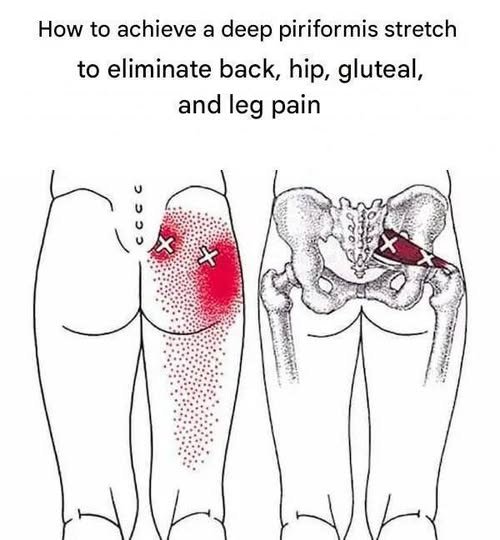
If your pain is coming from a tight or irritated piriformis muscle, improving its flexibility can reduce pressure on nearby tissues, including the sciatic nerve. However, it’s important to know that pain in the back, hip, buttock, or leg is not always caused by the piriformis. Similar symptoms can also come from a Lumbar Disc Herniation, Lumbar Spinal Stenosis, Sacroiliac Joint Dysfunction, or hip joint problems. If you have severe weakness, numbness in the groin, or loss of bladder or bowel control, seek urgent medical evaluation.
Understanding the piriformis
The Piriformis muscle:
- Lies deep beneath the gluteus maximus.
- Connects the sacrum to the upper femur.
- Rotates and stabilizes the hip.
- Sits very close to the sciatic nerve, which may become irritated in some people.
A proper stretch should create a deep pulling sensation in the buttock, not sharp pain in the lower back or knee.
Before stretching
Warm the muscles for 5–10 minutes:
- Brisk walking
- Cycling
- Marching in place
- Gentle hip circles
Warm muscles stretch more safely.
Stretch 1: Supine Figure-4 Stretch (Best for most people)
This is usually the safest and most effective starting stretch.
Step 1
Lie flat on your back.
Bend both knees.
Feet flat.
Step 2
Cross your right ankle over your left knee.
Your legs should resemble the number “4.”
Step 3
Reach behind your left thigh.
Pull your left thigh slowly toward your chest.
Avoid pulling directly on the knee.
Step 4
Keep:
- Lower back neutral
- Neck relaxed
- Shoulders on the floor
Step 5
Stop when you feel:
- Deep stretch in the right buttock
- Possibly into the outside hip
Not:
- Sharp pain
- Tingling
- Burning
Hold
30–60 seconds
Repeat 3–5 times.
Switch sides.
Stretch 2: Knee-to-Opposite-Shoulder Stretch
One of the deepest piriformis stretches.
Starting position
Lie on your back.
Right knee bent.
Left leg straight.
Movement
Grab the right knee.
Pull it toward your left shoulder.
Not toward the middle.
Aim diagonally.
The angle matters.
You should feel:
- Buttock
- Deep hip
- Back of hip
Hold:
45–60 seconds.
Repeat 3–4 times.
Stretch 3: Seated Piriformis Stretch
Ideal for office workers.
Sit tall.
Cross right ankle over left knee.
Keep the spine straight.
Lean forward from the hips.
Don’t round your back.
Stop when the stretch reaches:
- Buttock
- Hip
Hold:
30–60 seconds.
Stretch 4: Pigeon Pose
This produces one of the deepest stretches but requires good hip mobility.
Position
Start on hands and knees.
Bring the right knee toward the right wrist.
Place the right shin diagonally.
Extend the left leg straight behind.
Keep hips level.
Lean forward slowly.
You should feel:
- Deep glute
- Piriformis
- Hip rotators
Avoid forcing the shin parallel to the front of the mat if your hips are tight.
Hold:
30–90 seconds.
Repeat both sides.
Stretch 5: 90/90 Stretch
Sit with:
- Front leg bent 90°
- Back leg bent 90°
Keep chest upright.
Lean forward over the front shin.
This stretches:
- Piriformis
- Deep hip rotators
- Posterior capsule
Hold:
45–60 seconds.
Stretch 6: Standing Piriformis Stretch
Stand facing a table.
Place one ankle on the table.
Figure-4 position.
Keep spine straight.
Slowly hinge forward.
Feel the stretch in:
- Buttock
- Hip
Hold:
30–45 seconds.
Stretch 7: Foam Roller Release
Instead of stretching alone, releasing muscle tension can help.
Sit on a foam roller.
Cross one ankle over the opposite knee.
Lean slightly toward the affected side.
Roll slowly over the buttock.
Pause on tender spots for 20–30 seconds.
Spend 1–2 minutes per side.
Avoid rolling directly on the lower back.
How deep should the stretch feel?
Aim for:
- Moderate tension (about 5–7 out of 10)
- Deep pulling sensation
- Comfortable breathing
Do not force a painful stretch. Aggressive stretching can increase muscle guarding and irritation.
Breathing
Breathe slowly.
Inhale through the nose.
Exhale slowly.
As you exhale:
- Relax your hip muscles.
- Allow the stretch to deepen naturally.
Avoid holding your breath.
How often?
For flexibility:
- 2–3 sessions per day
Each stretch:
- Hold 30–60 seconds
- Repeat 3–5 times
Consistency over several weeks is generally more effective than stretching very aggressively.
Strengthening is also important
A tight piriformis is often associated with weakness in surrounding hip muscles. Once pain allows, strengthening can help reduce recurrence:
- Glute bridge
- Clamshell
- Side-lying hip abduction
- Bird-dog
- Dead bug
Perform these 2–3 times per week with good technique.
Common mistakes
- Stretching through sharp pain
- Bouncing instead of holding the stretch
- Rounding the lower back instead of hinging at the hips
- Twisting the pelvis
- Pulling hard on the knee joint
- Stretching cold muscles
- Ignoring worsening numbness or weakness
When to stop stretching
Stop and seek medical advice if stretching causes:
- Pain shooting below the knee that worsens
- Increasing numbness or weakness
- Significant loss of hip strength
- Severe night pain
- Fever, unexplained weight loss, or recent major trauma
- Loss of bladder or bowel control (seek emergency care)
If stretching isn’t helping
If you’ve stretched consistently for 2–4 weeks without improvement, or your pain becomes more severe, the cause may not be the piriformis. A healthcare professional such as a physical therapist or physician can assess whether the symptoms are coming from the hip, lower back, sacroiliac joint, or another source and recommend more targeted treatment.
For many people with true piriformis-related tightness, combining gentle stretching, gradual strengthening, regular walking, and avoiding prolonged sitting is more effective than relying on stretching alone.