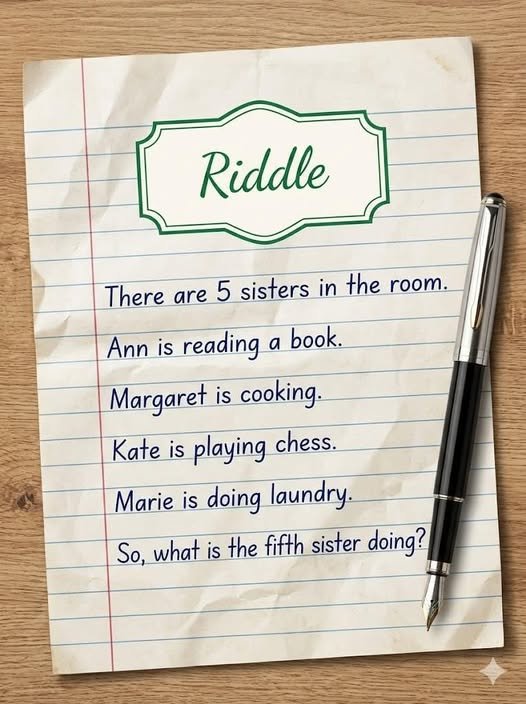
A tricky brain teaser is a puzzle that challenges your logical thinking, observation skills, creativity, and problem-solving abilities. These teasers often have surprising answers because they encourage you to think beyond the obvious.
What Is a Brain Teaser?
A brain teaser is a question or puzzle designed to test your ability to reason rather than your general knowledge. Unlike straightforward math or trivia questions, brain teasers often require careful analysis, pattern recognition, or thinking from a different perspective.
Benefits of Solving Brain Teasers
- Improves logical reasoning.
- Enhances critical thinking.
- Strengthens memory and concentration.
- Boosts creativity.
- Develops patience and problem-solving skills.
- Keeps the brain mentally active.
10 Tricky Brain Teasers with Detailed Explanations
1. The River Crossing Puzzle
Question:
A farmer has a wolf, a goat, and a cabbage. He needs to cross a river with a boat that can carry only himself and one item at a time. If left alone:
- The wolf will eat the goat.
- The goat will eat the cabbage.
How does he get everything across safely?
Solution
- Take the goat across.
- Return alone.
- Take the wolf across.
- Bring the goat back.
- Take the cabbage across.
- Return alone.
- Take the goat across again.
This works because the wolf is never left alone with the goat, and the goat is never left alone with the cabbage.
2. The Missing Dollar Puzzle
Question:
Three friends pay $30 for a hotel room ($10 each). Later, the hotel realizes the room should have cost only $25. The manager gives the bellboy $5 to return.
The bellboy keeps $2 and gives each friend $1 back.
Now each friend paid $9 (3 × $9 = $27).
The bellboy kept $2.
$27 + $2 = $29.
Where did the missing dollar go?
Solution
There is no missing dollar.
The mistake is adding the bellboy’s $2 to the $27.
The correct calculation is:
- Hotel keeps: $25
- Bellboy keeps: $2
- Friends receive back: $3
Total:
$25 + $2 + $3 = $30
3. Which Door Is Safe?
Question:
You must choose one of three doors.
- Door 1: Fire.
- Door 2: Hungry lions that haven’t eaten for three years.
- Door 3: Deadly snakes.
Which door is safest?
Answer
Door 2.
Lions cannot survive without food for three years.
4. The Clock Puzzle
Question:
How many times do the hands of a clock overlap in 24 hours?
Answer
They overlap 22 times.
Explanation:
The hour hand moves continuously, so the minute hand catches up roughly every 65 minutes and 27 seconds, resulting in 11 overlaps every 12 hours, or 22 in a full day.
5. The Light Switch Puzzle
You are outside a room with three switches.
Inside the room is one light bulb.
You may enter the room only once.
How do you determine which switch controls the bulb?
Solution
- Turn on Switch A for several minutes.
- Turn it off.
- Turn on Switch B.
- Enter the room.
- Bulb on → Switch B.
- Bulb off but warm → Switch A.
- Bulb off and cold → Switch C.
6. The Two Fathers Puzzle
Question:
Two fathers and two sons go fishing.
They catch three fish.
Each person gets one fish.
How is this possible?
Answer
There are only three people:
- Grandfather
- Father
- Son
The grandfather and father are the two fathers.
The father and son are the two sons.
7. The Egg Drop Riddle
Question:
A rooster lays an egg on the roof.
Which side does it roll down?
Answer
It doesn’t.
Roosters don’t lay eggs.
8. The Doctor’s Son
Question:
A boy is injured in a car accident.
His father dies.
At the hospital, the doctor says,
“I can’t operate. That’s my son.”
How is this possible?
Answer
The doctor is the boy’s mother.
This puzzle highlights how assumptions and stereotypes can influence our thinking.
9. The Candle Puzzle
Question:
You have:
- One candle
- One oil lamp
- One fireplace
You have only one match.
What do you light first?
Answer
The match.
10. The Number Pattern
Question:
What comes next?
1, 11, 21, 1211, 111221, ?
Answer
312211
This is the famous look-and-say sequence.
Read the previous number aloud:
- 111221
- “Three 1s, two 2s, one 1”
- 312211
Tips for Solving Brain Teasers
- Read the question carefully.
- Avoid making assumptions that are not stated.
- Look for hidden clues.
- Consider multiple perspectives.
- Draw diagrams for complex puzzles.
- Break larger problems into smaller parts.
- Check whether the puzzle is testing logic, language, or observation.
Why Brain Teasers Are Effective
Brain teasers exercise different cognitive skills, including:
- Logical reasoning
- Pattern recognition
- Spatial thinking
- Mathematical reasoning
- Creative thinking
- Attention to detail
They are used in classrooms, job interviews, aptitude tests, and cognitive training because they encourage flexible thinking rather than memorization.
Final Thought
The most challenging brain teasers are often the simplest-looking ones. They encourage you to question assumptions, analyze details, and approach problems from new angles. Regularly solving brain teasers can improve your reasoning skills, sharpen your concentration, and make problem-solving more enjoyable.