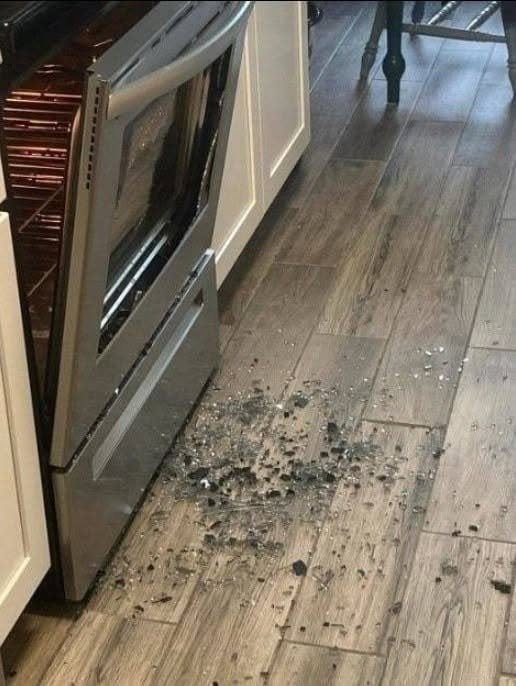
Here is a detailed explanation of why it happens and how to reduce the risk.
1. What kind of glass is used in oven doors?
Oven doors normally contain multiple layers of specially treated glass, rather than ordinary household window glass. The layers help with:
- High-temperature resistance
- Insulation
- Keeping the outside of the door cooler
- Preventing heat from escaping
- Structural strength
Some appliances use tempered or heat-strengthened glass. Heat treatment makes the glass much stronger than ordinary glass. However, it doesn’t make it indestructible.
When tempered glass fails, it can suddenly release the stresses stored within it and break into many relatively small pieces. GE notes, for example, that glass products can experience rare failures during repeated heating and cooling cycles.
2. The biggest causes of oven-door glass shattering
A. Thermal shock
One of the most important causes is rapid temperature change.
For example, imagine the oven door is at several hundred degrees and something suddenly causes one portion of the glass to cool much faster than another portion.
Glass expands when heated and contracts when cooled. If different areas change temperature at different rates, stresses develop inside the glass.
A simplified example:
Hot glass → sudden cold water/air → uneven contraction → internal stress → cracking or shattering
This is why you should avoid putting cold or wet substances directly against a very hot oven door.
Manufacturers similarly warn with other tempered-glass appliance components that sudden temperature changes can cause breakage.
How to prevent it
- Don’t throw cold water onto a hot oven door.
- Don’t wipe a very hot glass door with a cold, soaking-wet cloth.
- Don’t splash liquids onto the door while it is extremely hot.
- Allow the oven to cool before extensive cleaning.
- Follow the manufacturer’s instructions for steam-cleaning cycles.
For example, Frigidaire’s steam-cleaning instructions specifically say to keep the door closed during the cycle and to use care when opening it afterward because hot vapor can escape.
3. Small chips and scratches can become major problems
This is one of the most important things to understand.
A tiny chip, scratch, or impact may not cause the glass to break immediately. Instead, it can create a weak point.
Every time you heat and cool the oven, the glass experiences thermal expansion and contraction. If there is already microscopic damage, repeated thermal cycling can eventually cause the damage to propagate.
Think of it like a crack in a windshield: it may remain small for a while, but temperature changes and vibration can cause it to grow.
GE specifically warns that large scratches or impacts to glass doors can lead to broken or shattered glass.
Common ways the glass gets damaged
- Hitting the door with a heavy pan
- Dropping a rack onto the door
- Slamming the door
- Using abrasive cleaning tools
- Scraping the glass with inappropriate tools
- Placing heavy objects on an open door
- Accidentally knocking the door against something
- Removing/reinstalling the door incorrectly
Prevention
Inspect the glass periodically.
If you see:
- A chip
- Hairline crack
- Deep scratch
- Star-shaped impact mark
- Crack around an edge
- Cloudy area that appears to be structural damage
Don’t assume it is harmless.
4. Edge damage is particularly important
The edges of glass are generally vulnerable to impact.
A small impact against the edge can create a flaw that isn’t immediately obvious from the front.
For example:
Pan hits glass edge → microscopic damage → oven heats → glass expands → damage grows → sudden failure
This is one reason you should be careful when sliding racks and cookware in and out of the oven.
5. Improper installation or door reassembly
An oven door contains:
- Glass panels
- Metal frame
- Hinges
- Brackets
- Insulation
- Spacers
- Seals/gaskets
These components need to sit correctly.
If a glass panel is improperly positioned or a component is putting uneven pressure on it, the glass can be subjected to mechanical stress.
This is particularly relevant if someone has:
- Removed the oven door
- Replaced the glass
- Cleaned between the glass panels
- Reassembled the door
- Replaced a hinge
- Replaced a gasket
- Installed the oven
Manufacturers provide model-specific instructions because oven-door construction varies considerably. GE, for example, warns that door removal/reinstallation procedures differ by model and emphasizes properly seating the hinges.
For inner-glass replacement, GE recommends professional service because substantial door disassembly and reassembly may be required.
6. A damaged hinge can contribute
The hinges control how the heavy door moves.
If a hinge becomes:
- Bent
- Loose
- Misaligned
- Damaged
- Partially detached
the door may not close or move normally.
That can cause uneven forces on the door structure and glass.
A door that suddenly drops, slams, twists, or doesn’t sit correctly deserves attention.
Don’t continue using an oven with a door that is obviously damaged or misaligned.
7. Slamming the oven door
Repeatedly slamming the door isn’t a good idea.
The glass is designed to tolerate normal operation, but repeated mechanical shock can gradually damage it.
The impact doesn’t necessarily have to break the glass immediately.
Instead:
Repeated impact → microscopic damage → thermal cycling → crack growth → failure
Close the door normally and avoid pushing it shut with excessive force.
8. Putting weight on the oven door
Never use an open oven door as:
- A shelf
- A work surface
- A place to sit
- A place to put heavy cookware
Manufacturers specifically warn against people sitting, standing, or hanging on oven doors.
Even if the door survives the weight, the hinges or frame may be damaged.
9. Excessive heat or abnormal oven temperatures
Oven glass is designed for high temperatures, so normal baking temperatures generally shouldn’t cause it to shatter by themselves.
The concern is an abnormal situation, such as:
- Faulty temperature control
- Heating element malfunction
- Improper installation
- Blocked ventilation
- Damaged door components
- Uneven heating
- Incorrect replacement parts
If your oven is becoming dramatically hotter than its setting, investigate the problem rather than continuing to use it.
10. Self-cleaning cycles
Self-cleaning deserves special attention.
A self-clean cycle uses very high temperatures to burn away food residue. This creates substantial thermal stress throughout the oven and its components.
A properly functioning oven is designed for this, but if the glass already has a defect, the additional thermal cycling can potentially expose it.
Therefore:
Inspect the door before using self-clean.
Don’t use self-clean if the door glass is already cracked or damaged.
Also follow your specific owner’s manual rather than assuming every oven should be cleaned in exactly the same way. Frigidaire, for example, provides model-specific self-cleaning instructions and notes that the door remains locked until the oven has cooled sufficiently.
11. Cleaning products and cleaning techniques matter
Don’t aggressively scrub oven-door glass with inappropriate materials.
Avoid, unless specifically approved by your manufacturer:
- Steel wool
- Harsh abrasive powders
- Aggressive scouring pads
- Sharp metal scrapers
- Excessive force
- Strong chemicals not specified for the glass
GE recommends soap and water for exterior door surfaces and specifically advises against abrasive cleaners, steel wool, plastic scouring pads and cleaning powders on exterior surfaces.
The goal isn’t just appearance. Scratches can become stress-concentration points.
12. Don’t spray cold liquid onto a hot door
This deserves its own warning because it’s an easy mistake.
Suppose your oven has been running at 450°F (232°C).
You open it and spray cold water on the door.
The outside surface can cool much faster than the rest of the glass. That temperature difference can generate significant stress.
Instead:
Turn the oven off → allow it to cool → clean the door according to the manufacturer’s instructions.
13. Don’t use a cracked oven door
This is extremely important.
If you see a crack, stop using the oven until the glass has been evaluated/repaired.
GE explicitly states that it does not recommend operating a range or wall oven when the inner or outer door window is cracked or broken. It notes that additional heat can be exposed to other glass components and potentially cause further breakage.
So don’t think:
“It’s only a tiny crack, so I’ll keep using it.”
That’s not a good risk to take.
14. Why does the glass sometimes seem to “explode” for no reason?
This is the part that confuses many people.
You might have:
- Not touched the door
- Not dropped anything
- Not cleaned it
- Not slammed it
…and suddenly hear:
POP → CRACK → CRASH
There can be several explanations.
Internal flaw
Glass can contain microscopic imperfections. Under repeated heating and cooling, a flaw can eventually become critical.
GE discusses rare spontaneous breakage of heat-treated glass associated with impurities and thermal cycling in its microwave-door guidance.
Previous microscopic impact
The damage may have occurred days or months earlier.
Thermal stress
Repeated temperature changes can gradually increase stress around an existing defect.
Installation stress
The glass may have been subjected to pressure or improper positioning.
Combination of factors
Often it isn’t possible to identify one single cause after the glass has shattered.
15. How to prevent oven-door glass from shattering
Here is a practical prevention routine.
Before cooking
- Inspect the glass occasionally.
- Look for chips, scratches and cracks.
- Make sure the door opens and closes normally.
- Check for obvious hinge problems.
- Don’t operate an oven with damaged door glass.
During cooking
- Don’t slam the door.
- Don’t hit the door with cookware.
- Don’t place heavy objects on it.
- Keep racks from striking the glass.
- Don’t splash cold liquids onto hot glass.
During cleaning
- Let the door cool first.
- Use manufacturer-approved cleaning methods.
- Avoid abrasive materials.
- Don’t scratch the glass.
- Don’t use excessive pressure.
- Don’t spray liquids into door vents.
GE similarly advises cleaning the exterior door when cool and avoiding letting water or soap enter the door vent.
During self-cleaning
- Inspect the glass beforehand.
- Follow the exact owner’s manual.
- Don’t improvise cleaning methods.
- Don’t interrupt or manipulate the door unless the manual says to.
- Allow the oven to cool according to its normal cycle.
16. What if the oven door has already shattered?
Don’t use the oven.
First, keep people and pets away from the area.
Then:
- Turn the oven off.
- Allow it to cool completely.
- Don’t touch broken glass with bare hands.
- Keep children away.
- Don’t operate the oven to “see if it still works.”
- Consult the manufacturer’s service instructions.
- Replace the damaged glass/door component with the correct part.
GE specifically recommends against using an oven when the door window is broken or cracked.
17. What about cleaning up shattered glass?
Treat it as a significant glass hazard.
After the oven has completely cooled:
- Wear sturdy protective gloves.
- Keep children and pets away.
- Carefully collect large pieces.
- Use appropriate tools to collect small fragments.
- Don’t run your bare hand across surfaces to check for tiny pieces.
- Check surrounding areas because tempered glass can spread farther than expected.
- Dispose of the broken glass according to your local waste rules.
If glass has fallen inside the oven, don’t turn the oven on to burn it away.
Have the appliance inspected and cleaned appropriately.
18. Should you replace only the glass or the entire door?
It depends on the appliance.
Some ovens allow individual glass components to be replaced. Others require more extensive door disassembly.
For example, GE states that replacement of inner oven-door glass involves substantial disassembly and recommends scheduling service.
Don’t automatically buy generic glass based only on dimensions.
You need the correct:
- Model number
- Part number
- Glass type
- Thickness
- Shape
- Mounting arrangement
- Heat rating
Using the wrong glass can create a serious safety problem.
19. Warning signs that your oven door needs attention
Stop and investigate if you notice:
Glass
- Cracks
- Chips
- Deep scratches
- White/cloudy stress marks
- Loose glass
- Glass moving inside the frame
Door
- Doesn’t close properly
- Suddenly drops
- Doesn’t stay in position
- Sits crooked
- Rubs against the frame
- Has a damaged hinge
Heat
- Excessive heat escaping from one particular location
- Scorch marks around the door
- Smoke near the door
- Unusual overheating
GE notes that major heat leakage accompanied by scorching or smoke can indicate a damaged gasket or hinge and may require service.
20. The most important prevention rules
If you remember only a few things, remember these:
1. Never pour cold water onto hot oven glass.
2. Don’t hit, scratch, or slam the glass.
3. Don’t put heavy objects or body weight on the door.
4. Don’t use abrasive cleaning materials unless your manufacturer specifically approves them.
5. Inspect the door before using high-temperature/self-clean cycles.
6. If you see a crack or significant chip, stop using the oven.
7. If the door has been removed or repaired, make sure it is correctly reassembled.
8. Use only the correct replacement glass specified for your exact oven model.
9. If the glass shatters unexpectedly, don’t assume it was simply “bad luck”—have the door, hinges and glass mounting inspected.
Bottom line
An oven door usually doesn’t shatter because the normal oven temperature is simply “too hot.” The more common concern is a combination of heat cycling and a pre-existing weakness—such as a microscopic chip, scratch, impact, installation stress, or another defect. A sudden temperature change or additional thermal stress can then cause the weakened glass to fail.
And because a damaged door can create additional hazards, a cracked or shattered oven door should not be used until it has been properly repaired.