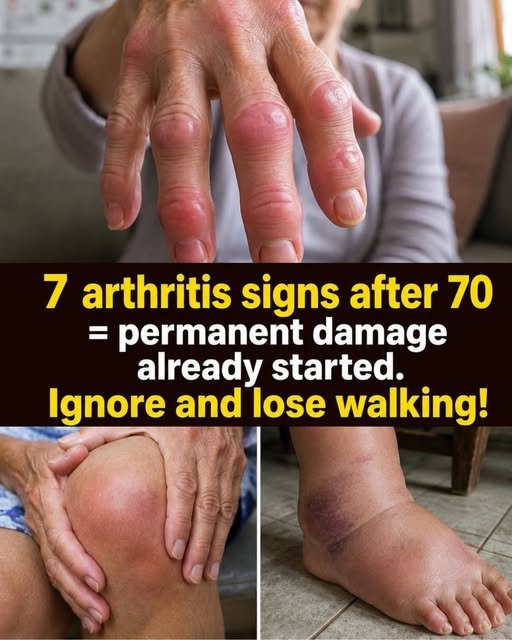
If you’re looking for the 7 arthritis warning signs after age 70 that should not be ignored, the key point is that arthritis is not an inevitable or harmless part of aging. Osteoarthritis becomes more common with age and can eventually cause significant disability, but many forms of arthritis can be managed—especially when recognized early.
7 arthritis signs you should take seriously after 70
1. Persistent joint pain
Pain in the knees, hips, hands, feet, back, or other joints that keeps returning or interferes with normal activities deserves medical attention.
Osteoarthritis pain often becomes noticeable with walking, climbing stairs, gripping objects, or other movement. As disease progresses, pain can occur even at rest or at night.
Why it matters: Persistent pain can cause you to move less. Reduced activity can lead to muscle weakness, which places additional stress on already painful joints and can contribute to loss of function.
2. Morning stiffness or stiffness after sitting
Pay attention to how long your joints remain stiff after getting out of bed or after sitting for a while.
With osteoarthritis, stiffness commonly lasts less than about 30 minutes. Stiffness lasting substantially longer—particularly with swelling and warmth—can suggest an inflammatory form such as rheumatoid arthritis rather than simple osteoarthritis.
Don’t simply dismiss prolonged morning stiffness as “getting old.” It is useful information for your doctor.
3. Swollen, warm, or tender joints
A joint that repeatedly becomes swollen, warm, red, or unusually tender should be evaluated.
Rheumatoid arthritis, gout, and other inflammatory conditions can produce these findings. Rheumatoid arthritis can cause swelling, warmth and tenderness and may affect multiple joints.
A suddenly very painful, hot, swollen joint, particularly if accompanied by fever or feeling very ill, needs prompt medical assessment because arthritis isn’t the only possible cause.
4. Your range of motion is getting smaller
Maybe you can no longer:
- Fully bend your knee.
- Reach overhead.
- Turn your neck comfortably.
- Open jars or button clothing.
- Make a fist.
- Get up from a chair normally.
Loss of movement is an important warning sign. Osteoarthritis can progressively restrict joint motion, while rheumatoid arthritis can cause swelling and loss of function.
Don’t wait until you can barely use the joint. Early assessment can help identify the cause and establish treatment and exercise strategies.
5. A knee, hip, or other joint feels unstable
If your knee feels as though it might give way or buckle, or a joint feels loose or unstable, take it seriously.
Osteoarthritis can produce joint instability, and knee problems can make walking increasingly difficult.
For someone over 70, this has an additional concern: falls. Arthritis-related pain, weakness, and instability can make normal movement more difficult, potentially increasing the consequences of a fall.
6. Arthritis is interfering with ordinary daily activities
This is one of the most important signs.
If joint symptoms are making it difficult to:
- Walk around the house.
- Climb stairs.
- Get into or out of a chair.
- Get on or off the toilet.
- Bathe or dress.
- Cook.
- Hold a cup or utensil.
- Shop or leave the house.
don’t regard it as something you simply have to accept because you’re over 70.
Osteoarthritis can eventually cause disability and interfere with daily tasks, but treatments and self-management strategies can reduce symptoms and improve function.
7. You have joint symptoms plus whole-body symptoms
Joint pain accompanied by unexplained fatigue, weakness, fever, loss of appetite, or weight loss deserves medical evaluation.
These symptoms can occur with rheumatoid arthritis and other inflammatory diseases.
They don’t automatically mean you have rheumatoid arthritis—there are many possible causes—but they are important clues that the problem may be more than ordinary osteoarthritis.
The important warning about becoming “crippled”
I would not say that ignoring these symptoms will inevitably leave someone “crippled.” That’s unnecessarily frightening and medically inaccurate.
However, untreated arthritis can lead to worsening pain, loss of mobility, muscle weakness, deformity in some forms of arthritis, and disability. The CDC specifically notes that managing arthritis can help prevent or delay worsening and disability.
And arthritis is not one disease. Osteoarthritis, rheumatoid arthritis, gout, and other forms have different causes and treatments. Getting the correct diagnosis matters because some inflammatory types can cause permanent joint damage if not treated appropriately.
What someone over 70 should do
If these symptoms are persistent or worsening, arrange an appointment with a healthcare professional rather than trying to diagnose yourself.
The evaluation may include a medical history, examination, X-rays or other imaging, and sometimes blood tests.
Treatment depends on the type of arthritis but can include appropriate physical activity/exercise, physical therapy, weight management when appropriate, joint-protection strategies, medications, assistive devices, and sometimes joint replacement.
Most importantly: severe or rapidly worsening joint symptoms, a suddenly hot/red/swollen joint, inability to bear weight, or joint pain accompanied by fever or significant illness should not be brushed off as “just arthritis.” Get prompt medical assessment.
If you tell me which joints are hurting, how long the stiffness lasts in the morning, whether there is swelling, and how long this has been happening, I can explain which type of arthritis those symptoms are more consistent with and what questions to ask your doctor