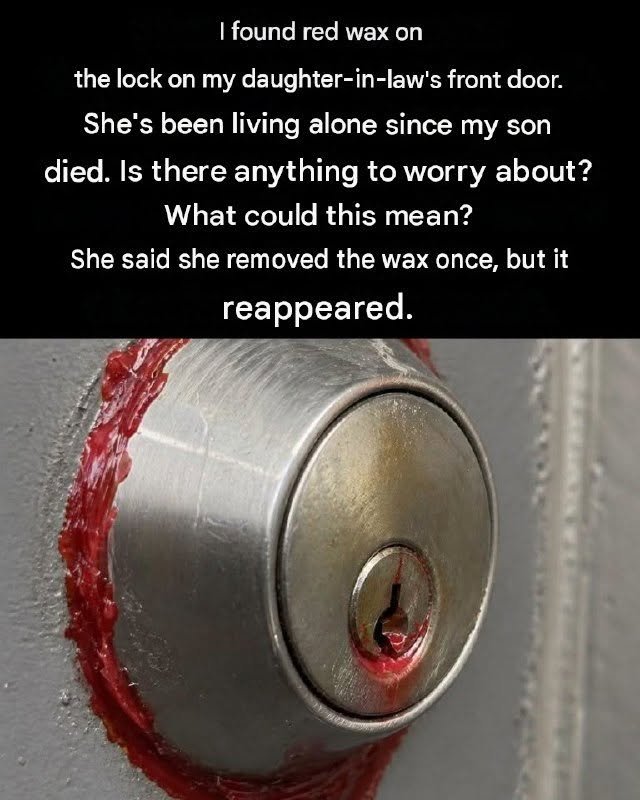
Absolutely — here’s a full article, written with an important caveat: there is no reliable universal meaning that “red wax on a door lock” is a burglar code. Some online articles make that claim, but the evidence is weak and the meaning of a random wax mark can vary.
Found Red Wax on Your Door Lock? Here’s What It Means and How to Protect Your Home (Without Panic!)
You walk up to your front door after a long day and notice something strange: a small smear or blob of red wax around your door lock.
At first, you might think it is nothing. Maybe someone accidentally dropped candle wax. Maybe it came from a decoration or craft project.
But then another thought enters your mind:
“Did someone put this here deliberately?”
It is understandable to feel uneasy. Your front door is one of the most important security points in your home, and anything unusual around the lock deserves a closer look.
The good news is that red wax on a lock does not automatically mean that your home has been targeted by burglars. There are several innocent explanations, and there is no universally recognized color code that says red wax means a particular thing.
Still, if you did not put the wax there, it makes sense to investigate calmly and take a few sensible security precautions.
What Could Red Wax on Your Door Lock Mean?
There is no single answer. The meaning depends on where the wax came from, how it was placed, and whether there are any other unusual signs around your property.
1. It Could Be Completely Accidental
The simplest explanation is often the correct one.
Red wax can come from candles, decorative items, arts and crafts, or even sealing wax used on envelopes. A small piece can transfer to a key, hand, bag, or clothing and eventually end up on a lock.
If the mark looks irregular, smeared, or dripped rather than deliberately placed, an innocent explanation is particularly plausible.
Some everyday sources include:
- Candle wax
- Decorative wax
- Wax seals from invitations or letters
- Children’s crafts
- Crayons or similar materials
- Lip balm or cosmetic products
- Wax transferred from another object
One recent discussion of the phenomenon similarly points to candles, decorative sealing wax, and household products as possible explanations.
2. Someone Could Have Been Playing a Prank
An unusual mark on a door can also be the result of a prank.
Children, teenagers, neighbors, or visitors sometimes leave strange substances or markings on doors without any connection to criminal activity.
That does not mean you should ignore unexplained evidence, but it does mean there is no reason to immediately assume the worst.
3. It Could Be a Deliberate Mark — But Don’t Assume What It Means
You may have seen stories claiming that criminals use red wax, chalk, stickers, tape, or other objects to secretly mark houses.
There are certainly documented examples of criminals using markings and other methods to communicate or identify locations. However, the specific claim that red wax on a residential lock has one standardized meaning is not established.
Several websites repeat claims that red wax indicates that a house has been “cased,” is empty, or is an easy target. Those claims should be treated cautiously rather than as established fact.
In other words:
A mysterious wax mark is worth investigating, but it is not proof that a burglar has selected your home.
So, Should You Panic?
No.
A better approach is:
Notice → Document → Inspect → Secure.
Instead of immediately assuming that someone is planning a break-in, look for additional evidence.
Ask yourself:
- Have you seen the mark before?
- Is the wax only on the lock, or is it elsewhere?
- Does the lock show scratches or other damage?
- Is the door functioning normally?
- Are there unfamiliar marks around windows or gates?
- Has anything been moved or disturbed?
- Have neighbors noticed anything similar?
- Does your security-camera footage show anyone approaching the door?
The more unusual details you find, the more seriously you should treat the situation.
What to Do If You Find Red Wax on Your Lock
Step 1: Take a Photo Before Removing It
Before cleaning the wax away, take several clear photographs.
Photograph:
- The entire door
- The lock from several angles
- The wax close-up
- Any nearby marks or damage
- The surrounding entryway
If the situation later turns out to be suspicious, having a record of what you found can be useful.
Step 2: Check the Lock Carefully
Look for signs that someone may have physically interfered with it.
Pay attention to:
- Scratches around the keyway
- Fresh dents
- Damage to the cylinder
- Difficulty inserting or turning your key
- Damage around the strike plate
- Marks on the door frame
- Signs that the door has been forced
A wax mark by itself tells you very little. A wax mark combined with physical damage is much more concerning.
Step 3: Check Your Other Entry Points
Don’t focus only on the front door.
Walk around the property and inspect:
- Back doors
- Garage doors
- Side entrances
- Accessible windows
- Gates
- Basement entrances
- Outdoor storage areas
You’re looking for anything that appears newly disturbed or damaged.
Step 4: Review Security-Camera Footage
If you have a video doorbell or security cameras, check recent recordings.
Look for:
- People approaching the door without an obvious reason
- Repeated visits
- Someone examining the lock
- People photographing the property
- Vehicles repeatedly stopping nearby
- Activity occurring when nobody was home
Don’t confront a suspicious person yourself. If the footage suggests an attempted break-in or other crime, preserve it and contact the appropriate authorities.
Step 5: Ask Your Neighbors
A quick conversation with neighbors can provide useful context.
Ask whether they have noticed:
- Similar markings
- Suspicious visitors
- Attempts to open doors
- Unfamiliar vehicles
- Other unusual activity
If several homes have experienced similar incidents, that information may be more significant than a single unexplained mark.
When Should You Take It More Seriously?
A single blob of red wax isn’t necessarily a warning sign.
However, concern is more justified if you notice multiple indicators at the same time.
For example:
Red wax + damaged lock + suspicious camera footage is considerably more concerning than red wax alone.
Likewise:
Unexplained mark + repeated unfamiliar visitors + signs of attempted entry deserves prompt attention.
The key is to look at the entire situation rather than assigning a meaning to the color of the wax.
Don’t Make the “Red Means Target” Assumption
One of the biggest problems with viral home-security stories is that they can turn an uncertain observation into a frightening certainty.
You may encounter claims online saying:
- Red means “easy target.”
- Red means “house is empty.”
- Red means “valuable items inside.”
- Red means “break in later.”
- Red means “security system absent.”
There is no universal system in which every burglar uses these meanings.
Even genuine security seals come in different colors, including red, and color alone does not necessarily communicate a particular message. Tamper-evident seals are commonly designed to show whether something has been opened or interfered with, but their meaning comes from the particular sealing system—not simply from the color red.
So don’t let an alarming internet story convince you that a red mark automatically means someone has targeted your house.
How to Improve Your Home Security Anyway
Whether the wax turns out to be innocent or suspicious, it can be a useful reminder to review your home’s security.
Strengthen Your Doors
Your exterior doors should have sturdy locks, secure frames, and properly installed hardware.
If your lock is old, damaged, loose, or unreliable, consider having it inspected or replaced by a qualified locksmith.
Improve Exterior Lighting
Good lighting makes it harder for someone to approach your doors unnoticed.
Consider motion-activated lighting around:
- Front entrances
- Back doors
- Garages
- Side passages
- Other poorly lit areas
Consider a Video Doorbell
A video doorbell can provide visibility around your main entrance and may give you useful evidence if something unusual happens.
Make sure cameras are positioned appropriately and that recordings are retained according to the manufacturer’s settings.
Keep Windows and Secondary Doors Secure
Home security is only as strong as its weakest accessible entrance.
Check that windows, garage doors, basement entrances, and secondary doors are properly secured.
Avoid Advertising That Your Home Is Empty
When you’re away, avoid obvious signs of an unoccupied property.
Depending on your situation, that might include:
- Having mail collected
- Using timers for lights
- Asking someone to check the property
- Keeping entrances maintained
- Avoiding publicly announcing extended absences
Keep Your Security Routine Simple
You don’t need a high-tech fortress.
Basic habits can make a meaningful difference:
- Lock doors and windows
- Keep spare keys secure
- Maintain exterior lighting
- Know your neighbors
- Keep cameras functioning
- Repair damaged locks promptly
What If the Wax Appears Again?
This is when documentation becomes particularly useful.
If you remove the wax and a similar unexplained mark appears again, photograph it before removing it and make a note of the date and time.
Look for patterns.
Is it happening after you leave for work?
Is it appearing on multiple entrances?
Are there other signs of suspicious activity?
Repeated unexplained activity deserves more attention than a one-time mark.
If you believe someone has attempted to enter your home or is actively targeting the property, contact your local law-enforcement agency rather than confronting a suspected individual yourself.
What Not to Do
There are also a few mistakes worth avoiding.
Don’t confront strangers. If you see someone behaving suspiciously around your property, prioritize your safety.
Don’t destroy potentially useful evidence. Take photographs before cleaning or changing anything.
Don’t spread unverified claims. Telling neighbors that “red wax definitely means burglars are targeting houses” can create unnecessary fear.
Don’t ignore obvious signs of forced entry. If the lock, door, or frame appears damaged, treat the physical evidence seriously regardless of what color the wax is.
The Bottom Line
Finding red wax on your door lock can certainly be unsettling.
But red wax does not have a universally established meaning, and its presence alone is not proof that burglars have marked your home.
It could be accidental candle wax, craft material, decorative sealing wax, a prank, or something deliberately placed there for reasons you don’t yet understand.
The smartest response is neither panic nor complete dismissal.
Take a photograph. Inspect your lock and other entry points. Review available security footage. Ask neighbors whether they’ve noticed anything unusual. If you find actual signs of tampering or attempted entry, report them and take appropriate security measures.
Most importantly, remember this:
Be alert without being afraid.
A strange mark on your door is a reason to pay attention—not a reason to assume that danger is coming.
Your best defense is a calm assessment, good security habits, and knowing what is actually happening around your home.