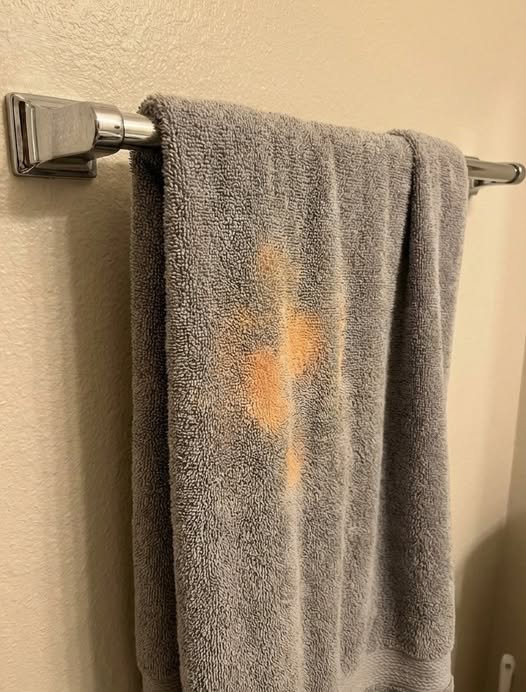
Why towels get orange stains that won’t wash out
Orange or rust-colored marks on towels can have several very different causes, and the reason they seem “impossible” to remove is that some of them are not ordinary stains at all. In some cases, the towel’s dye has actually been chemically altered.
The two biggest culprits are benzoyl peroxide from skincare products and iron/rust in the water or washing machine.
1. Benzoyl peroxide: the big culprit on dark towels
If your towel is black, navy, charcoal, dark gray, blue, or another deep color, and the orange area looks like a lighter patch rather than something sitting on top of the fabric, benzoyl peroxide is one of the first things to suspect.
Benzoyl peroxide is widely used in acne treatments. It is an oxidizing chemical that can act much like a bleaching agent on dyed fabrics. Instead of depositing an orange substance onto your towel, it can destroy some of the original dye, exposing lighter colors underneath.
This is why you might see:
- Orange or peach patches
- Yellow-orange areas
- Pinkish discoloration
- Irregular patches around the area where you wipe your face
- Discoloration that becomes more obvious after several washes
The important point is that there may be nothing left to “wash out.” If the dye has been chemically removed, additional detergent, scrubbing, vinegar, or ordinary stain remover cannot put that dye back.
This is particularly common with towels used after applying acne medication to the face, neck, shoulders, or back. Even if the product has been rinsed from your skin, residue can remain and transfer to the towel.
2. Iron in your water can create genuine rust-colored stains
If the towel itself is white or light-colored, or if the marks look genuinely reddish-brown rather than like faded fabric, investigate your water supply.
Dissolved iron can be present in water without the water looking obviously rusty when it comes out of the faucet. Once iron is exposed to oxygen, it can oxidize and produce reddish-brown or orange deposits. Iron is well known to cause staining of laundry and plumbing fixtures.
You may notice this pattern if:
2. Iron in your water can create genuine rust-colored stains
- Several towels develop similar orange marks.
- White clothes are becoming yellow, orange, or rusty.
- The toilet, sink, bathtub, or shower has reddish-brown deposits.
- Stains appear after washing rather than after using the towel.
- You have well water.
- The water sometimes looks yellow, brown, or metallic.
- The stains are concentrated around certain areas of the washing machine.
Iron can also come from rusting pipes, a water heater, or components of the washing machine, rather than directly from the municipal or well water.
3. Why ordinary detergent doesn’t remove rust
Rust is fundamentally different from grease, food, sweat, or ordinary body oils.
Laundry detergent is designed primarily to loosen and suspend organic soils and oils. Iron oxide deposits require a different chemistry. That’s why repeatedly washing a rust-stained towel with more detergent often accomplishes very little.
In fact, chlorine bleach is a particularly bad choice for iron/rust stains. It can oxidize iron further and make the discoloration darker or more difficult to remove. Both Clorox and university extension guidance specifically warn against using chlorine bleach on iron/rust staining.
So if you see orange/rust stains, don’t assume:
“It’s orange, therefore I need bleach.”
With iron stains, that can make the situation worse.
4. Sunscreen can also be responsible
If the orange marks occur primarily on beach towels, pool towels, or towels you use after applying sunscreen, sunscreen deserves consideration.
Certain sunscreen ingredients, particularly avobenzone, can interact with iron present in water and produce stubborn yellow-orange or rust-like discoloration. This is especially noticeable on white fabrics.
The clue is the timing: if the towel develops the discoloration after repeated use with sunscreen, rather than simply after ordinary bathing, sunscreen becomes more plausible.
5. Hard water isn’t necessarily the same thing as iron
People often say “hard water” when they see laundry discoloration, but there’s an important distinction.
Hardness is primarily associated with minerals such as calcium and magnesium. It can make towels feel stiff, leave mineral deposits, reduce detergent effectiveness, and contribute to dingy laundry.
Iron, however, is what is particularly associated with reddish-orange/rust-colored laundry stains.
So a water problem can involve:
- Calcium/magnesium → hardness, mineral buildup, stiff or dull towels
- Iron → orange/rust-colored stains
- Manganese → generally darker brown, gray, or black staining
6. Your washing machine itself could be the source
Don’t automatically blame the water.
Inspect the washer for:
- Rust around the drum
- Rust near the detergent dispenser
- Rust around drain holes
- Corrosion underneath the lid or door
- Rust-colored residue around seals
- Damaged or corroded metal components
If the same orange marks repeatedly appear after laundering different items, the machine is worth investigating. Manufacturer laundry guidance also identifies rusty pipes, water heaters, and iron/manganese in the water as possible causes of yellow, orange, or brown laundry stains.
How to tell which problem you have
A useful diagnostic is to look at the relationship between the original towel color and the orange mark.
| What you see | Most likely cause |
|---|---|
| Bright orange/pink patches on black or navy towel | Benzoyl peroxide bleaching the dye |
| Reddish-brown marks on white towels | Iron/rust |
| Orange marks appearing mainly after sunscreen use | Sunscreen + minerals/iron |
| Orange marks on many loads | Water, pipes, water heater, or washer |
| Brown/black discoloration | Possible manganese or other deposits |
| Towel is simply gray/dull/stiff rather than orange | Hard-water/mineral buildup or laundry residue |
What to do if it’s benzoyl peroxide
Unfortunately, if benzoyl peroxide has bleached the towel’s dye, there isn’t a conventional stain-removal technique that will restore the original color.
You can prevent additional damage by:
- Using white towels when using benzoyl-peroxide acne products.
- Rinsing your skin thoroughly before drying.
- Keeping benzoyl-peroxide products away from towels and colored bedding.
- Washing affected towels separately if there may still be product residue.
- Considering towels specifically designated for use after acne treatments.
The key distinction is that you aren’t trying to remove orange pigment—the original pigment has been destroyed.
What to do if it’s iron/rust
For an actual rust stain, use a laundry-safe rust remover according to its label rather than chlorine bleach. Rust removers work through acidic chemistry that targets iron deposits.
For valuable or colored towels, test any treatment on an inconspicuous area first.
Also, don’t repeatedly treat the towel without addressing the source. If your water contains substantial iron, the next wash can simply create another round of stains.
A water test can help determine whether iron is present and at what concentration. If iron is confirmed, appropriate treatment may involve a water softener for some lower concentrations or a dedicated filtration/oxidation system for higher concentrations, depending on the water chemistry.
One mistake to avoid
Don’t throw chlorine bleach at an unexplained orange stain.
If the orange discoloration is caused by iron, bleach can make it worse. If the towel has already been damaged by benzoyl peroxide, bleach obviously won’t restore the missing dye either.
The easiest way to identify your particular problem
Look at three things:
- Towel color: Is it dark or white/light?
- Shape of the orange area: Is it a lighter patch in the dye, or a deposit/streak sitting on the fabric?
- Where it occurs: Does it happen only on face towels, only after sunscreen, or across multiple loads?
Dark towel + orange/pink faded patch = strongly suspect benzoyl peroxide.
White towel + reddish-brown/rust marks across multiple towels = investigate iron in the water, pipes, water heater, or washer.
Beach/pool towel + sunscreen use + orange marks = investigate sunscreen/mineral interaction.
If you tell me the towel’s color, where the orange stains appear, whether you use acne products or sunscreen, and whether you have city or well water, I can narrow down the cause and tell you exactly how I’d try to remove it.