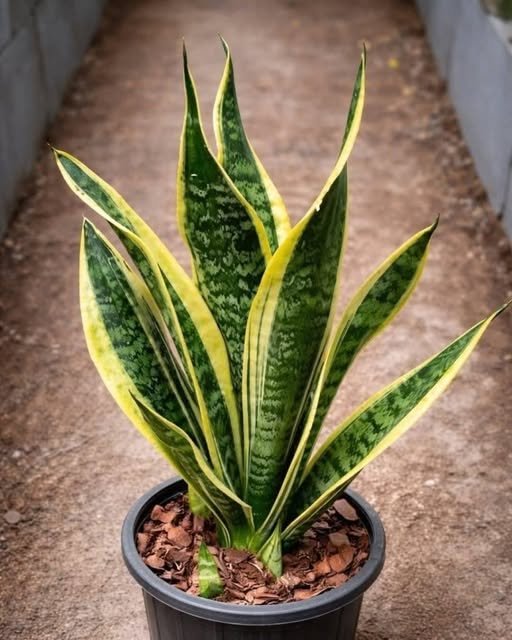
If you’re referring to the popular claim that “if you have this plant in your house, you have a natural air purifier,” the plant most commonly being promoted is the snake plant (Sansevieria/Dracaena trifasciata). However, the air-purifying claim needs some important context.
🌿 Snake Plant: Why It’s Called a Natural Air Purifier
The snake plant is a hardy indoor plant with tall, upright leaves, often featuring green and yellow patterns. It is popular because it tolerates low light, infrequent watering, and relatively dry indoor conditions.
1. It can absorb certain airborne chemicals
Plants can take up some volatile organic compounds (VOCs) from the air through their leaves and, indirectly, through microorganisms associated with their roots and soil.
Laboratory research has found that certain houseplants can remove compounds such as:
- Formaldehyde
- Benzene
- Trichloroethylene
- Xylene
- Toluene
These chemicals can originate from paints, adhesives, furniture, cleaning products, plastics and other household materials.
2. Snake plants are unusual at night
One reason snake plants became particularly famous is their CAM (Crassulacean Acid Metabolism) photosynthetic pathway.
Many plants primarily exchange gases during daylight. CAM plants can open their stomata at night, allowing them to take in carbon dioxide while reducing water loss.
This has led to the common statement that snake plants “produce oxygen at night.” More precisely, their CAM metabolism allows them to fix carbon dioxide at night, while oxygen production is associated with their photosynthetic processes during the appropriate light conditions.
3. But one plant won’t clean an entire house
This is the most important qualification.
The famous NASA-associated experiments demonstrated that plants can remove certain pollutants under controlled laboratory conditions. A normal room is very different: it has ventilation, air movement, changing pollutant concentrations, furniture, people and other sources of VOCs.
So you shouldn’t think of a snake plant as a replacement for:
- Opening windows or using appropriate ventilation
- A properly sized HEPA air purifier
- Controlling indoor pollution sources
- Maintaining HVAC systems and filters
- Avoiding smoking indoors
In an ordinary home, a few potted plants are unlikely to make a major measurable difference to overall indoor air quality.
🪴 Other Houseplants Often Associated With Air Purification
Several plants have also been studied for their ability to interact with indoor pollutants:
- Spider plant (Chlorophytum comosum)
- Peace lily (Spathiphyllum)
- Golden pothos (Epipremnum aureum)
- English ivy (Hedera helix)
- Dracaena species
- Boston fern (Nephrolepis exaltata)
The exact effectiveness varies considerably depending on the pollutant, plant species, light, soil, airflow and experimental conditions.
💧 Don’t Overlook Humidity
Plants release water vapor through transpiration. A collection of indoor plants can therefore contribute some moisture to the surrounding air.
This can be pleasant in a very dry environment, but excessive indoor humidity can encourage mold growth. Plants should not be treated as a substitute for a humidifier or dehumidifier when precise humidity control is needed.
⚠️ A Small Safety Consideration
Snake plants are generally easy-care houseplants, but they shouldn’t be considered edible. If you have pets or small children who chew on plants, it’s worth checking the toxicity information for the particular species you keep.
🌱 How to Get the Most Benefit From a Snake Plant
Keep it healthy rather than simply buying many plants.
- Put it somewhere with bright indirect light when possible.
- It can tolerate relatively low light, but growth will generally be slower.
- Let the soil dry substantially between waterings.
- Use a pot with good drainage.
- Avoid leaving the roots sitting in water.
- Remove dead or damaged leaves.
- Don’t rely on the plant as your primary method of removing indoor pollutants.
Bottom line
Yes, snake plants have biological mechanisms that allow them to interact with indoor air and certain pollutants, and controlled experiments have demonstrated pollutant-removal capabilities. But calling a single snake plant a “natural air purifier” can be misleading. In a real home, ventilation and dedicated air filtration are much more important for substantially improving indoor air quality.
If you tell me which plant you mean (or upload a photo of it), I can identify it and give you detailed information about its air-purifying properties, oxygen production, care, benefits, and potential risks.