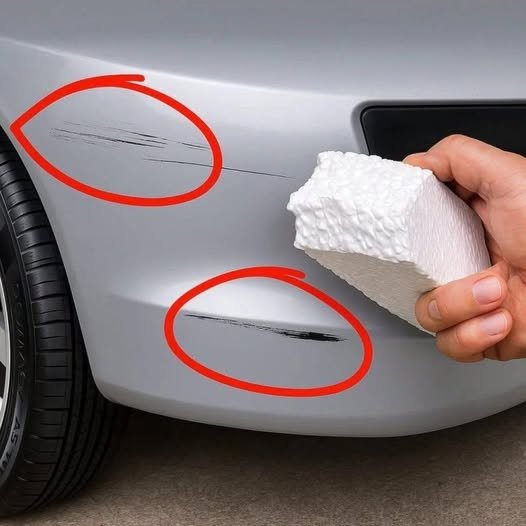
If by “foam” you mean a car-polishing/cleaning foam or foam pad, it can help with light surface scratches, especially scratches that haven’t penetrated the clear coat. It won’t reliably remove deep scratches.
Step-by-step
- Wash the area
- Clean the panel thoroughly with car shampoo and water.
- Dry it with a clean microfiber towel.
- Don’t polish over dirt or grit—it can create more scratches.
- Check the scratch
- Run a clean fingernail lightly across it.
- If your nail doesn’t catch, it’s often a clear-coat-level mark that may respond to polishing.
- If your nail catches or you can see primer/metal, foam polishing alone probably won’t remove it.
- Apply a small amount of scratch-removing polish
- Put a small dab of automotive polishing compound on a soft foam applicator/pad.
- Work on a small section, roughly 20–30 cm (8–12 inches) across.
- Polish gently
- Rub with overlapping passes using moderate, even pressure.
- Work for about 30–60 seconds, rather than aggressively scrubbing.
- Keep the foam clean and avoid letting the product dry completely on the paint.
- Wipe and inspect
- Remove the residue with a clean microfiber towel.
- Look at the panel from several angles in good lighting.
- If the scratch has become less visible, repeat the process once or twice rather than applying heavy pressure.
- Protect the paint
- Once you’re satisfied, apply a suitable wax or paint sealant according to its instructions.
Important
A foam pad itself doesn’t “erase” a scratch. The polishing compound does most of the corrective work, while the foam helps distribute it. Trying to remove a deep scratch by repeatedly polishing can remove too much clear coat.
If you tell me whether the scratch is light/swirl-like, white, or deep enough to catch your fingernail, I can tell you the quickest method and what type of foam/polish to use.