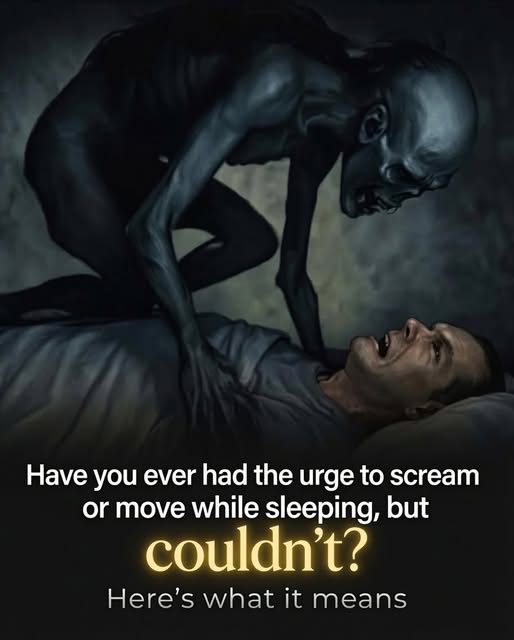
Understanding Sleep Paralysis: The Science Behind Nocturnal Immobility
Sleep paralysis is a temporary state in which a person becomes conscious while the body remains unable to move or speak normally. It usually happens while falling asleep (hypnagogic sleep paralysis) or waking up (hypnopompic sleep paralysis).
Although the experience can be extremely frightening—especially when accompanied by a feeling that someone is in the room, pressure on the chest, or vivid hallucinations—it is generally understood as a temporary mismatch between wakefulness and REM sleep physiology.
1. What happens during normal sleep?
Sleep isn’t a single uniform state. It cycles through several stages:
- N1: Light sleep; the transition from wakefulness into sleep.
- N2: Deeper non-REM sleep, characterized by sleep spindles and K-complexes.
- N3: Deep, slow-wave sleep.
- REM (rapid eye movement) sleep: A stage associated with vivid dreaming, rapid eye movements, and distinctive changes in muscle activity.
A typical sleep cycle lasts roughly 90–120 minutes, with several cycles occurring during the night. REM periods generally become longer toward morning.
Sleep paralysis is particularly associated with REM sleep.
2. The key mechanism: REM atonia
One of the most important features of REM sleep is muscle atonia—a near-paralysis of most voluntary skeletal muscles.
This sounds alarming, but it is actually a normal protective mechanism.
During REM sleep, the brain generates powerful motor commands associated with dreams. At the same time, neural circuits in the brainstem inhibit the activity of motor neurons in the spinal cord.
In simplified form:
REM sleep → brainstem inhibitory circuits → reduced spinal motor-neuron activity → skeletal muscles become temporarily inactive
This prevents you from physically acting out most of your dreams.
For example, if you’re dreaming that you’re running, your brain can generate a vivid experience of running while your major limb muscles remain largely inactive.
During sleep paralysis
The problem isn’t necessarily that REM atonia itself is abnormal.
Instead, consciousness can return before the REM-related motor inhibition has completely disappeared.
The result is something like:
REM physiology + waking consciousness → temporary inability to move
This is the central scientific explanation for sleep paralysis.
3. Why can’t you move?
Movement requires a chain of communication:
Brain → descending motor pathways → spinal cord → motor neurons → muscles
During REM sleep, inhibitory neurotransmitter systems suppress the spinal motor neurons responsible for activating many skeletal muscles.
Important neurochemical systems involved in REM-related muscle inhibition include GABAergic and glycinergic signaling.
The result is profound reduction of skeletal-muscle activity.
When a person experiences sleep paralysis, the brain’s systems responsible for conscious awareness may have transitioned toward wakefulness, while these REM-related inhibitory mechanisms are still active.
So the person may think:
“I’m awake, but I can’t move.”
This isn’t imaginary paralysis. The inability to move is a genuine physiological state.
4. Why can you sometimes move your eyes?
A fascinating feature of REM sleep is that not every muscle is equally suppressed.
The extraocular muscles controlling eye movements remain highly active during REM. This allows rapid eye movements characteristic of the stage.
Some other muscles, including those involved in breathing, also continue functioning.
Consequently, someone experiencing sleep paralysis may be unable to move their arms or legs but may still be able to:
- Move their eyes
- Blink
- Breathe
- Make small facial movements
- Eventually move a finger or toe as the episode resolves
The exact experience varies between individuals.
5. Why does sleep paralysis feel so real?
One of the most interesting aspects of sleep paralysis is that people can experience extraordinarily vivid perceptions while partially awake.
These experiences are often called hypnagogic hallucinations when occurring around sleep onset and hypnopompic hallucinations when occurring around awakening.
They aren’t necessarily hallucinations in the sense of a psychiatric disorder. Rather, they can represent dream-like perceptual experiences intruding into an emerging waking state.
The brain is effectively occupying an unusual intermediate state:
Wake-like awareness + REM/dream processes
This can produce remarkably convincing experiences.
6. The three major components of sleep paralysis
Researchers often describe sleep paralysis experiences in terms of several recurring components.
A. Intruder experiences
The person senses that another being or person is present.
Examples include:
- A person standing beside the bed
- A shadowy figure
- A threatening presence
- Footsteps
- Someone watching them
- The sensation that somebody has entered the room
The feeling of a “presence” can be extraordinarily convincing.
B. Incubus experiences
The person experiences:
- Chest pressure
- Difficulty breathing
- A sensation of being held down
- Suffocation or choking
- A threatening entity sitting on the chest
This is sometimes called an incubus phenomenon.
Importantly, the feeling of suffocation doesn’t necessarily mean that the person’s airway is actually blocked.
C. Unusual bodily experiences
Some people report sensations such as:
- Floating
- Flying
- Falling
- Vibrating
- Spinning
- Leaving the body
- Being pulled or lifted
- Moving despite being physically still
These experiences may reflect unusual interactions between sensory, motor, vestibular, and body-representation systems during the transition between REM sleep and wakefulness.
7. Why do people see a “shadow person”?
This is one of the most famous features of sleep paralysis.
A person may perceive a dark human-like figure in the bedroom.
There are several possible neurological explanations.
During ordinary waking perception, the brain continuously combines sensory information with expectations and predictions to construct a representation of the world.
During sleep paralysis:
- Visual processing may still contain dream-like activity.
- The bedroom may be only partially perceived.
- The brain has limited sensory information.
- Fear and threat-detection systems may be strongly activated.
- A person’s expectations can influence the interpretation of ambiguous sensory information.
The brain may therefore construct a human-like threatening presence from incomplete sensory information.
This doesn’t mean the experience is “fake” in the sense that the person is deliberately imagining it. The perceptual experience itself can be completely convincing.
8. Why is fear so intense?
Sleep paralysis frequently produces extreme fear.
REM sleep involves changes in emotional and sensory processing, and waking from REM can produce a strange combination of:
- Awareness
- Dream imagery
- Immobility
- Threat perception
- Confusion
- Physiological arousal
The amygdala and other brain networks involved in detecting threats and processing emotions may contribute to the intense fear associated with these episodes.
Imagine suddenly becoming conscious in a dark room while:
- You cannot move.
- You feel pressure on your chest.
- You hear or see something unusual.
- You don’t understand why your body isn’t responding.
The brain naturally interprets this as a potential emergency.
Fear can then amplify the perception of the experience, creating a feedback loop:
Unusual sensation → threat interpretation → fear → increased attention to sensations → stronger perceived threat
9. Why does breathing sometimes feel impossible?
This is one of the most frightening symptoms.
During REM sleep, breathing is regulated differently from wakefulness. Breathing becomes more variable, and the respiratory system interacts with changes in muscle activity.
Although the muscles necessary for basic respiration continue working, the sensation of breathing can feel abnormal during sleep paralysis.
Several things may contribute:
- REM-related changes in respiration
- Reduced movement of certain respiratory muscles
- Altered perception of breathing
- Chest-pressure sensations
- Anxiety and panic
- Dream imagery involving suffocation
A person can therefore feel as though they are suffocating even though they continue to breathe.
That said, genuinely severe breathing difficulty, chest pain, fainting, or other concerning symptoms should not automatically be attributed to sleep paralysis.
10. Why can’t you scream?
Speech requires coordinated activity involving:
- The respiratory system
- Laryngeal muscles
- Tongue
- Jaw
- Facial muscles
- Brain motor networks
Because REM-related motor inhibition can affect many voluntary muscles, someone may desperately try to call for help but produce little or no sound.
This creates another terrifying mismatch:
“I know I’m trying to scream, but nothing is coming out.”
Some people can produce a weak sound, groan, or whisper, while others cannot vocalize at all.
11. How long does sleep paralysis last?
Episodes generally feel much longer than they actually are.
They commonly last seconds to several minutes, although individual experiences vary.
The episode usually ends when:
- REM-related muscle inhibition fades,
- the person falls back asleep,
- or the brain transitions fully into wakefulness.
Sometimes the person can deliberately concentrate on making a small movement—such as moving a finger or toe—which may help them regain a sense of control.
12. Why does it happen when waking up?
This is called hypnopompic sleep paralysis.
A person may emerge from REM sleep with consciousness returning before the motor system has completely transitioned out of REM physiology.
Conceptually:
REM sleep → partial awakening → consciousness returns → REM atonia persists → sleep paralysis
This is particularly likely when awakening occurs abruptly from REM sleep.
13. Why can it happen while falling asleep?
This is called hypnagogic sleep paralysis.
Instead of waking into REM-related immobility, the person becomes aware during the transition toward sleep.
Conceptually:
Wakefulness → REM-like sleep physiology develops → awareness persists → sleep paralysis
So sleep paralysis isn’t necessarily only a problem with waking. It can occur at either boundary.
14. What increases the risk?
Sleep paralysis can occur in otherwise healthy people, but several factors are associated with increased likelihood.
Sleep deprivation
Not getting enough sleep can disrupt normal sleep architecture and increase transitions between sleep and wakefulness.
Irregular sleep schedules
Frequently changing bedtime and wake time can destabilize sleep patterns.
Examples include:
- Shift work
- Jet lag
- All-nighters
- Frequently sleeping at different times
Sleeping on your back
Some studies have reported an association between supine sleeping and sleep paralysis.
The mechanism isn’t completely established.
Stress
Psychological stress can interfere with sleep quality and sleep architecture.
Narcolepsy
Recurrent sleep paralysis can occur as part of narcolepsy, a neurological sleep disorder involving abnormal regulation of REM sleep.
However, having sleep paralysis does not mean that you have narcolepsy.
Family history
There appears to be a genetic component in susceptibility to sleep paralysis, although the precise genetic mechanisms remain under investigation.
15. Sleep paralysis and narcolepsy
This distinction is important.
Isolated sleep paralysis can occur in otherwise healthy people.
Narcolepsy, on the other hand, is a chronic neurological sleep disorder.
A person with narcolepsy may experience:
- Excessive daytime sleepiness
- Sleep attacks
- Cataplexy in some forms
- Sleep paralysis
- Vivid hallucinations around sleep transitions
- Disrupted nighttime sleep
One particularly important symptom is cataplexy.
Cataplexy involves sudden loss of muscle tone while awake, often triggered by emotions such as laughter, excitement, or surprise.
That is different from ordinary sleep paralysis, which occurs around the transition between sleep and wakefulness.
16. Is sleep paralysis dangerous?
Typical isolated sleep paralysis is not considered physically dangerous.
The paralysis itself is temporary and normally resolves spontaneously.
However, the experience can be psychologically distressing.
Repeated episodes may contribute to:
- Fear of going to sleep
- Anxiety about bedtime
- Sleep avoidance
- Poor sleep
- Daytime fatigue
- Increased vigilance around sleep
This can create a vicious cycle:
Sleep paralysis → fear of sleeping → insufficient sleep → disrupted sleep → greater susceptibility to another episode
Breaking this cycle is often more important than trying to prevent every individual episode.
17. Is sleep paralysis a mental illness?
No.
Sleep paralysis itself is generally classified as a sleep-related phenomenon, not a psychotic disorder.
The hallucination-like experiences occur in a particular physiological context: the transition between REM sleep and wakefulness.
This distinction matters.
Someone who sees a figure during sleep paralysis isn’t necessarily experiencing hallucinations caused by schizophrenia, psychosis, or another psychiatric condition.
The timing is a major clue:
Sleep-transition hallucination: occurs while falling asleep or waking and is often accompanied by sleep paralysis.
Psychotic hallucination: occurs during waking consciousness and is not restricted to sleep transitions.
Of course, people can have both sleep disorders and psychiatric conditions, so unusual experiences occurring fully awake should be discussed with an appropriate clinician.
18. Why do cultural beliefs influence sleep paralysis?
Interestingly, people around the world have described remarkably similar experiences for centuries.
Different cultures have interpreted them differently.
One person may describe:
“A shadow person was standing beside my bed.”
Another may interpret a similar experience as:
- A ghost
- A demon
- A spirit
- A supernatural attacker
- An extraterrestrial
- A deceased person
- A religious entity
The underlying neurological phenomenon may be similar, while the interpretation is shaped by cultural expectations and personal beliefs.
This is an important example of how the brain doesn’t simply record reality like a camera. It actively interprets ambiguous sensory information using previous knowledge and expectations.
19. Why do people sometimes feel that they left their body?
Some episodes include out-of-body sensations.
The brain maintains an internal representation of where the body is located in space. This involves integration of information from:
- Vision
- Touch
- Proprioception
- Vestibular organs
- Motor signals
During unusual sleep-wake transitions, these systems may become temporarily mismatched.
The result can be a sensation such as:
cience provides mechanisms by which altered integration of body-position signals can generate powerful”I was floating above my body.”
This doesn’t necessarily imply that the person literally left their physical body. Neuroscience provides mechanisms by which altered integration of body-position signals can generate powerful out-of-body experiences.
20. Why do episodes sometimes happen repeatedly?
Some people experience sleep paralysis once or twice, while others experience recurrent episodes.
Repeated episodes may be associated with persistent factors such as:
- Chronic sleep deprivation
- Irregular schedules
- Stress
- Sleep disorders
- Genetic susceptibility
- Frequent REM-to-wake transitions
A particularly important point is that anticipatory fear can itself interfere with sleep, potentially increasing vulnerability.
21. What should you do during an episode?
The most important thing is to remember:
The episode will end.
If you recognize what is happening, try to remain calm and remind yourself: