ChatGPT said:
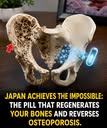
The claim: “Japan has created a pill that regenerates bones and reverses osteoporosis”
There is an important distinction between the headline claim and what the medical evidence actually shows.
As of August 2026, I could not find credible evidence that Japan has approved a pill that completely regenerates damaged bones or permanently reverses osteoporosis. However, Japan has been involved in important osteoporosis research, and there is a real treatment that can stimulate new bone formation while simultaneously reducing bone breakdown: romosozumab.
The treatment is scientifically impressive, but it is not an oral pill and “reverses osteoporosis” is an oversimplification.
1. What is the real treatment?
Romosozumab is a monoclonal antibody that targets sclerostin, a protein that normally suppresses bone formation.
Blocking sclerostin has a two-part effect:
- ↑ Bone formation — osteoblast activity increases.
- ↓ Bone resorption — activity of bone-removing osteoclasts decreases.
- Consequently, bone mineral density (BMD) can rise substantially.
Clinical research specifically in postmenopausal Japanese women found significant BMD increases with monthly romosozumab. In the 210-mg group, after 12 months, the average increase was about 16.9% at the lumbar spine, 4.7% at the total hip and 3.8% at the femoral neck compared with baseline.
So there really is a therapy capable of producing rapid and substantial increases in bone density.
2. Is it a pill?
No.
Romosozumab is administered as a subcutaneous injection once every month, rather than being swallowed as a tablet. The Japanese clinical study used 70, 140 or 210 mg injections monthly for 12 months.
Therefore, if you’ve seen a social-media headline saying something like:
“Japan invented a pill that grows new bones”
you should be skeptical. The word “pill” appears to be inaccurate if the article is referring to romosozumab.
3. Does it actually “regenerate” bone?
This requires some nuance.
Your skeleton is constantly being remodeled. Specialized cells called osteoblasts build bone, while osteoclasts remove old bone.
Osteoporosis occurs when bone loss exceeds bone formation over time, resulting in weaker, more porous bones.
Romosozumab changes this balance in favor of bone accumulation. That’s why researchers sometimes describe it as building or rebuilding the skeletal foundation. In a Japanese subgroup of the large FRAME trial, one year of romosozumab followed by two years of denosumab produced substantially greater BMD gains than the placebo-to-denosumab sequence.
But this doesn’t mean that a severely damaged bone is simply returned to its original state.
A better description is:
“The drug stimulates new bone formation and increases bone mineral density, thereby strengthening the skeleton and reducing fracture risk.”
4. How impressive are the results?
The Japanese phase-2 study included 252 postmenopausal women with osteoporosis. The women received placebo or different doses of romosozumab for 12 months.
The 210-mg monthly group showed:
| Measurement | Change after 12 months |
|---|---|
| Lumbar-spine BMD | +16.9% |
| Total-hip BMD | +4.7% |
| Femoral-neck BMD | +3.8% |
The drug also changed biochemical markers of bone metabolism very rapidly: the bone-formation marker P1NP increased while the bone-resorption marker CTX decreased.
That’s why this class of treatment is particularly interesting: many conventional osteoporosis treatments primarily slow bone loss, whereas romosozumab has a strong bone-building component.
5. What about fracture prevention?
Increasing BMD is important, but the ultimate objective is preventing fractures.
In the Japanese subgroup of the FRAME trial, women received romosozumab for 12 months and then denosumab for another 24 months. Compared with the placebo→denosumab group, the romosozumab→denosumab group had greater BMD increases at 36 months.
The observed new-vertebral-fracture rate was:
- 1.7% with romosozumab → denosumab
- 4.5% with placebo → denosumab
That corresponds to an observed relative reduction of about 63%, although the Japanese subgroup by itself was not statistically powered to establish fracture reductions with certainty.
So it’s important not to turn the result into “the drug eliminates osteoporosis.”
6. Why does the treatment sometimes have to be followed by another drug?
This is a particularly important point.
Romosozumab is generally used as a limited-duration anabolic treatment, rather than something that patients simply take indefinitely.
After the bone-building phase, an antiresorptive treatment such as denosumab or a bisphosphonate may be used to help maintain the newly acquired bone.
The Japanese FRAME analysis specifically investigated one year of romosozumab followed by two years of denosumab, and found that the BMD gains were maintained/improved through the subsequent treatment period.
This illustrates why calling it a “permanent cure” would be misleading.
7. What about side effects?
Romosozumab isn’t appropriate for everyone.
One of the major concerns with this drug class is cardiovascular risk. Consequently, physicians consider a patient’s cardiovascular history and overall fracture risk when deciding whether it is appropriate.
The Japanese studies generally found the treatment reasonably well tolerated, but “generally well tolerated” doesn’t mean “risk-free.”
That’s also why someone shouldn’t purchase an alleged “bone-regenerating supplement” online based on headlines about Japanese research.
8. There is another Japanese “regeneration” story you may be seeing
There is a second, completely different Japanese biotechnology story that can easily get mixed into these headlines.
A Japanese biotechnology company, Toregem BioPharma, is developing TRG035, an antibody-based drug intended to stimulate tooth regeneration, particularly for congenital absence of teeth.
According to a 2026 announcement from JIC Venture Growth Investments, TRG035 had completed Phase 1 and the company was preparing Phase 2 trials in Japan and the United States.
That’s tooth regeneration—not a treatment that regenerates the bones of the skeleton.
This distinction is important because sensational articles sometimes combine Japanese research involving bone formation, osteoporosis and tooth regeneration into one exaggerated “Japan has discovered a regeneration pill” story.
9. What about an actual oral osteoporosis drug?
There are oral osteoporosis medicines, including bisphosphonates such as alendronate and other drug classes, but they don’t work like a magical bone-regeneration pill.
Some treatments primarily:
- reduce bone resorption,
- slow further bone loss,
- increase BMD over time,
- and reduce fracture risk.
Romosozumab is unusual because it has a particularly strong dual action—promoting bone formation while suppressing resorption.
10. There are also experimental bone-building antibodies
Research continues on other drugs targeting the same biological pathway.
For example, the experimental antibody SHR-1222 targets sclerostin. In a phase-1 study of postmenopausal women with osteoporosis, multiple doses increased bone-formation markers and reduced a bone-resorption marker. The 300-mg monthly group showed a 14.6% lumbar-spine BMD increase from baseline by day 169, compared with 0.6% in placebo.
But this is experimental research, not evidence of an approved Japanese “bone-regenerating pill.”
Bottom line
The exciting part is real: modern osteoporosis therapy can do much more than merely slow bone loss. Drugs targeting sclerostin can substantially stimulate bone formation and increase bone density, and Japanese patients have participated in studies demonstrating impressive results.
The sensational part isn’t accurate: there is no good evidence that Japan has produced a universally available oral pill that completely regenerates the skeleton and cures osteoporosis.
If the headline you saw specifically mentions “Japan’s bone-regenerating pill,” “2026,” or gives the name of the drug/company, send me the headline or article. I can break down exactly what drug it is, who developed it, clinical-trial results, approval status, price/availability, side effects, and whether the claim is legitimate or clickbait.