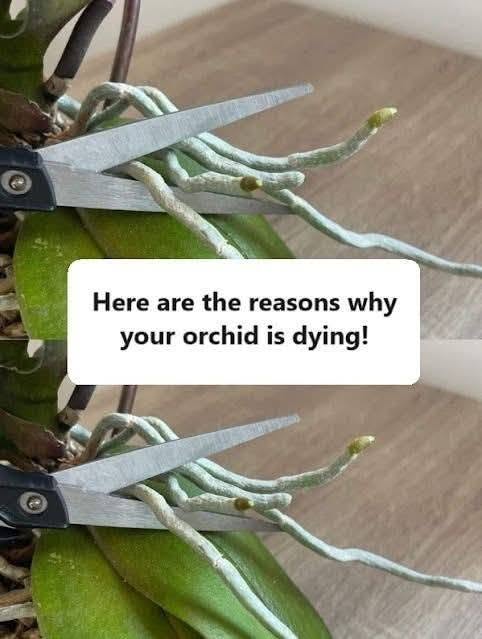
If your orchid is dying, don’t panic—orchids can often recover once the underlying problem is corrected. The most common causes are watering problems, root damage, insufficient light, temperature stress, and pests or disease.
🌸 Why Your Orchid May Be Dying
1. 💧 Overwatering — the most common problem
Orchids, especially Phalaenopsis orchids, don’t like constantly wet roots.
Signs:
- Yellowing leaves
- Soft, limp leaves
- Black or brown roots
- A musty smell
- Roots that feel mushy rather than firm
- Leaves dropping unexpectedly
When the potting medium stays wet for too long, the roots can suffocate and rot.
What to do:
Remove the orchid from its pot and inspect the roots. Cut away dead, mushy, black/brown roots with sterilized scissors and repot into fresh, airy orchid medium.
2. 🌵 Underwatering
Although overwatering is common, an orchid can also become dehydrated.
Signs:
- Wrinkled or accordion-like leaves
- Very dry potting medium
- Roots that are gray, thin, or shriveled
- Drooping leaves
- Flowers wilting prematurely
What to do:
Water thoroughly when the growing medium has mostly dried, then allow excess water to drain completely. Don’t let the pot sit in water.
3. 🪴 Poor drainage
Even if you’re watering correctly, a pot without adequate drainage can cause problems.
Orchid roots need air as well as moisture. A decorative pot that traps water around the roots can lead to root rot.
Better setup:
- Use a pot with drainage holes.
- Use orchid bark or another chunky, well-aerated orchid medium.
- Don’t bury the orchid’s crown—the point where the leaves meet—under the medium.
4. ☀️ Too much or too little light
Too much direct sunlight:
- Leaves develop pale, bleached, yellow, or brown patches.
- Leaves may feel unusually hot.
Too little light:
- Dark green leaves
- Weak or stretched growth
- Failure to bloom
- Slow recovery
For many common orchids, bright, indirect light is ideal. An east- or bright filtered-window is often a good location.
5. 🌡️ Temperature stress
Orchids can suffer when exposed to extreme temperatures.
Avoid:
- Cold drafts
- Direct blasts from air conditioners
- Hot radiators
- Very hot windows
- Sudden temperature changes
A relatively stable indoor temperature is generally better than frequent fluctuations.
6. 🌱 Old or decomposed potting medium
Orchid bark eventually breaks down and becomes compact.
This reduces airflow around the roots and causes the medium to stay wet longer.
Signs:
- Medium looks decomposed or resembles soil
- Water drains poorly
- Roots remain wet for a long time
- Orchid becomes unstable in its pot
Repotting into fresh orchid medium may help.
7. 🦠 Root, crown, or bacterial/fungal problems
Sometimes the issue isn’t simply watering.
Watch for:
- Black or rapidly spreading spots
- Soft, collapsing tissue
- Rotting crown
- Unpleasant odor
- Sudden leaf loss
Crown rot is particularly serious. If water repeatedly collects in the center of the orchid, the crown can begin to rot.
Keep water out of the crown and provide good airflow.
8. 🐛 Pests
Inspect both sides of the leaves and around the roots.
Possible pests include:
- Mealybugs
- Scale insects
- Aphids
- Spider mites
- Thrips
Look for sticky residue, tiny insects, cottony white material, bumps on stems/leaves, or fine webbing.
9. 🌿 Natural aging of leaves
Not every yellow leaf means your orchid is dying.
An older bottom leaf may naturally turn yellow and fall off while the plant continues producing healthy new leaves.
Usually less concerning: one old bottom leaf gradually yellowing while the rest of the plant looks healthy.
More concerning: several leaves turning yellow or becoming soft in a short period.
10. 🌸 Flowers falling off doesn’t necessarily mean the orchid is dying
Orchid flowers naturally have a limited lifespan.
Flowers may drop because:
- The flowering period has ended.
- The plant experienced environmental stress.
- Temperature or light changed.
- The plant was moved.
If the leaves and roots are healthy, losing flowers is usually normal.
🔍 The fastest way to diagnose your orchid
Check these five things:
| What you see | Likely problem |
|---|---|
| Mushy black/brown roots | Root rot |
| Wrinkled leaves + dry roots | Dehydration |
| Yellow/bleached patches | Too much light |
| Very dark green leaves + no flowers | Too little light |
| Soft/black crown | Crown rot |
| Cottony white insects | Mealybugs |
| One old bottom leaf turning yellow | Often natural aging |
| Water sitting in the pot | Poor drainage/overwatering |
🚑 If your orchid looks very sick
Don’t immediately add fertilizer. First determine whether the roots are alive.
Healthy orchid roots are generally firm, while rotten roots are usually soft, mushy, hollow, or easily collapse when touched.
If you want, send me a clear photo of your orchid (leaves, roots, pot, and growing medium) and I can help you identify the most likely problem and tell you exactly what to do to try to save it.