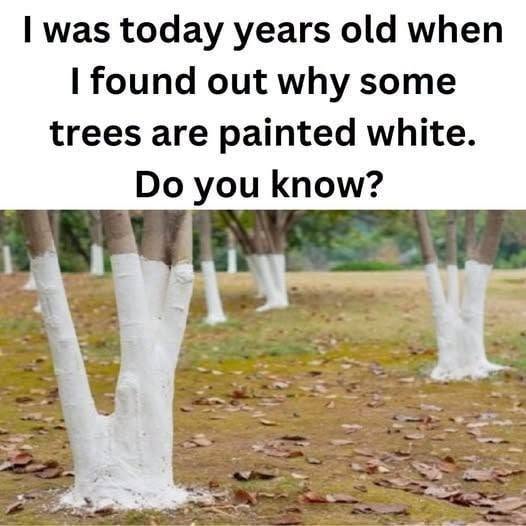
Why Are Some Trees Painted White? A Detailed Explanation


Have you ever noticed that some trees have their trunks painted white, especially in parks, gardens, orchards, along roads, or in rural areas? This practice is called tree whitewashing. It is usually done to protect the tree’s bark from environmental damage, temperature changes, certain pests, and other problems.
However, not every white-painted tree is painted for the same reason. The purpose depends on the climate, tree species, local agricultural practices, and the material used.
1. The main reason: Protecting trees from sunlight and temperature changes

One of the most important reasons for painting tree trunks white is to prevent sunscald, a type of injury caused by excessive sunlight and sudden changes in temperature.
How does sunscald happen?
During winter, especially in regions with cold nights and sunny days, a tree trunk can experience large temperature fluctuations.
-
Sunlight warms the south- or southwest-facing side of the trunk during the day.
-
The bark and the tissues beneath it become warmer, and the cells may become active.
-
When the sun disappears or temperatures suddenly drop, those tissues cool rapidly.
-
The resulting temperature stress can damage the bark and the living tissue beneath it.
The damage may cause cracks, sunken areas, peeling bark, or dead patches on the trunk.
How does white paint help?
White surfaces reflect more sunlight than dark surfaces. A suitable white coating reflects some incoming solar radiation, helping the trunk remain cooler and reducing temperature fluctuations.
This is particularly useful for:
-
Young fruit trees with thin bark.
-
Newly planted trees.
-
Trees in orchards exposed to strong winter sunlight.
-
Trees that have recently been pruned, exposing previously shaded bark.
Important: Whitewashing does not make a tree immune to frost or sun damage. It reduces one source of temperature stress, and the effectiveness depends on the coating and local conditions.
2. Preventing bark cracking and damage

Tree bark is more than an outer covering. Beneath it lies the cambium, a thin layer of living cells responsible for producing new wood and inner bark.
When the bark is damaged by intense sunlight or rapid temperature changes, it may crack, peel, or die in patches. Whitewashing helps reduce the likelihood of this type of injury by moderating the temperature of the trunk.
Bark damage can have several consequences:
-
The tree may have difficulty transporting nutrients and sugars through damaged tissues.
-
Wounds can provide entry points for certain fungi and other disease-causing organisms.
-
Severe or repeated injury can weaken the tree and contribute to branch dieback.
Whitewashing is a preventive measure. It does not repair existing cracks or restore dead bark.
3. Reducing problems caused by certain insects

Some insects, such as flatheaded borers, are more likely to attack trees that have already been weakened or injured by sunburn.
Whitewashing may help reduce these problems indirectly:
-
White coating reflects sunlight.
-
Reduced heating helps prevent sunburn and bark cracking.
-
Healthier, undamaged bark may be less vulnerable to certain wood-boring insects.
However, ordinary white paint is not a reliable insecticide. It does not eliminate all insects, eggs, or larvae, and it should not replace appropriate pest management.
4. Protecting fruit trees in orchards


Whitewashing is particularly common in fruit-growing regions because young fruit trees can be vulnerable to sun damage.
Examples include:
-
Apple trees — young trunks may be susceptible to winter sunscald.
-
Peach trees — exposed bark can be damaged by intense sunlight.
-
Avocado trees — trunks and branches may become sunburned when the leafy canopy is sparse.
-
Other young fruit and nut trees with thin bark or newly exposed branches.
In commercial orchards, preventing trunk injury can help preserve the tree’s long-term health and productivity. Whitewashing can be especially useful after heavy pruning, when branches that were previously shaded become exposed to direct sunlight.
5. Why are trees painted white along roads and in public places?

In some countries, you may see rows of white-painted tree trunks beside highways, village roads, parks, government buildings, or public gardens.
There can be several reasons for this practice.
-
Traditional maintenance: Whitewashing may be part of a customary tree-care routine.
-
Appearance: Uniform white trunks create a neat, orderly appearance in landscaped areas.
-
Visibility: The pale trunks may be easier for drivers to distinguish in dim conditions, although this is not a substitute for proper road lighting and reflective markers.
-
Tree protection: Where trees receive strong sunlight, the coating may help prevent sun damage.
Not every roadside tree is painted for horticultural reasons. In some locations, the practice is mainly traditional, decorative, or part of a local maintenance program.
6. What material is used to paint tree trunks white?
The white coating is often called whitewash. Different materials may be used depending on the local practice and purpose.

A. Diluted white interior latex paint
A commonly recommended option for preventing sunburn on susceptible trees is white, water-based interior latex paint mixed with an equal amount of water. For example, one cup of paint mixed with one cup of water. This is a horticultural protective coating, not a general recommendation to paint every tree.

B. Limewash
Limewash is traditionally made using lime and water. It has been used in some agricultural settings to coat trunks. However, hydrated lime can be caustic and hazardous to handle, so it should not be mixed or applied casually. Follow appropriate agricultural guidance and safety precautions.

C. Commercial tree guards and protective coatings
Some gardeners use purpose-made tree paints, white trunk wraps, or tree guards instead. The product should be suitable for the particular tree and climate, and wraps must not constrict the growing trunk.
What should you avoid?
-
Do not use ordinary oil-based paint or an arbitrary exterior paint on living bark.
-
Do not assume that any white chemical mixture is safe for trees.
-
Avoid tightly wrapping trunks with materials that trap moisture or constrict growth.
-
Do not cover wounds indiscriminately with paint or other sealants; pruning wounds generally do not need routine wound paint.
University of California’s integrated pest management guidance specifically recommends diluted white interior latex paint rather than exterior paint for this purpose.
7. When should trees be painted white?
The timing depends on the reason for the treatment.
|
Situation |
Appropriate timing |
|---|---|
|
Preventing winter sunscald |
Before the period of strong winter sun and freezing nights |
|
Protecting newly planted trees |
Soon after planting, if the species and site are susceptible |
|
Protecting newly exposed bark |
After pruning or another event exposes previously shaded trunk or branches |
|
Preventing summer sunburn |
Before or as the risk of intense sun exposure develops |
In cold climates, late fall is often a useful time to prepare vulnerable young trees for winter. In hot climates, sunburn protection may be needed during summer as well.
8. Does painting a tree white harm the tree?
Not necessarily. When an appropriate coating is used for a suitable purpose, whitewashing can be beneficial. But painting every tree without considering its needs is unnecessary.
Many mature trees have thick bark or enough natural shade to protect their trunks. These trees may not benefit much from whitewashing.
The main considerations are:
-
Tree age: Young trees often have thinner, more vulnerable bark.
-
Sun exposure: Trees exposed to direct sunlight, especially on their south- or southwest-facing sides in the Northern Hemisphere, may be more susceptible.
-
Species: Different trees have different bark characteristics and tolerances.
-
Product choice: An unsuitable paint or caustic mixture can cause harm.
-
Tree health: Water stress, root damage, and loss of foliage can increase the risk of sunburn.
Good planting, adequate watering, suitable pruning, and maintaining healthy foliage are also important. Whitewashing is just one possible part of tree care.
9. Does white paint help trees grow faster?
White paint does not directly make trees grow faster, produce more fruit, or develop stronger roots.
Its benefit is mainly preventive. By reducing sun damage and helping preserve healthy bark, it can reduce the risk of injuries that interfere with normal tree growth.
A protected tree may consequently remain healthier than a comparable tree that suffers repeated trunk damage, but the paint itself is not a growth stimulant.
10. Why are only the lower parts of tree trunks painted?

The lower trunk is often painted because it is a convenient area to treat and is commonly exposed to direct sunlight. It is also the part of the tree most often affected by certain types of trunk injury.
However, the appropriate area depends on the risk. If a tree has branches or sections of trunk that were previously shaded and become exposed after pruning, those areas may also need protection. In some agricultural settings, growers coat major exposed branches as well.
Quick summary
Main reason: Sun protection
White reflects sunlight and helps prevent bark overheating and sunscald.
Secondary benefit: Less bark injury
Preventing cracks and damaged tissue can reduce opportunities for some pests and disease-causing organisms to exploit wounds.
Where it is most useful
Young trees, fruit orchards, and trees with bark newly exposed to strong sunlight.
Important precaution
Use a tree-appropriate coating. Not every tree needs painting, and ordinary white paint is not a universal pest-control treatment.
The key idea: Trees are painted white mainly because white reflects sunlight, helping protect vulnerable bark from excessive heating and sudden temperature changes. The practice can help trees stay healthy, but the right method depends on the tree and its environment.