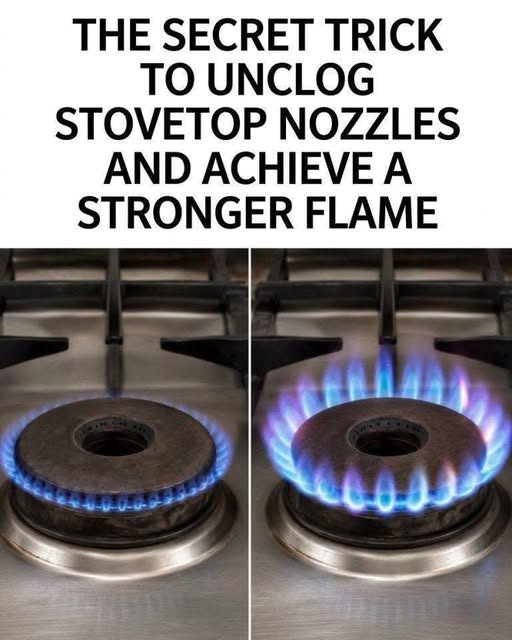
The Secret to Unclogging Stovetop Nozzles and Getting a Stronger Flame
A weak, uneven, yellow, or flickering flame on a gas stove is often caused by clogged burner ports, food residue, grease, or moisture. The secret is properly cleaning the burner components and ensuring that the gas openings are completely clear without damaging or enlarging them.
Here is a detailed, practical guide.
1. Understand why stovetop flames become weak


Common causes include:
-
Grease buildup: Cooking oil and grease accumulate around the small burner openings.
-
Food particles: Spilled milk, sauces, and food debris block the burner ports.
-
Moisture: Water trapped inside the burner after cleaning can cause uneven ignition.
-
Misaligned burner cap: An incorrectly positioned cap can disturb the flame pattern.
-
Clogged burner head: Dirt and carbon deposits restrict the flow of the gas-air mixture.
-
Gas supply problems: A weak supply or regulator problem can affect flame strength.
2. The safest way to clean clogged burner ports


Step 1: Turn off the gas and let the stove cool
-
Turn all burner knobs off.
-
Close the gas supply valve if accessible.
-
Allow the burner to cool completely.
-
Never clean a hot burner.
Step 2: Remove the burner components
-
Remove the burner grate.
-
Lift off the burner cap.
-
Remove the burner head if your stove design allows it.
-
Remember how the components are positioned.
Do not force parts that are fixed or designed not to be removed.
Step 3: Clean with warm soapy water
Prepare a cleaning solution:
-
1 bowl of warm water.
-
A few drops of dishwashing liquid.
Clean removable burner caps and heads according to the manufacturer’s instructions.
Use a soft nylon brush to remove grease and food residue.
Step 4: Clean the burner openings carefully

This is an important step.
-
Use a soft brush to remove loose debris around the burner ports.
-
Do not enlarge the holes.
-
Do not force needles, pins, drills, or metal wires into the openings.
-
Do not pour water or cleaning liquid into the gas injector or nozzle.
The injector is a precision component, and damage can cause unsafe combustion.
Step 5: Dry everything completely
This is often overlooked.
-
Wipe removable components with a clean cloth.
-
Allow them to air-dry completely.
-
Check that no moisture remains in the burner openings.
-
Never reinstall wet burner components.
3. The secret to getting an even, strong blue flame


A properly operating gas burner generally produces a stable, predominantly blue flame.
|
Flame appearance |
Possible meaning |
|---|---|
|
Strong blue flame |
Generally normal combustion |
|
Weak blue flame |
Blocked ports or gas supply issue |
|
Yellow or orange flame |
Contamination or combustion problem |
|
Uneven flame |
Dirty or incorrectly positioned burner |
|
Flame repeatedly going out |
Moisture, airflow, or gas supply issue |
A stronger flame is not necessarily a safer or better flame. The goal is a stable, even flame that matches the manufacturer’s specifications.
4. Common mistakes you should avoid

Avoid inserting needles or drills into the gas nozzle.
This can enlarge or damage the calibrated opening and create dangerous combustion conditions.

Avoid pouring water directly into the nozzle.
Water can enter the gas passage and interfere with burner operation.

Never increase gas pressure to compensate for a weak flame.
Incorrect pressure can cause excessive flames, gas leaks, or carbon monoxide production.
5. When should you call a gas technician?
Call a qualified gas technician if:
-
The flame remains weak after cleaning.
-
The flame is persistently yellow or produces soot.
-
Only one burner has a very weak flame despite proper cleaning.
-
You suspect a blocked injector or gas regulator.
-
You smell gas or hear gas escaping.
If you smell gas, turn off the supply only if safe, avoid operating electrical switches or creating flames, leave the area, and contact your gas emergency service from a safe location.
6. How to maintain your stovetop
-
Clean burner caps regularly.
-
Wipe food spills as soon as the stove cools.
-
Keep burner openings free of grease.
-
Ensure burner caps are properly seated.
-
Allow components to dry completely after washing.
-
Have the gas system inspected if flame performance deteriorates.
Let me help you identify the exact problem
Different gas stoves have different burner and nozzle designs. The right cleaning method depends on the type.
1. Which type of gas stove do you have?
2. What is the main problem?
3. How many burners are affected?
I can then explain the appropriate burner-cleaning procedure, likely cause of the weak flame, and how to restore normal flame performance safely.