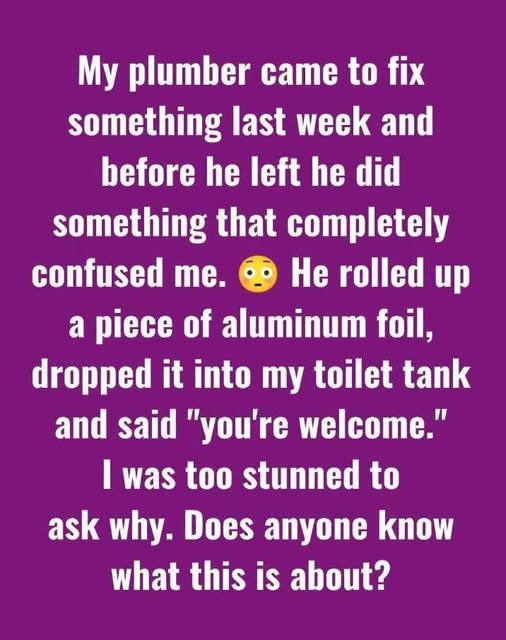
Putting Aluminum Foil in Your Toilet Tank: Does This Viral Household Hack Actually Work?


You’ve probably seen the viral household tip claiming that putting aluminum foil balls inside your toilet tank can make your toilet cleaner, reduce stains, remove mineral deposits, or even improve flushing.
But is there any truth to it?
The short answer: Aluminum foil in your toilet tank is not a proven toilet-cleaning method. Although aluminum can participate in certain chemical reactions, simply placing foil in a tank of ordinary toilet water does not reliably clean the toilet, disinfect it, remove hard-water stains, or prevent mineral buildup.
Let’s examine what the hack claims, the science behind it, possible risks, and what actually works.
1. What is the aluminum foil toilet tank hack?


The viral hack generally involves:
-
Taking a sheet of ordinary household aluminum foil.
-
Crumpling it into one or more small balls.
-
Removing the toilet tank lid.
-
Dropping the foil balls into the tank.
-
Leaving them there while the toilet is used normally.
Some versions recommend adding baking soda or other household ingredients, but the central claim is that the foil interacts with the water and helps keep the toilet clean.
The proposed benefits usually include:
-
Reducing yellow and brown toilet stains.
-
Preventing mineral deposits and limescale.
-
Making the toilet bowl look whiter.
-
Removing unpleasant odors.
-
Reducing the need for frequent toilet cleaning.
However, these claims should not be confused with scientifically established results.
2. Why do people believe aluminum foil works?
There are a few reasons this hack sounds believable.
A. Aluminum has interesting chemical properties
Aluminum reacts with certain substances under specific conditions. For example, aluminum foil can participate in a chemical reaction that removes tarnish from silver.
This is a real chemical process involving:
-
Aluminum foil.
-
Hot water.
-
Baking soda or another suitable electrolyte.
-
Tarnished silver.
However, this reaction is not the same as cleaning a toilet.
A toilet tank contains ordinary cold water, and simply dropping a ball of foil into it does not create the conditions needed for the silver-cleaning reaction.
B. Aluminum develops a protective surface layer
Aluminum naturally develops a thin aluminum oxide layer when exposed to oxygen.
This layer helps protect the metal against corrosion.
But here’s the important distinction:
Aluminum protecting itself from corrosion does not mean aluminum protects your toilet from rust.
A loose piece of foil cannot magically prevent rust on the toilet’s metal components.
C. People confuse scrubbing with soaking
Aluminum foil can sometimes be used as a mild abrasive for certain metal-cleaning tasks.
But physically rubbing foil against a surface is very different from leaving it submerged in a toilet tank.
In the tank, the foil isn’t scrubbing anything. It’s simply sitting in water.
That distinction explains much of the confusion surrounding the viral hack.
3. Does aluminum foil actually deliver the promised benefits?
Let’s examine the most common claims individually.
Claim 1: Removes yellow and brown toilet stains
Not proven

Toilet stains often come from mineral deposits, iron, organic material, or bacterial growth.
Aluminum foil sitting in the tank does not contain an effective cleaning agent to dissolve these deposits.
Verdict: It won’t reliably remove existing toilet stains.
Claim 2: Prevents rust
False claim

Rust is primarily associated with iron corrosion.
Aluminum foil does not act as a universal rust inhibitor. Preventing corrosion requires addressing the actual source, such as deteriorating metal parts, water chemistry, or moisture exposure.
Verdict: There is no reliable evidence that foil prevents rust in a toilet tank.
Claim 3: Keeps the toilet bowl cleaner
Not proven

A toilet bowl needs cleaning agents that can remove organic residue, mineral deposits, and other stains.
Plain aluminum foil does not release an effective toilet-cleaning solution into the water.
Verdict: It won’t replace toilet cleaner or regular brushing.
Claim 4: Eliminates unpleasant odors
Not proven

Toilet odors can come from waste residue, bacteria, plumbing problems, or sewer-gas issues.
Aluminum foil does not disinfect the toilet or neutralize these odor sources.
Verdict: It is not a deodorizer.
Claim 5: Saves water
Misleading

A foil ball might displace a tiny amount of tank water, but this does not mean it improves flushing efficiency.
Water-saving toilet adjustments should be made using the proper fill-level settings or manufacturer-approved devices.
Verdict: Foil is not a reliable water-saving device.
Claim 6: Stops toilet leaks
False claim
A leaking toilet commonly has a worn flapper, damaged seal, faulty fill valve, or incorrectly adjusted water level.
Aluminum foil cannot repair these mechanical problems.
Verdict: It cannot fix a leaking toilet.
4. What happens if you actually put aluminum foil in your toilet tank?

At first, you might notice absolutely nothing.
The toilet may continue flushing normally. The foil may simply settle at the bottom of the tank.
However, there are potential problems.
Potential problem 1: Interference with the flushing mechanism
Toilet tanks contain several moving components:
-
Fill valve: Refills the tank after flushing.
-
Float: Controls the water level.
-
Flapper or flush seal: Controls the release of water into the bowl.
-
Overflow tube: Prevents the tank from overflowing.
A loose foil ball could move around and interfere with these components.
If it prevents the flapper from sealing properly, water may continuously leak from the tank into the bowl.
Potential problem 2: Small pieces can become trapped
Aluminum foil can tear, fold, or break into smaller pieces.
Loose fragments could become lodged around tank components or travel into parts of the flushing system.
This creates an unnecessary maintenance risk.
Potential problem 3: It can contribute to unnecessary maintenance
If foil interferes with the fill valve or flush mechanism, you may experience:
-
Continuous running water.
-
Incomplete flushing.
-
Improper tank refilling.
-
Water wastage.
-
A need to remove the obstruction or repair a component.
Not every foil ball will cause these problems, but there is no meaningful benefit to justify introducing the risk.
These concerns are consistent with household-maintenance guidance warning against placing loose objects inside toilet tanks.
5. What should you use instead of aluminum foil?
If your goal is a cleaner toilet, there are safer and more effective methods.

1. White vinegar for mineral deposits
White vinegar contains acetic acid, which can help dissolve calcium-based mineral deposits. Use it on suitable surfaces according to the toilet manufacturer’s cleaning instructions.

2. A toilet bowl cleaner
Choose a cleaner formulated for your particular stains. Use a toilet brush to remove ordinary grime and residue.

3. Proper toilet tank cleaning
Follow the manufacturer’s instructions. If cleaning is permitted, turn off the water supply, flush the tank, and gently remove sediment using a suitable cloth or sponge.

4. Adjust the fill valve to save water
If your toilet uses more water than necessary, check the manufacturer’s recommended water level and adjust the float or fill valve appropriately.

5. Replace worn-out flappers
If water continuously runs into the bowl, inspect the flapper and flush seal. Replacing a worn component is more effective than trying household hacks.
Important cleaning safety: Never mix bleach with vinegar, toilet-bowl acids, ammonia, or other cleaning products. Dangerous gases can result. Also, avoid putting bleach tablets or aggressive chemical cleaners in the tank unless the toilet manufacturer explicitly approves them.
6. How to clean a toilet tank properly
If your tank has accumulated dirt, sediment, or mineral buildup, here’s a practical maintenance routine.


-
Turn off the water supply. Locate the shutoff valve near the toilet.
-
Flush the toilet. This lowers the water level inside the tank.
-
Inspect the interior. Look for mineral buildup, sediment, rust-colored deposits, and damaged rubber components.
-
Clean gently. Use a soft sponge or cloth and a cleaner approved by your toilet manufacturer.
-
Inspect the mechanical parts. Check the flapper, fill valve, float, and overflow tube.
-
Restore the water supply. Allow the tank to refill and check that the toilet flushes correctly.
-
Check for leaks. Make sure water stops flowing when the tank reaches its normal level.
You don’t need to clean the inside of your toilet tank every week. Periodic inspection and cleaning when necessary are generally sufficient.
7. Why does this viral household hack become so popular?
There are several reasons these tricks spread rapidly on social media.
-
Low cost: Aluminum foil is inexpensive and available in nearly every household.
-
Simplicity: The method takes only a few seconds to demonstrate.
-
Visual appeal: Videos can make ordinary household objects appear surprisingly useful.
-
Exaggerated promises: Claims of saving money, eliminating cleaning, and preventing plumbing problems attract attention.
-
Confusion about chemistry: A genuine use of aluminum in one cleaning application gets incorrectly applied to another.
A particularly important point is that seeing a toilet flush successfully after someone adds foil does not prove the hack works.
To establish that it prevents stains or saves water, you would need controlled comparisons over time, measuring actual cleaning results and water consumption.
There is no convincing published evidence establishing those benefits.
8. Final verdict: Is this hack worth trying?

Not recommended
|
Question |
Answer |
|---|---|
|
Does foil clean the toilet bowl? |
No proven benefit |
|
Does it remove mineral stains? |
No |
|
Does it prevent rust? |
No proven benefit |
|
Does it kill bacteria? |
No |
|
Does it eliminate odors? |
No |
|
Does it repair leaks? |
No |
|
Does it save water? |
Not meaningfully |
|
Can it interfere with toilet mechanisms? |
Yes, potentially |
My conclusion
Putting aluminum foil in your toilet tank is one of those household hacks that sounds clever but lacks convincing scientific support.
Aluminum foil has legitimate uses in cleaning and household maintenance, but leaving it inside a toilet tank does not turn it into a cleaning agent, disinfectant, rust protector, or plumbing repair solution.
In fact, it introduces an unnecessary risk of interfering with the toilet’s internal components.
My recommendation: Skip the aluminum foil. Use an appropriate toilet cleaner, maintain the tank’s mechanical components, and fix the actual cause of stains, odors, leaks, or excessive water consumption.
The best household hack is one that saves time and money without creating another repair problem.