-
The upside-down baluster: History, symbolism, and the belief that only God is perfect
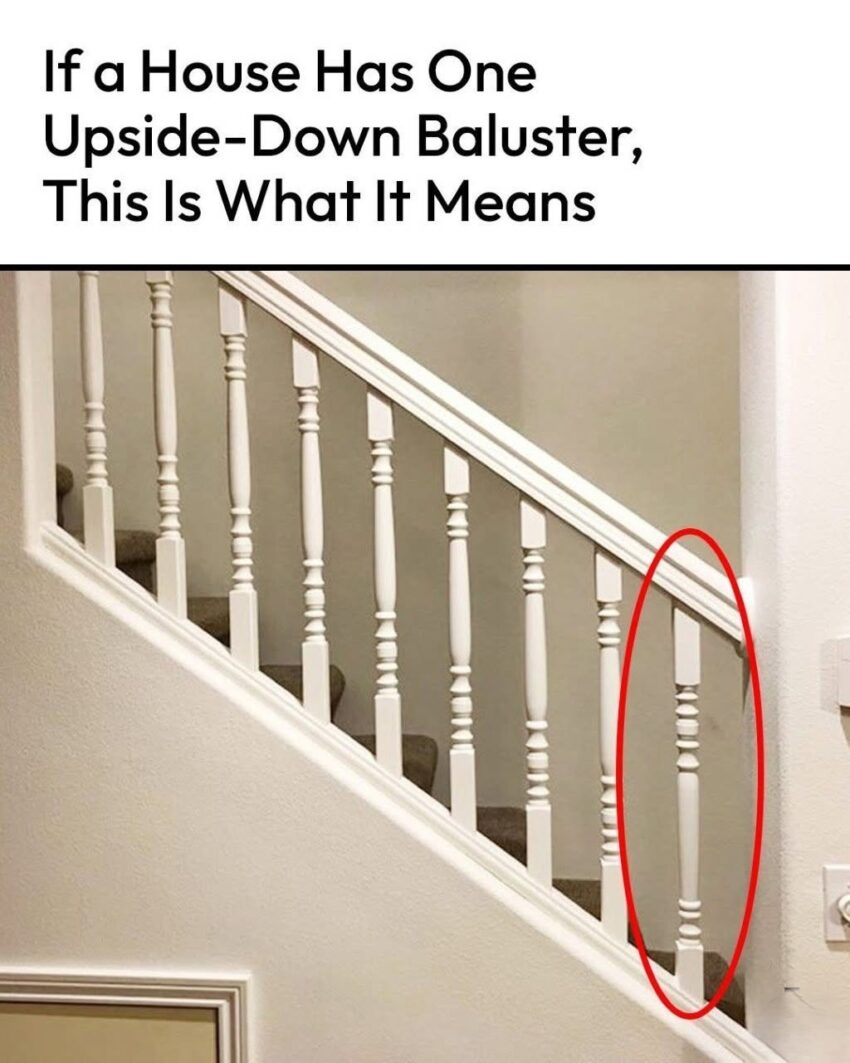
An upside-down baluster (also called a spindle) is a fascinating feature sometimes found on traditional wooden staircases. It is associated with an old architectural belief that human beings should never claim to achieve absolute perfection, because perfection belongs to God alone.
According to the popular tradition, a carpenter would deliberately install one baluster upside down among the correctly positioned spindles. This small irregularity was said to symbolize human humility, reminding everyone that no matter how skilled an artisan might be, only God can create something truly perfect.
The story is often associated with historic homes, traditional craftsmanship, and religious interpretations of architecture.
1. What does the upside-down baluster symbolize?
The tradition carries several possible meanings:
-
Humility before God: The reversed spindle represents the belief that human beings cannot create anything as perfect as God’s creation.
-
Religious devotion: The carpenter acknowledges that even the finest human craftsmanship has limitations.
-
Acceptance of imperfection: It serves as a reminder that flaws are part of human nature and should not be confused with failure.
-
A quiet act of faith: The small detail becomes a symbolic expression of religious belief without requiring a written message or inscription.
The underlying message is that craftsmanship can be beautiful without being perfect.
2. The historical and architectural background
Balusters have a long architectural history.
-
Renaissance period (15th–16th centuries): Balusters became popular architectural features in European buildings, particularly in Italian Renaissance architecture.
-
17th–18th centuries: Elaborately turned wooden balusters became common in grand houses and traditional staircases.
-
19th–early 20th centuries: Decorative staircases became prominent in public buildings, government buildings and private residences.
The religious explanation for the inverted spindle is widely repeated, but it is important to distinguish the story from documented architectural history. There is no evidence that all historical carpenters followed a universal religious rule of installing one spindle upside down.
An architectural historian, Calder Loth, explains the development of baluster designs in the Renaissance and their subsequent use in European architecture.
Institute of Classical Architecture & Art3. Famous examples in American architecture
Two frequently mentioned examples are:
South Dakota State Capitol
Its grand staircase is associated with the tradition that an inverted baluster represents the belief that only God is perfect. One account identifies its position as the third baluster from the right, symbolizing the Holy Trinity.
Wyoming State Capitol
Another inverted baluster is associated with a story about Amish craftsmen deliberately introducing an imperfection to acknowledge that human beings cannot attain divine perfection.
WRTV+14. Other folklore surrounding inverted balusters
Interestingly, the humility explanation is not the only story associated with this unusual feature.
Three interpretations are commonly circulated:
Interpretation
Traditional meaning
Religious humility
Only God is perfect.
Protection against evil
An inverted spindle was believed to confuse or deter evil spirits.
Good luck
The unusual detail was considered a protective charm.
One architectural history book, Staircases: History, Repair and Conservation, also discusses inverted balusters and suggests that some may simply have been reversed during repairs or replacement.
dokumen.pub+15. The deeper philosophical meaning
Perhaps the most beautiful aspect of this tradition is the message it communicates.
Imagine a carpenter spending weeks carefully measuring, carving, shaping and assembling a magnificent staircase. Every spindle is carefully crafted, every curve is considered, and every detail reflects exceptional skill.
Yet, according to the tradition, the carpenter deliberately turns one spindle upside down.
Why?
Because the carpenter believes that the work should demonstrate skill, not arrogance.
The inverted baluster becomes a quiet reminder that:
-
Human achievement should be accompanied by humility.
-
Beauty does not require absolute perfection.
-
A small imperfection can carry a profound meaning.
-
True craftsmanship is not just about appearance but also about the values behind the work.
6. The central lesson
The upside-down baluster is a wonderful example of how a seemingly insignificant architectural detail can carry a meaningful story.
Whether it was installed as a religious gesture, a protective superstition, a practical replacement or simply a carpenter’s mistake, it invites us to look beyond appearances.
Its most memorable traditional message is simple:
We can strive for perfection, but we should remain humble enough to recognize that perfection belongs to God alone.
That is the enduring beauty of the upside-down baluster—not necessarily that every one has this history, but that the story reminds us that humility can be built into even the smallest details of our lives.
-