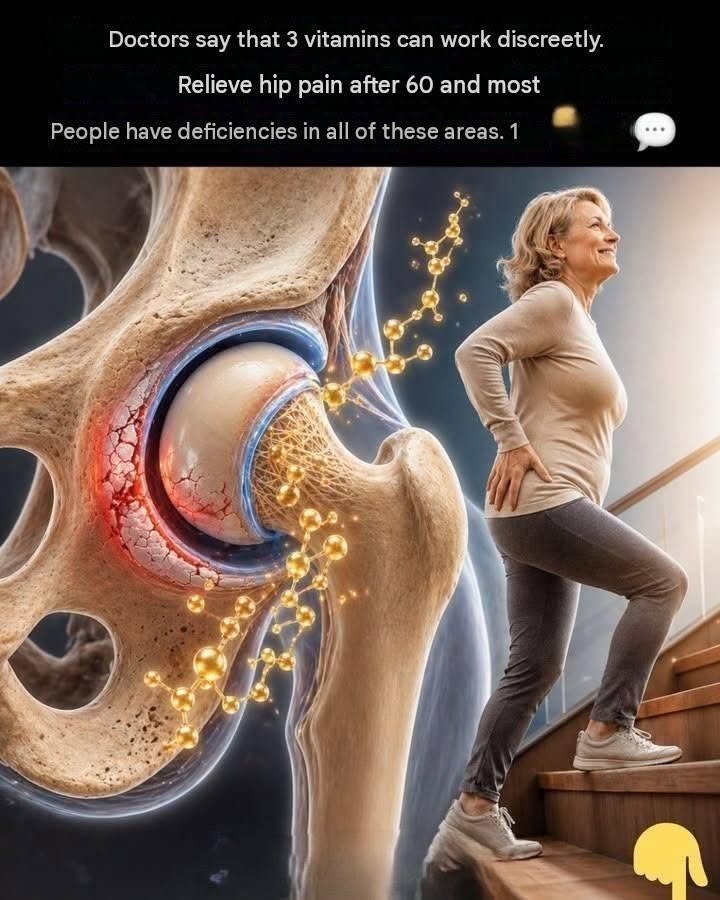
If you have hip osteoarthritis (OA), it is understandable to wonder whether vitamins or supplements can reduce pain or slow joint damage. The important distinction is between nutrients that support normal bone, muscle and joint health and supplements that have actually been shown to reduce osteoarthritis pain.
Current evidence does not support any vitamin as a reliable pain treatment for hip OA. The 2024 American Academy of Orthopaedic Surgeons (AAOS) hip-OA guideline emphasizes treatments such as exercise/physical therapy, appropriate weight management, oral NSAIDs when appropriate, and corticosteroid injections for short-term relief—not vitamin supplements.
That said, three nutrients are particularly relevant to people with hip OA because deficiencies can compromise musculoskeletal health.
1. Vitamin D — important if you are deficient
Vitamin D is essential for calcium absorption, bone mineralization and normal muscle function. This matters with hip OA because the hip is a major weight-bearing joint, and maintaining strong bone and muscle around the joint is important.
Can vitamin D reduce hip OA pain?
This is where the evidence is often overstated.
Studies have produced mixed results. Some people who are vitamin-D deficient may feel better when their deficiency is corrected, but clinical trials have generally not shown vitamin D supplementation to consistently relieve osteoarthritis pain. The American College of Rheumatology/Arthritis Foundation guideline conditionally recommends against vitamin D specifically as an OA treatment because trials showed small or absent effects on OA symptoms.
So:
- If you are deficient: correcting the deficiency is worthwhile for overall bone and muscle health.
- If your vitamin D level is already adequate: taking extra vitamin D is unlikely to make your arthritic hip pain substantially better.
- Vitamin D should therefore be considered a nutritional correction, not an OA painkiller.
Food sources
Good sources include:
- Fatty fish such as salmon, sardines and trout
- Fortified milk or plant milks
- Fortified cereals
- Egg yolks
- Some mushrooms
A blood test for 25-hydroxyvitamin D [25(OH)D] can determine whether you are deficient.
Important caution
More is not necessarily better. Excessive vitamin D supplementation can cause abnormally high calcium levels and other complications. It is better to base high-dose supplementation on a clinician’s assessment and, when appropriate, blood testing.
2. Calcium — supports the bones around the hip
Calcium is not a treatment for the cartilage loss of osteoarthritis. However, it is essential for maintaining bone strength, including the bones that form the hip joint.
This distinction is particularly important because osteoporosis and osteoarthritis are different conditions:
- Osteoarthritis primarily involves degeneration and remodeling of the joint.
- Osteoporosis involves reduced bone strength and increased fracture risk.
Calcium cannot rebuild worn-out hip cartilage, but inadequate calcium intake can contribute to poor bone health.
Why does this matter for hip OA?
The hip contains the femoral head and acetabulum, both of which depend on healthy bone. Maintaining adequate calcium, together with adequate vitamin D and resistance/weight-bearing activity appropriate for your condition, helps support the skeleton.
However, there is no good evidence that taking calcium supplements by itself reduces hip-OA pain.
Best sources
Prefer food sources when possible:
- Milk
- Yogurt
- Cheese
- Calcium-fortified plant milks
- Calcium-set tofu
- Sardines or canned salmon with bones
- Certain leafy green vegetables
If you have a balanced diet, you may not need a calcium supplement.
A common mistake
Some people take large doses of calcium hoping that it will “strengthen the cartilage.” It does not. Calcium is primarily a bone mineral, not a cartilage-rebuilding supplement.
3. Vitamin K — useful for bone health, but not proven as an OA pain treatment
Vitamin K is involved in normal bone metabolism and blood clotting. Vitamin K is found particularly in leafy green vegetables.
There has been research examining whether vitamin K status is associated with osteoarthritis. Some observational studies have found associations between inadequate vitamin K and musculoskeletal abnormalities, but that does not establish that taking vitamin K supplements will relieve hip-OA pain or prevent progression. The Arthritis Foundation notes associations between vitamin D/K deficiencies and worse bone or cartilage findings, but this should not be interpreted as proof that supplementation treats OA.
Food sources
Especially good sources include:
- Kale
- Collard greens
- Spinach
- Broccoli
- Brussels sprouts
- Other dark leafy greens
For most people, getting vitamin K from food is preferable to taking a high-dose supplement.
Important medication issue
If you take warfarin (Coumadin) or another vitamin-K-sensitive anticoagulant regimen, do not substantially change your vitamin K intake or begin a vitamin K supplement without discussing it with your clinician.
What about glucosamine and chondroitin?
These are often advertised specifically for “joint cartilage,” so they deserve special attention.
They are not vitamins, but they are among the most commonly marketed supplements for OA.
Unfortunately, the evidence for hip osteoarthritis is disappointing.
The ACR/Arthritis Foundation guideline strongly recommends against glucosamine for hip OA and against chondroitin for hip OA. It also recommends against glucosamine/chondroitin combinations for hip OA. The guideline found that the best-quality evidence did not demonstrate an important benefit over placebo.
Therefore, I would not put glucosamine/chondroitin among the three most evidence-based things to take for painful hip OA.
There are also practical considerations: glucosamine may affect blood glucose in some people, and glucosamine/chondroitin products can interact with warfarin.
What about omega-3/fish oil?
Fish oil contains omega-3 fatty acids, which have anti-inflammatory effects in some conditions. That makes it sound promising for arthritis.
But for osteoarthritis, the evidence isn’t convincing. The ACR/Arthritis Foundation guideline conditionally recommends against fish oil for hip, knee and hand OA because the available clinical evidence did not demonstrate meaningful benefit.
Eating fish as part of a healthy diet is still a good idea, but fish-oil capsules shouldn’t be expected to treat hip-OA pain.
So what actually helps hip-OA pain?
This is probably the most important part.
Supplements generally have a much smaller evidence base than treatments directed at movement, strength, body weight and inflammation/pain.
The AAOS 2024 hip-OA guideline gives strong support to oral NSAIDs for reducing pain and improving function when they are medically appropriate. It also supports physical therapy for people with mild-to-moderate symptomatic hip OA and corticosteroid injections as an option for short-term pain and functional improvement.
The ACR/Arthritis Foundation guideline also strongly recommends exercise and appropriate weight loss for people with overweight/obesity and hip OA.
In practical terms, the hierarchy is more like:
- Regular therapeutic exercise/strengthening
- Maintaining a healthy body weight, if weight reduction is appropriate
- Physical therapy when needed
- Appropriate pain/anti-inflammatory medication after considering your other medical conditions
- Corticosteroid injection when appropriate for significant symptoms
- Correcting genuine nutritional deficiencies
- Supplements marketed specifically as cartilage/pain treatments, where evidence is considerably weaker
A useful way to think about the three nutrients
| Nutrient | Main role | Will it cure hip OA? | Can it help pain? |
|---|---|---|---|
| Vitamin D | Bone & muscle health | No | Mainly if you are deficient; not reliably otherwise |
| Calcium | Bone strength | No | No convincing direct OA pain benefit |
| Vitamin K | Bone metabolism | No | Not established as an OA pain treatment |
So I would describe these as “important nutrients to get enough of” rather than “three supplements that treat hip arthritis.”
What I would prioritize
If someone has painful hip OA, a sensible nutritional strategy is to eat a Mediterranean-style, nutrient-dense diet containing vegetables, fruit, legumes, whole grains, fish, nuts/seeds, healthy fats and adequate protein. This helps provide vitamin K, calcium and other nutrients while making it easier to maintain a healthy weight. A healthy weight is particularly relevant because excess body weight increases mechanical loading and is associated with worse OA symptoms.
If you suspect a deficiency, it is more useful to test and correct the deficiency than to take large doses of several supplements blindly.
Bottom line
Vitamin D, calcium and vitamin K are important for maintaining healthy bones and muscles, but none has strong evidence as a stand-alone treatment for hip-OA pain. Vitamin D is the one where checking for deficiency can be particularly useful. For actual hip-OA pain relief, exercise/physical therapy, weight management when appropriate, and evidence-based medical treatments have substantially stronger support.
If you tell me your age, whether your hip OA is mild/moderate/severe, current medications, and whether you have had a vitamin-D or calcium blood test, I can also explain which nutrients are worth checking, typical dietary targets, and which supplements are probably a waste of money.