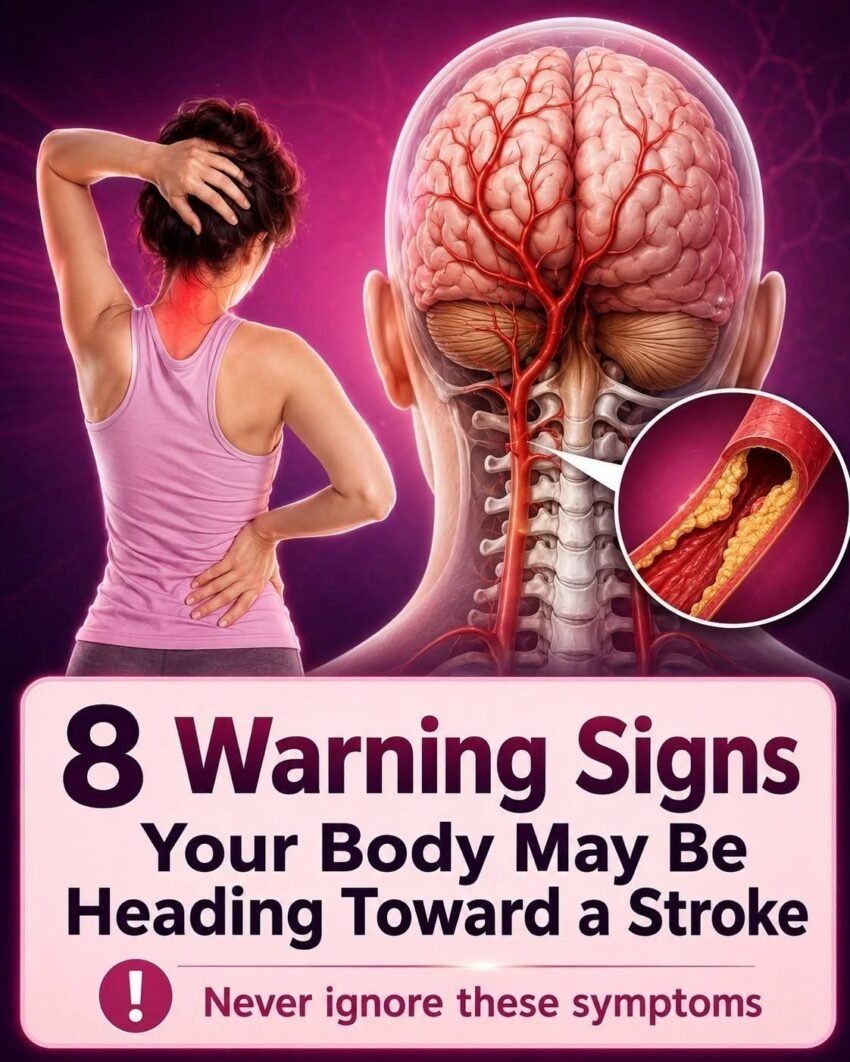
8 Warning Signs of a Stroke You Should Never Ignore
A stroke is a medical emergency. It happens when blood flow to part of the brain is blocked by a clot or when a blood vessel in the brain ruptures. Brain cells can begin dying within minutes, so recognizing symptoms and getting emergency treatment quickly can reduce brain damage and disability.
If you or someone else suddenly develops any of the symptoms below, call 911 immediately. Do not wait to see whether they improve.
1. Sudden weakness or numbness
One of the most recognizable stroke symptoms is sudden numbness or weakness, particularly affecting:
- One side of the face
- One arm
- One leg
- Several areas on the same side of the body
For example, a person may suddenly be unable to lift one arm normally, experience a strange sensation in one hand, or notice that one side of their face feels numb.
The weakness may be mild initially, so don’t assume it is harmless simply because the person can still move.
2. Drooping or unevenness of the face
A stroke can affect the nerves controlling facial muscles. One side of the face may suddenly:
- Droop
- Become numb
- Look different from the other side
- Make a smile appear uneven
A simple check is to ask the person to smile. If one side doesn’t move normally, treat it as an emergency—especially if it occurs together with weakness or speech problems.
3. Sudden difficulty speaking or understanding
Stroke can interfere with the brain’s ability to produce or understand language.
Warning signs include:
- Slurred speech
- Difficulty finding the right words
- Speaking strangely or nonsensically
- Being unable to speak
- Suddenly having trouble understanding what other people are saying
Someone who is normally articulate may suddenly sound confused or unable to form a simple sentence.
Ask the person to repeat a simple sentence. If their speech is abnormal or they cannot repeat it correctly, call 911.
4. Sudden vision changes
Stroke can affect the areas of the brain responsible for vision. Symptoms may include:
- Sudden blurred vision
- Double vision
- Loss of vision in one eye
- Loss of vision in both eyes
- A portion of the visual field suddenly disappearing
Vision problems may occur without obvious weakness or facial drooping, which can make them easier to overlook. Sudden unexplained vision changes can be a stroke warning sign and require emergency evaluation.
5. Sudden dizziness or loss of balance
A person having a stroke may suddenly become:
- Very dizzy
- Unsteady while standing
- Unable to walk normally
- Unable to coordinate their movements
- Unable to maintain their balance
They may describe the room as spinning or appear as though they are intoxicated even when they have not consumed alcohol.
Sudden balance or coordination problems are particularly important when they appear abruptly or occur alongside vision, speech, or weakness symptoms.
6. Sudden severe headache with no known cause
A sudden, severe headache that has no obvious explanation can be a warning sign of stroke, particularly certain types of bleeding in or around the brain.
The headache may be unusually intense or unlike headaches the person normally experiences. It can sometimes occur with other symptoms such as vomiting, dizziness, weakness, confusion, or loss of consciousness.
Don’t dismiss a sudden, extremely severe headache as “just a headache.” It warrants urgent medical assessment.
7. Sudden confusion or difficulty understanding
A person experiencing a stroke may suddenly seem confused or unable to understand information that would normally be easy for them to process.
You might notice that they:
- Don’t understand simple questions
- Give inappropriate or unrelated answers
- Suddenly seem disoriented
- Can’t follow a basic conversation
- Appear unusually confused
Sudden confusion can occur alone or alongside speech difficulties and is an important stroke warning sign.
8. Sudden difficulty walking or coordinating movements
Although closely related to dizziness and balance problems, sudden difficulty walking can be a particularly important warning sign.
Someone may suddenly:
- Stumble or fall
- Be unable to walk in a straight line
- Lose coordination
- Have difficulty controlling an arm or leg
- Become unusually clumsy
When this happens suddenly—especially together with dizziness, vision problems, weakness, or speech changes—it should be treated as a possible stroke.
Remember: B.E. F.A.S.T.
The American Stroke Association recommends B.E. F.A.S.T. as a way to remember the major warning signs:
B — Balance: Sudden loss of balance or coordination
E — Eyes: Sudden vision changes
F — Face: Does one side of the face droop?
A — Arms: Is one arm weak or numb, or does it drift downward?
S — Speech: Is speech slurred, strange, or difficult to understand?
T — Time: Call 911 immediately.
What to do if you suspect a stroke
- Call 911 immediately.
- Note the exact time the symptoms began, or the last time the person was known to be normal.
- Don’t drive the person yourself if an ambulance is available. EMS can begin care while transporting the patient and alert the hospital.
- Don’t wait for symptoms to disappear.
- If symptoms disappear after several minutes, still seek emergency medical attention. This could be a transient ischemic attack (TIA), sometimes called a “mini-stroke.” A TIA is a medical emergency and can be a warning of a future stroke.
The most important point
Stroke symptoms usually appear suddenly. You don’t need to have every symptom. Even one sudden warning sign can be enough to call 911. Early treatment can make a major difference in recovery, and some stroke treatments must be given within a limited time window.
If these symptoms are happening right now to you or someone near you, don’t continue reading—call 911 now.