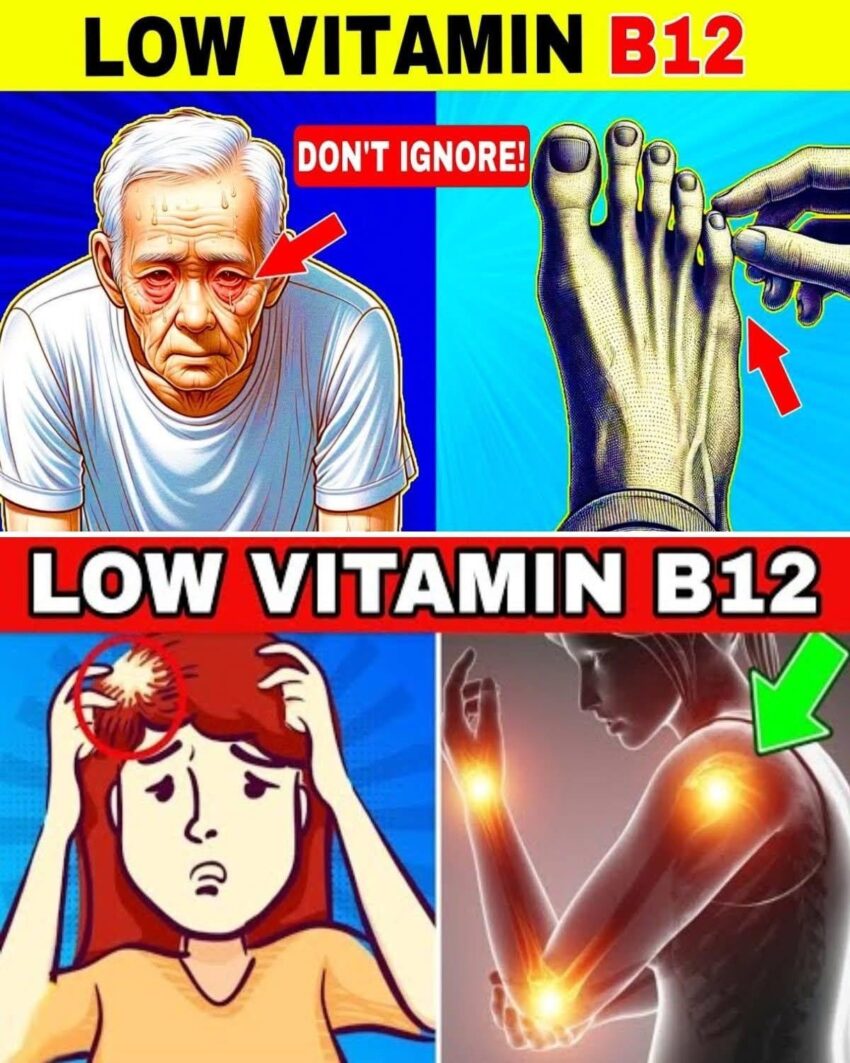
Here are 9 signs worth knowing:
1. Persistent fatigue or low energy
B12 deficiency can interfere with normal red blood-cell production and contribute to megaloblastic anemia. As oxygen delivery becomes less efficient, you may feel unusually tired, weak, or lacking in stamina—even after adequate sleep.
What to notice: fatigue that persists, reduced exercise tolerance, weakness, or feeling exhausted by activities that previously felt easy.
2. Tingling, numbness, or “pins and needles”
B12 is important for maintaining the protective covering around nerves. Deficiency can cause neurological symptoms such as tingling, burning, numbness, or altered sensation, particularly in the hands and feet.
This is one of the symptoms that shouldn’t simply be ignored, because prolonged B12 deficiency can potentially cause neurological damage.
3. Balance or coordination problems
Nerve dysfunction from B12 deficiency can affect proprioception—the body’s ability to sense its position in space. Some people may experience unsteadiness, difficulty walking, or reduced coordination.
Balance problems have many possible causes, however, so they shouldn’t automatically be attributed to B12.
4. A swollen, sore, or unusually smooth tongue
B12 deficiency can affect cells that rapidly regenerate, including cells lining the mouth. This may produce glossitis, in which the tongue becomes sore, inflamed, red, or unusually smooth.
Some people also develop mouth soreness or recurrent oral discomfort.
5. Brain fog or difficulty concentrating
Neurological effects of B12 deficiency may include difficulty concentrating, forgetfulness, mental sluggishness, or problems with memory.
These symptoms are nonspecific and can also occur with insufficient sleep, stress, medications, thyroid disorders, depression, and numerous other conditions.
6. Pale or slightly yellowish skin
B12 deficiency can cause anemia, which may make the skin appear paler than usual. In some cases, increased breakdown of abnormal red blood cells can contribute to a subtle yellowish (jaundiced) appearance.
A noticeable change in skin color should be evaluated rather than assumed to be a vitamin deficiency.
7. Shortness of breath or a racing heartbeat
When B12 deficiency causes significant anemia, the heart may work harder to deliver enough oxygen. This can lead to shortness of breath, heart palpitations, dizziness, or a faster heartbeat, particularly during physical activity.
Severe or sudden shortness of breath, chest pain, fainting, or a very rapid heartbeat warrants prompt medical attention.
8. Mood changes
B12 participates in several neurological processes, and deficiency has been associated with depression, irritability, or other mood changes.
However, mood symptoms alone aren’t a reliable way to diagnose B12 deficiency. They have many other potential causes.
9. Unexplained weakness or reduced physical performance
B12 deficiency can produce more than ordinary tiredness. Some people experience generalized weakness, muscle fatigue, reduced endurance, or difficulty performing routine physical activities.
When weakness occurs together with numbness, tingling, balance problems, or cognitive changes, B12 deficiency becomes one of several conditions a clinician may consider.
Who is more likely to become B12 deficient?
Risk is higher in people who:
-
Eat little or no animal-derived food without using reliable B12-fortified foods or supplements.
-
Have pernicious anemia or other conditions that impair B12 absorption.
-
Have had certain stomach or intestinal surgeries.
-
Have gastrointestinal disorders that interfere with nutrient absorption.
-
Take metformin or certain acid-suppressing medications for prolonged periods.
-
Are older adults, because absorption can become less efficient with age.
How is B12 deficiency confirmed?
Symptoms alone aren’t enough. A healthcare professional may order a complete blood count (CBC) and serum B12, and sometimes additional tests such as methylmalonic acid (MMA) or homocysteine when the diagnosis isn’t clear.
Importantly, B12 deficiency doesn’t always present with obvious anemia or classic blood-count abnormalities, so neurological symptoms can sometimes be important clues.
If you have several of these symptoms—particularly numbness/tingling, balance problems, memory changes, or significant weakness—it’s reasonable to discuss B12 testing with a healthcare professional rather than starting high-dose supplements based solely on symptoms.
If you’d like, I can also give you a detailed list of B12-rich foods, daily B12 requirements by age, normal B12 blood-test ranges, and the symptoms of severe deficiency.