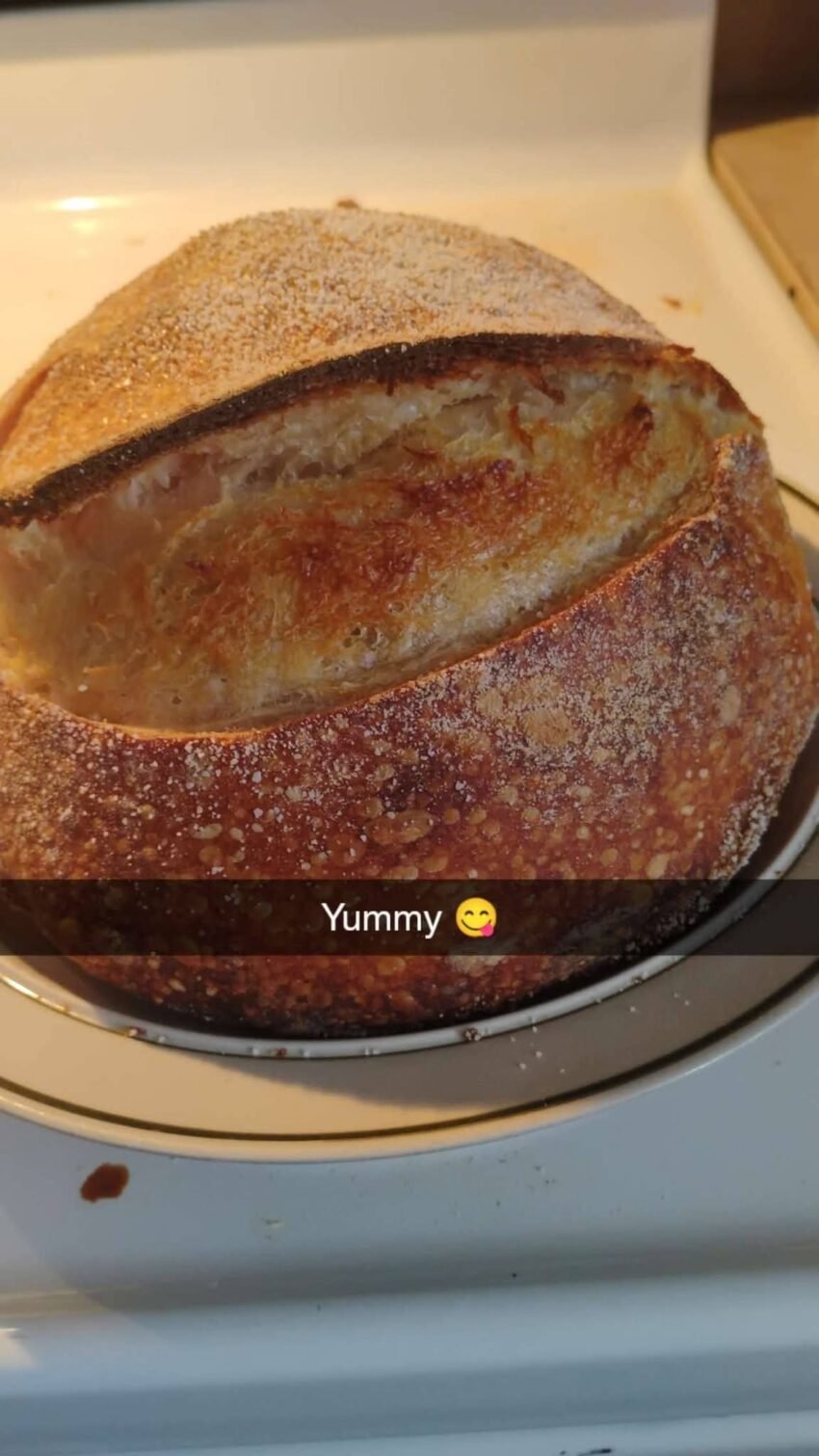
Here’s a detailed beginner-friendly sourdough bread recipe using a natural starter, with timing, technique, and troubleshooting included.
—
Classic Sourdough Bread Recipe
What You’ll Make
1 large artisan sourdough loaf
Crispy crust
Chewy, open crumb
Mildly tangy flavor
—
Ingredients
For the Dough
500 g bread flour
350 g water (room temperature)
100 g active sourdough starter
10 g salt
Optional
25 g whole wheat flour for extra flavor
Rice flour for dusting
—
Equipment
Mixing bowl
Kitchen scale
Dough scraper
Banneton/proofing basket or bowl lined with towel
Dutch oven or baking stone
Sharp blade or lame
Clean towel/plastic cover
—
Understanding the Starter
Your starter should:
Double in size within 4–6 hours after feeding
Smell pleasantly tangy
Pass the “float test” (small spoonful floats in water)
If you don’t have one yet, you can make a sourdough starter in about 7 days.
—
Timeline Overview
Step Time
Mix dough 20 min
Autolyse 30–60 min
Bulk fermentation 4–6 hrs
Shape 20 min
Cold proof 8–16 hrs
Bake 45–50 min
—
Step 1: Feed the Starter
About 4–6 hours before mixing:
Feed your starter:
50 g starter
50 g flour
50 g water
Wait until it becomes bubbly and active.
—
Step 2: Mix Flour and Water (Autolyse)
In a large bowl:
Combine:
500 g flour
350 g water
Mix until no dry flour remains.
Cover and rest for 30–60 minutes.
Why this matters:
Hydrates flour
Builds gluten naturally
Improves texture
—
Step 3: Add Starter and Salt
Add:
100 g active starter
10 g salt
Mix thoroughly by squeezing and folding the dough until fully combined.
The dough will feel sticky — that’s normal.
—
Step 4: Bulk Fermentation (First Rise)
Duration:
About 4–6 hours at warm room temperature (24–27°C ideal)
During the first 2 hours: Perform stretch-and-folds every 30 minutes.
How to Stretch and Fold
1. Wet your hand
2. Grab one side of dough
3. Stretch upward
4. Fold over itself
5. Rotate bowl and repeat 4 times
Do this:
4 sets total
You’ll notice the dough becoming smoother and stronger.
—
Step 5: Check Fermentation
The dough is ready when:
It rises about 50–75%
Surface looks puffy
Bubbles appear
Dough jiggles slightly
Avoid over-proofing:
Dough becomes very loose
Hard to shape
Collapses easily
—
Step 6: Pre-Shape
Lightly flour the counter.
Turn out the dough and gently shape into a round.
Rest uncovered for 20–30 minutes.
This relaxes the gluten.
—
Step 7: Final Shaping
Shape tightly:
Pull dough toward yourself on the counter to create surface tension
Place seam-side up into a floured banneton or towel-lined bowl.
—
Step 8: Cold Proof (Recommended)
Cover and refrigerate:
8–16 hours
Benefits:
Better flavor
Easier scoring
Improved crust
You can also proof at room temperature for 1–2 hours if needed.
—
Step 9: Preheat Oven
Preheat oven with Dutch oven inside:
250°C (480°F)
At least 45 minutes
A very hot oven is essential.
—
Step 10: Score and Bake
Turn dough onto parchment paper.
Score the top using a sharp blade:
One deep slash works well
This controls expansion.
Bake:
1. Covered: 20 minutes at 250°C
2. Uncovered: 20–25 minutes at 230°C
Bread should be:
Deep golden brown
Hollow-sounding when tapped
—
Step 11: Cool Completely
Wait at least 1 hour before slicing.
Cutting too early makes the crumb gummy.
—
Hydration Notes
This recipe is 70% hydration:
\text{Hydration}=\frac{350}{500}\times100=70\%
Higher hydration:
More open crumb
Harder to handle
Lower hydration:
Easier for beginners
—
Common Problems & Fixes
Dense Bread
Causes:
Weak starter
Under-fermented dough
Fix:
Let dough rise longer
Feed starter consistently
—
Flat Loaf
Causes:
Over-proofing
Weak shaping
Fix:
Shorter proof
Build more surface tension
—
Gummy Interior
Causes:
Cut too early
Underbaked
Fix:
Bake longer
Cool fully
—
Pale Crust
Fix:
Bake hotter
Longer uncovered bake
—
Storage
Best:
Wrapped in towel or paper bag
Room temperature for 2–3 days
For longer storage:
Slice and freeze
Avoid refrigeration — it dries bread out faster.
—
Optional Add-Ins
You can mix in:
Roasted garlic
Cheese
Jalapeños
Olives
Seeds
Dried fruit
Add during the first stretch-and-fold.
—
Beginner Tips
Use a kitchen scale
Keep notes on temperature and timing
Don’t rush fermentation
Sticky dough is normal
Practice shaping — it improves quickly
—
Quick Same-Day Version
If you don’t want overnight proofing:
Bulk ferment fully
Shape
Final proof 1–2 hours
Bake same day
Flavor will be milder but still excellent.
—
Helpful Recipe Resources
King Arthur Baking Sourdough Guide
The Perfect Loaf Beginner Sourdough
Breadtopia Sourdough Techniques
If you want, I can also give:
a Pakistani kitchen–friendly version (without Dutch oven),
whole wheat sourdough recipe,
sandwich-style sourdough,
ultra-open crumb method,
or a 7-day starter creation guide.