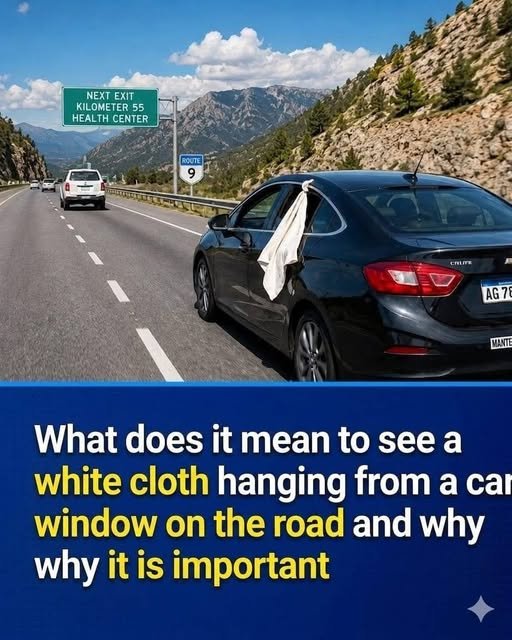
Here’s a detailed explanation.
What does a white cloth on a car window mean?
Traditionally, a white cloth, towel, handkerchief, or even a white plastic bag tied to a car’s window or door mirror is used to indicate:
- The vehicle has broken down.
- The driver has left temporarily to seek assistance.
- The vehicle is not abandoned.
- Other drivers, police, or roadside assistance should recognize that the owner is aware of the vehicle’s condition.
The practice predates mobile phones, when a stranded driver often had to walk to find a telephone or service station.
Why white?
White has long been associated with peaceful intent and signaling for assistance. It is highly visible during daylight and generally easy to recognize from a distance.
The same color has historically been used in situations such as:
- Surrender flags in wartime.
- Emergency signaling.
- Temporary distress markers.
Although these uses are unrelated, the visibility and recognizable nature of white contributed to its adoption as an informal roadside signal.
Is it an official traffic signal?
Generally, no.
Most countries’ traffic laws do not officially designate a white cloth as a recognized traffic control device.
Instead, it is a courtesy signal that has become common through local custom.
Official emergency warnings usually involve:
- Hazard warning flashers.
- Reflective warning triangles.
- Road flares (where legal).
- Emergency beacons.
These are the methods recommended by road safety authorities.
Where is this commonly seen?
The custom has been reported in parts of:
- The United States
- Canada
- Mexico
- Some areas of Latin America
- Certain rural communities elsewhere
Awareness varies widely. In some regions, many drivers recognize the signal; in others, few people do.
Does police recognize it?
In some jurisdictions, police officers may recognize a white cloth as an indication that the driver intends to return rather than having abandoned the vehicle. However, it does not guarantee that:
- the vehicle will not be ticketed,
- it will not be towed, or
- officers will treat it differently.
If a vehicle is creating a hazard or violating parking regulations, it may still be removed according to local laws.
Should you rely on it?
Not by itself.
If your car breaks down, a better approach is to:
- Pull off the roadway as far as safely possible.
- Turn on your hazard lights.
- Place reflective warning triangles if you have them.
- Contact roadside assistance or emergency services if needed.
- Stay inside the vehicle if it is safer than standing near moving traffic, unless emergency authorities advise otherwise.
A white cloth can be an additional informal signal, but it should not replace standard safety measures.
Common myths
Some claims circulating online are inaccurate, such as:
- “A white cloth guarantees police won’t tow your vehicle.” — False.
- “It is an international traffic law.” — False.
- “Every driver knows what it means.” — False.
- “Emergency services are required to stop.” — False.
Modern relevance
With widespread mobile phones and roadside assistance services, the practice is less common than it once was. Drivers today are more likely to:
- call for roadside assistance,
- share their location electronically, and
- use hazard lights and reflective safety equipment.
Still, the white cloth tradition persists in some communities as an informal way to indicate that a disabled vehicle has not been abandoned.
Bottom line
A white cloth tied to a car window is best understood as an informal distress or breakdown signal, not an official traffic sign. It may communicate that the vehicle has mechanical problems and that the driver has gone to seek help, but drivers should always follow their local road safety regulations and use officially recommended warning devices whenever possible.