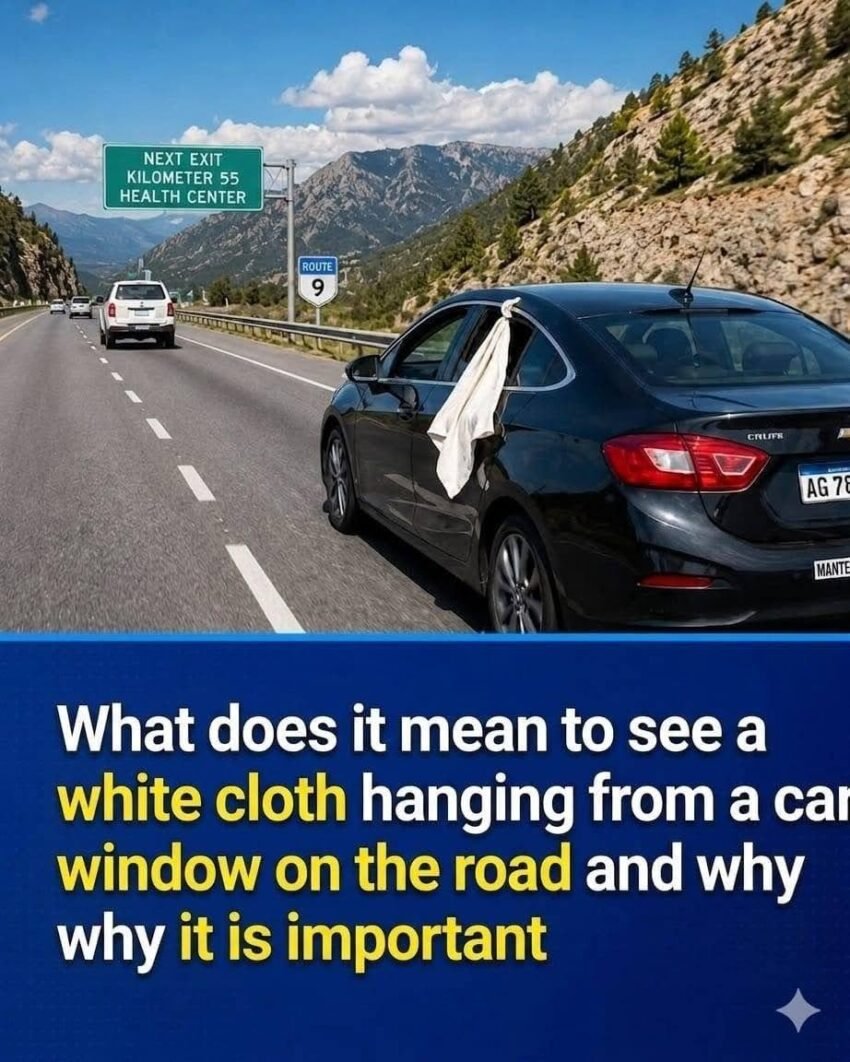
Here are the most common interpretations:
1. Vehicle Has Broken Down (Most Common Meaning)
In many places, a white cloth indicates that a vehicle has mechanical problems and the driver intends to return.
Examples include:
- Engine failure
- Flat tire
- Overheating
- Dead battery
- Running out of fuel
The cloth tells others:
- The vehicle is not abandoned.
- The owner plans to come back.
- Police or towing services may recognize that the situation is temporary.
This practice was more common before mobile phones became widespread.
2. Request for Assistance
Some drivers use a white cloth to indicate they need help.
It may signal:
- Car won’t start
- Medical issue
- Need fuel
- Need mechanical assistance
However, because there is no universal standard, many motorists may not recognize this signal today.
3. Temporary Marker
People sometimes tie a white cloth to help identify their vehicle.
Examples:
- In crowded parking lots
- At festivals
- During large sporting events
- Construction sites
- Farms or rural properties
4. Funeral Processions
In some regions and cultures, white ribbons or cloths on vehicles indicate participation in a funeral procession.
This is highly regional and not common everywhere.
5. Rural and Agricultural Uses
On farms or in rural communities, white cloths may be used:
- To identify work vehicles
- To mark equipment
- To indicate vehicles involved in harvesting or field work
6. Emergency or Distress Signal (Historical)
Historically, before hazard lights became common, motorists sometimes displayed a white cloth to show their vehicle had broken down.
Today, hazard warning lights, reflective triangles, and roadside assistance have largely replaced this practice.
Is It an Official Traffic Signal?
Generally, no.
Most countries’ traffic laws do not define a white cloth on a vehicle as an official road sign. Instead, official emergency equipment includes:
- Hazard warning lights
- Reflective warning triangles
- Road flares (where permitted)
- High-visibility safety vests
These are recognized by law in many jurisdictions.
What Should You Do If You See One?
If you notice a vehicle displaying a white cloth:
- Slow down if the vehicle is stopped in a hazardous location.
- Be alert for people working around the vehicle.
- Change lanes if it is safe to do so.
- If it appears someone needs help and it is safe, you may stop or contact roadside assistance or emergency services if the situation seems serious.
Common Myths
Some online posts claim that a white cloth always means:
- The driver has been kidnapped.
- The vehicle belongs to law enforcement.
- Criminals use it to mark targets.
- It is an official police signal.
There is no reliable evidence that these meanings are universally true. Such claims often circulate on social media without support from traffic authorities.
Country Differences
The meaning can vary:
- United States: Traditionally associated with a disabled vehicle whose owner intends to return.
- Canada: Similar informal use in some areas, though uncommon today.
- Australia: Sometimes seen in rural areas as an informal breakdown indicator.
- United Kingdom: Rare; official warning equipment is generally used instead.
- Many other countries: There is no widely recognized meaning, and many drivers may not interpret it at all.
Bottom Line
A white cloth on a car window, mirror, or door handle is usually an informal sign that the vehicle has broken down or that the owner intends to return. It is not an official international road signal, and its meaning can vary by location. Modern safety practices rely on hazard lights, reflective warning triangles, and contacting roadside assistance rather than using a white cloth alone.