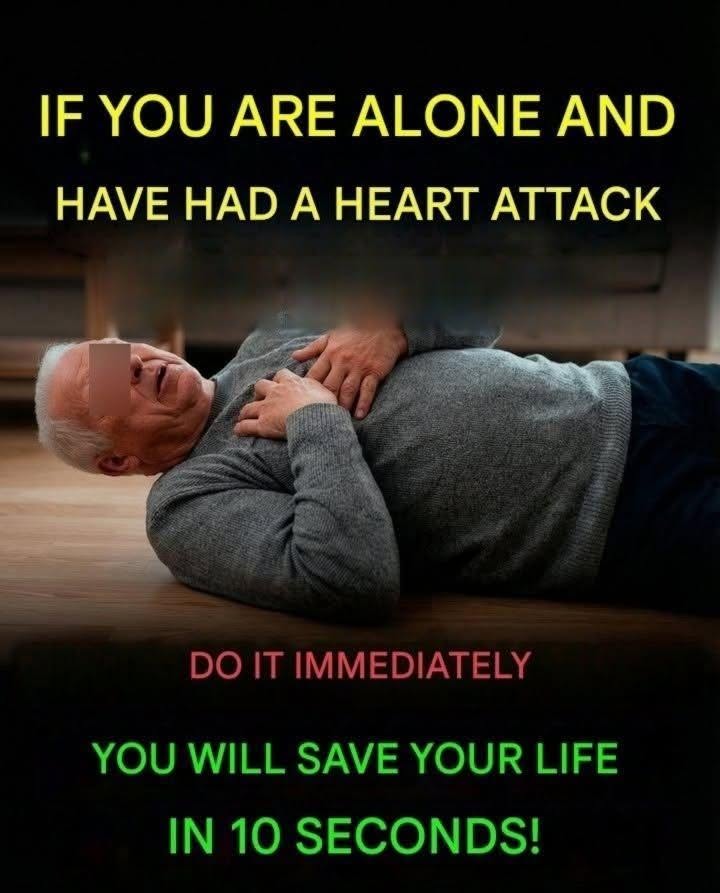
If You’re Alone During a Heart Attack: Immediate Steps That Could Save Your Life
A heart attack can happen at home, while driving, at work, or when you are completely alone. The most important thing to remember is that every minute matters. Recognizing the warning signs, calling emergency services immediately, and avoiding dangerous delays can significantly improve your chances of survival.
A heart attack occurs when blood flow to part of the heart muscle becomes blocked. Without prompt treatment, the affected heart muscle can begin to suffer permanent damage. A heart attack can also trigger a life-threatening abnormal heart rhythm.
If you suspect you are having a heart attack, do not wait for the symptoms to become severe. Call emergency services immediately. In the United States, call 911.
1. Recognize the warning signs immediately


Heart attack symptoms vary from person to person. Some begin suddenly and intensely, while others start gradually with mild discomfort.
Watch for these warning signs:
-
Chest discomfort: Pressure, squeezing, fullness, heaviness, burning, or pain in the center or left side of the chest. It may last several minutes or disappear and return.
-
Pain in other areas: Discomfort may spread to one or both arms, the shoulders, back, neck, jaw, or upper abdomen.
-
Shortness of breath: Difficulty breathing, sometimes even without chest pain.
-
Cold sweats: Sudden sweating that feels unusual or clammy.
-
Nausea or vomiting: Sometimes accompanied by indigestion-like discomfort.
-
Dizziness or lightheadedness: Feeling faint, weak, or as though you might pass out.
-
Unusual fatigue: Sudden or unexplained exhaustion, sometimes beginning hours or days before the event.
Women, older adults, and people with diabetes may experience less typical symptoms, including nausea, back or jaw pain, breathlessness, or unusual fatigue. However, anyone can have atypical symptoms.
Important: You do not need to have every symptom to be experiencing a heart attack. If symptoms are new, unexplained, or concerning, seek emergency medical help.
2. Call 911 immediately — do not wait

This is the single most important action.
If you suspect a heart attack, call 911 in the United States or your local emergency number elsewhere. Do this before looking for medication, searching the internet, or trying home remedies. Even if you are uncertain, get emergency help.
When the dispatcher answers:
-
Say clearly, “I think I am having a heart attack. I am alone and need an ambulance.”
-
Give your exact address, apartment number, floor, and any entry instructions.
-
Describe your symptoms and tell the dispatcher when they began.
-
Put your phone on speaker so you can keep your hands free.
-
Follow the dispatcher’s instructions and stay on the line.
If you cannot speak easily, try to communicate your location and emergency as best you can. Do not assume a mobile phone will automatically provide responders with your exact location.
Never drive yourself to the hospital. Your condition can deteriorate suddenly, and emergency medical personnel may begin treatment before you reach the hospital.
3. Stop what you are doing and rest
As soon as you have called emergency services, reduce the strain on your heart.

-
Stop walking, climbing stairs, exercising, or carrying anything.
-
Sit in a comfortable, supported position, often semi-upright if breathing is difficult.
-
If you feel faint, lower yourself to the floor carefully to avoid falling.
-
Try to remain still and breathe normally without forcing deep breaths.
-
Do not attempt to clean the house, pack a bag, or walk outside to meet the ambulance.
There is no single position that is best for everyone. Choose a position that allows you to breathe comfortably and minimizes the risk of falling, and follow the dispatcher’s advice.
4. Consider aspirin only when it is safe and appropriate
Aspirin can reduce the formation of blood clots involved in many heart attacks. However, it is not suitable for everyone, and it must never delay the emergency call.
-
Call 911 first.
-
Ask the emergency dispatcher whether you should chew and swallow aspirin.
-
Do not take aspirin if you have a known aspirin allergy or have been told by a healthcare professional not to take it.
-
Tell the dispatcher if you have a significant bleeding problem or take blood-thinning medication.
-
Follow the dispatcher’s instructions about the dose and whether to take it.
Some first-aid guidelines recommend a single adult dose of approximately 162–325 mg for a suspected heart attack when appropriate. However, because other conditions can cause chest pain, do not assume aspirin is safe for you without considering these precautions and the dispatcher’s guidance.
Aspirin is not a substitute for emergency treatment, and you should not wait to see whether it relieves your symptoms.
5. Use your prescribed heart medication correctly
If you have been prescribed nitroglycerin for angina or chest pain, use it only as directed by your own clinician.
-
Follow your prescribed instructions while waiting for emergency help.
-
Do not take another person’s nitroglycerin.
-
Do not take extra doses beyond your prescribed instructions.
-
Tell the dispatcher what medication you have taken.
Nitroglycerin can lower blood pressure and may be dangerous in certain circumstances. It also does not rule out a heart attack if your pain improves.
Do not experiment with new medications, sleeping pills, supplements, or home remedies during a suspected heart attack.
6. Make it easier for emergency responders to reach you
If you are alone at home, take practical steps to help responders find you, but only if you can do so without straining yourself.

Unlock the door if it is safe
If the door is locked, unlock it remotely or unlock it yourself only if doing so is safe and nearby. Do not climb stairs or walk a long distance to open it.

Keep your phone close
Use speakerphone and stay connected with the dispatcher. If you need to lie down, keep the phone within reach.

Tell responders how to find you
Provide the apartment number, gate code, floor, or other entry details. If possible, alert a nearby trusted person without delaying emergency care.
These steps can help responders reach you more quickly. Do not risk a fall or worsen your symptoms to complete them.
7. Avoid these common mistakes
Some seemingly reasonable reactions can waste valuable time or increase risk.
|
Avoid doing this |
Why it matters |
|---|---|
|
Waiting to see whether the pain goes away |
Heart attack symptoms may come and go even while damage continues. |
|
Driving yourself to the hospital |
You could lose consciousness while driving; an ambulance can provide emergency care. |
|
Walking around or exercising to test your symptoms |
Physical exertion can increase the heart’s workload. |
|
Taking someone else’s heart medication |
It may cause dangerous side effects or a sudden drop in blood pressure. |
|
Taking aspirin before calling for help |
Preparing or searching for medication should never delay emergency care. |
|
Eating a large meal, drinking alcohol, or trying home remedies |
These actions do not treat a blocked coronary artery and may complicate care. |
|
Coughing forcefully over and over to stop a heart attack |
So-called “cough CPR” is not a reliable treatment for a heart attack or cardiac arrest. |
The safest approach is to call emergency services, rest, follow the dispatcher’s instructions, and wait for professional care.
8. What if your heart suddenly stops while you are alone?
A heart attack and cardiac arrest are different emergencies, although a heart attack can trigger cardiac arrest.
-
Heart attack: Blood flow to part of the heart muscle is blocked.
-
Cardiac arrest: The heart suddenly stops pumping blood effectively, often because of a dangerous electrical rhythm. The person collapses and becomes unresponsive.
If you are alone and suddenly lose consciousness, you cannot perform CPR on yourself. That is why calling for help at the first warning signs is so important.
If you are helping another person who collapses, is unresponsive, and is not breathing normally:
-
Call 911 immediately, preferably using speakerphone.
-
Begin hard, fast chest compressions in the center of the chest at 100–120 compressions per minute.
-
Use an automated external defibrillator (AED) as soon as one is available, following its voice instructions.
-
Continue CPR until emergency personnel take over or the person shows signs of life.
Follow the emergency dispatcher’s instructions. These CPR steps are for a person who has collapsed and is unresponsive, not for an alert person experiencing chest pain.
9. What if you think it is just indigestion or anxiety?
This is a particularly dangerous source of delay.
Heart attack discomfort can sometimes resemble heartburn, gas, muscle pain, or a panic attack. Some people have mild symptoms rather than crushing chest pain. Unfortunately, it is not possible to reliably distinguish every heart attack from these other conditions at home.
Seek emergency help immediately if you experience new, unexplained chest pressure or discomfort, particularly when accompanied by shortness of breath, sweating, nausea, dizziness, or pain in the arm, back, neck, or jaw.
Do not wait for the symptoms to become unbearable, and do not cancel the ambulance simply because you start feeling better. Emergency professionals can assess whether your symptoms may be due to a heart attack.
10. Prepare now in case you are ever alone during an emergency
A few simple preparations can make it easier to act quickly under stress.
Emergency preparedness checklist
Your preparation
0 of 7 completed
The most important steps to remember
1. Call 911 immediately.
Do not wait for symptoms to worsen.
2. Stop activity and rest.
Sit or rest in a safe, comfortable position.
3. Follow medical instructions.
Take aspirin only when appropriate and use only your own prescribed medication as directed.
4. Make access easier.
Unlock the door if safe, keep your phone close, and stay on the line.
Reliable sources for further information
-
American Heart Association — Warning signs of a heart attack .
-
National Heart, Lung, and Blood Institute — Heart attack symptoms and when to call 911 .
If you are experiencing possible heart attack symptoms right now, stop reading and call 911. Do not wait for another symptom or for someone to arrive before asking for emergency help.