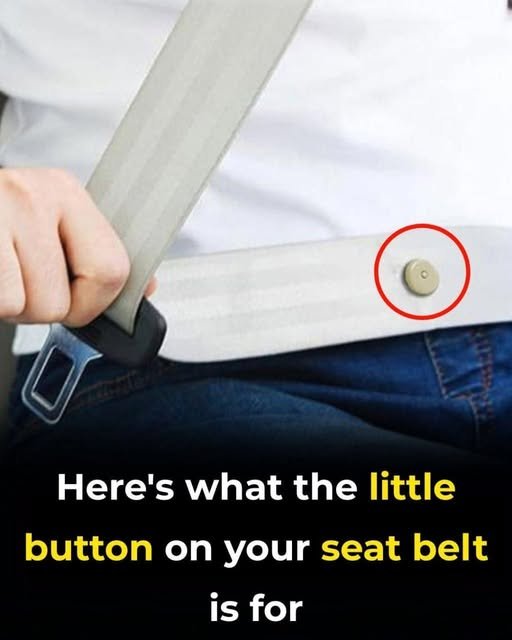
Yes. That small button on your seat belt strap (usually a round plastic button near the lower part of the belt, close to where the buckle tongue rests) has a simple but important purpose: it is a seat belt stop button (also called a belt stop, webbing stop, or retainer button).
What the little seat belt button does
When you unbuckle your seat belt, the metal latch plate (the part you insert into the buckle) slides freely along the belt. Without the small button, the latch plate would keep sliding downward and could end up near the floor.
The button acts as a physical stopper that:
- Keeps the metal latch plate in a convenient position
It prevents the buckle tongue from sliding too far down the belt, so it is easier to grab when you get into the vehicle. - Makes buckling faster and easier
The latch plate stays around waist or shoulder level instead of falling near the seat base. - Improves comfort and usability
It prevents you from having to search around for the buckle every time you enter the car.
Is it a safety device?
Not directly. The button does not hold you in place during a crash and does not add strength to the seat belt system. The actual safety comes from:
- The seat belt webbing (the strong fabric strap)
- The buckle mechanism
- The retractor that locks during sudden movement
- The anchor points attached to the vehicle structure
The button is mainly a convenience feature.
Why is it sometimes missing?
If the button breaks or falls off, the seat belt will usually still work safely. However:
- The latch plate may slide all the way down toward the floor.
- It may become annoying or harder to reach.
- Some people may accidentally position the belt incorrectly because they cannot easily grab the buckle.
Replacement stop buttons are inexpensive and can usually be installed without replacing the entire seat belt.
Are there other buttons on a seat belt?
Some vehicles have additional small plastic parts, such as:
- Height adjuster buttons
Found on the shoulder belt mount; they allow the shoulder strap position to move up or down. - Comfort clips or belt guides
These change how the belt sits on your shoulder. - Child-seat-related guides
Some vehicles include extra belt-routing parts.
But the tiny button on the belt itself is almost always the stop button that keeps the buckle tongue from sliding away.