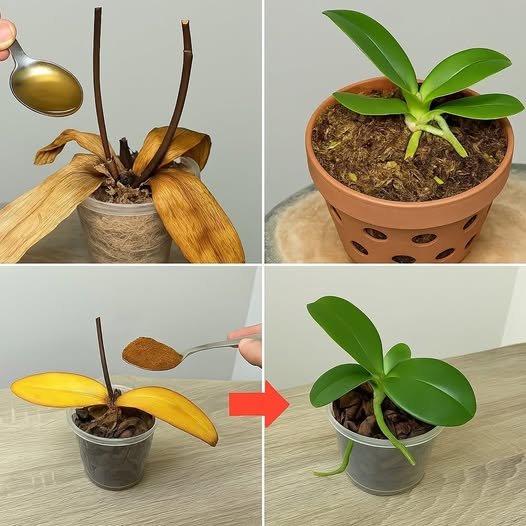
The idea that you can “sprinkle 1 spoon on dead orchid roots and the orchid will suddenly revive and bloom all year round” is a popular gardening claim, but it is not a guaranteed miracle treatment. Orchids with dead roots usually need proper diagnosis and care. However, some natural additives can help support recovery when used correctly.
First: Check if the orchid is truly dead
Before adding anything:
- Healthy orchid roots: firm, plump, green/silver, not mushy.
- Dead roots: brown/black, hollow, soft, or smell rotten.
- Dead leaves but living roots: the orchid may still recover.
- Completely dead roots and crown: recovery is unlikely.
The “1 spoon” method (often shared online)
Many viral tips recommend adding a spoon of ingredients such as:
1. Cinnamon (commonly suggested)
Cinnamon is sometimes used on cut orchid roots because it has antifungal properties.
How to use:
- Remove rotten roots with sterilized scissors.
- Let the cuts dry briefly.
- Apply a very small amount of cinnamon powder only to damaged cuts.
- Repot the orchid in fresh orchid bark.
Important: Do not sprinkle cinnamon heavily into the potting mix or onto healthy roots. Cinnamon can dry out living root tissue.
2. Rice water or nutrient powders (another common claim)
Some gardeners use diluted rice water or fertilizers to encourage growth.
A safer approach:
- Use a balanced orchid fertilizer (such as a diluted orchid feed).
- Feed only when the orchid has living roots.
- Avoid feeding a severely damaged orchid because it cannot absorb nutrients properly.
How to revive an orchid with rotten roots
Step 1: Remove damaged roots
- Take the orchid out of its pot.
- Wash away old bark.
- Cut away mushy roots using clean scissors.
Step 2: Disinfect and dry
- Allow cut areas to dry for a few hours.
- Avoid keeping wounds constantly wet.
Step 3: Repot correctly
Use:
- Orchid bark
- A small amount of sphagnum moss (optional)
- A pot with drainage holes
Avoid normal garden soil—it suffocates orchid roots.
Step 4: Provide the right environment
For recovery:
- Light: bright, indirect sunlight
- Temperature: about 65–80°F (18–27°C)
- Humidity: around 40–70%
- Water: soak only when the bark becomes mostly dry
Can an orchid bloom all year round?
No orchid normally blooms continuously all year. Many orchids (especially Phalaenopsis orchid) can bloom for several months and rebloom multiple times per year if conditions are good, but they still need rest periods.
To encourage repeated flowering:
- Give enough indirect light.
- Fertilize lightly during active growth.
- Keep roots healthy.
- Provide a slight nighttime temperature drop to encourage flower spikes.
A “one spoon miracle powder” will not replace proper root care, but a recovering orchid can often be saved with the right steps and patience.