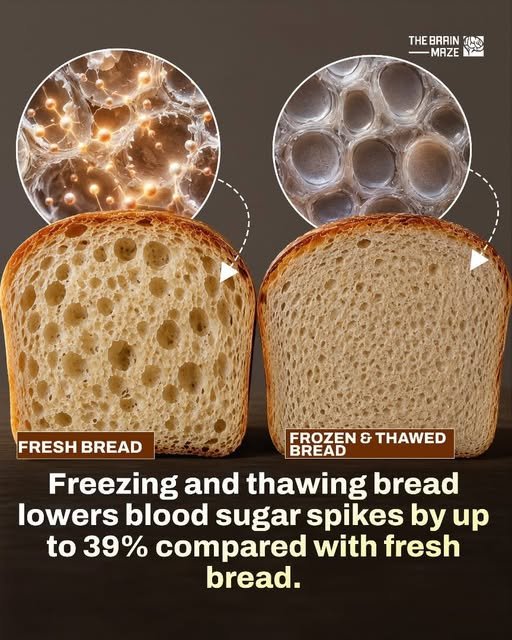
Here’s a detailed look at what the science says.
What Happens When Bread Is Frozen?
Bread is mainly made of starch, a carbohydrate consisting of two molecules:
- Amylose – a straight-chain starch
- Amylopectin – a branched starch
Freshly baked bread contains starch that is easy for digestive enzymes to break down.
When bread is frozen, the starch molecules rearrange themselves through a process called starch retrogradation. During this process:
- Some digestible starch becomes resistant starch.
- Resistant starch is harder for your body to digest.
- Less glucose is released rapidly into the bloodstream.
This change continues even after the bread is thawed.
What Is Resistant Starch?
Resistant starch is a type of carbohydrate that behaves more like dietary fibre than ordinary starch.
Instead of being digested in the small intestine, it travels to the large intestine where beneficial gut bacteria ferment it.
This produces short-chain fatty acids (SCFAs), especially butyrate, which supports colon health.
Types of Resistant Starch
Scientists classify resistant starch into five types:
| Type | Source |
|---|---|
| RS1 | Whole grains, seeds |
| RS2 | Raw potatoes, green bananas |
| RS3 | Cooked and cooled foods (bread, rice, pasta, potatoes) |
| RS4 | Chemically modified starch |
| RS5 | Amylose-fat complexes |
Freezing bread mainly increases RS3 (retrograded starch).
Does Freezing Bread Lower Blood Sugar?
Research suggests yes, to some extent.
Several studies have shown that frozen bread can produce a lower glycaemic response than fresh bread.
Why?
When resistant starch forms:
- Digestion slows down.
- Glucose enters the bloodstream more gradually.
- Insulin spikes may be smaller.
The effect varies depending on:
- Bread type
- Ingredients
- Freezing duration
- Whether the bread is toasted after thawing
What Research Shows
One well-known study published in the European Journal of Clinical Nutrition found that:
- Fresh bread produced the highest blood sugar response.
- Frozen bread reduced the glycaemic response.
- Toasted bread also reduced it.
- Bread that was frozen, thawed, and then toasted produced the lowest response among the tested methods.
The reductions were measurable but moderate, not dramatic.
How Much Resistant Starch Is Formed?
Freezing increases resistant starch, but not by a huge amount.
The exact increase depends on:
- Flour type
- Moisture
- Bread recipe
- Storage temperature
- Freezing time
Whole-grain breads generally contain slightly more resistant starch than white bread.
Is Frozen Bread Lower in Calories?
Not really.
Calories remain essentially the same.
For example:
- Fresh slice = about 90 calories
- Frozen slice = about 90 calories
Some calories become less available because resistant starch isn’t fully digested, but the overall calorie difference is very small.
Benefits of Resistant Starch
Increasing resistant starch may provide several health benefits.
1. Better Blood Sugar Control
Because resistant starch digests slowly, it may:
- Reduce blood sugar spikes
- Improve insulin sensitivity over time
- Help people with prediabetes or type 2 diabetes as part of an overall healthy diet
2. Improved Gut Health
Gut bacteria ferment resistant starch into beneficial compounds including:
- Butyrate
- Acetate
- Propionate
These compounds:
- Nourish cells lining the colon
- Help maintain the gut barrier
- Support a healthy microbiome
3. Increased Fullness
Resistant starch may increase feelings of fullness after meals.
Some studies suggest people naturally eat slightly fewer calories later in the day, though results are mixed.
4. Colon Health
Butyrate, produced during fermentation, is associated with:
- Reduced inflammation in the colon
- Improved gut function
- Support for healthy colon cells
Research is ongoing, and more evidence is needed to confirm long-term effects.
Does Toasting Frozen Bread Make It Even Better?
Research suggests that freezing followed by toasting may increase resistant starch more than freezing alone.
Heating and cooling cause repeated structural changes in starch.
This combination often results in a lower glycaemic response than eating fresh bread.
Does This Work for All Bread?
The effect varies.
White Bread
- Largest improvement
- Still relatively high in refined carbohydrates
Whole Wheat Bread
- Already contains more fibre
- Freezing provides additional resistant starch
- Often a better nutritional choice overall
Sourdough Bread
Sourdough already has a lower glycaemic index because fermentation changes its starch structure.
Freezing may offer an additional small benefit.
High-Fibre Bread
The effect is usually smaller because fibre already slows digestion.
Does It Work for Gluten-Free Bread?
Yes, but results vary depending on the starches used.
Gluten-free breads made from:
- Rice flour
- Potato starch
- Tapioca starch
may also develop resistant starch after freezing, although the amount depends on the recipe.
Does Freezing Bread Destroy Nutrients?
No.
Freezing is one of the best methods for preserving nutrients.
Vitamins and minerals remain largely unchanged.
Protein, fibre, and healthy fats are also unaffected.
Food Safety Benefits
Freezing also helps:
- Prevent mould growth
- Reduce food waste
- Extend shelf life for several months
- Preserve freshness
Bread should be thawed safely and not repeatedly frozen and thawed, as repeated cycles can affect texture and quality.
Who Might Benefit Most?
Freezing bread may be especially useful for:
- People with prediabetes
- Individuals with type 2 diabetes (as part of an overall eating plan)
- People trying to moderate blood sugar spikes
- Those looking to increase resistant starch intake
- Anyone wanting to reduce food waste
It is not a substitute for choosing nutrient-rich foods or following medical advice for diabetes management.
Practical Tips
- Freeze bread as soon as it’s fresh to preserve quality.
- Store slices separately or in a resealable freezer bag for easy use.
- Thaw at room temperature or toast directly from frozen.
- Pair bread with protein or healthy fats (such as eggs, yoghurt, peanut butter, or avocado) to further slow digestion.
- Choose whole-grain or high-fibre breads when possible for additional nutritional benefits.
Common Myths
Myth: Freezing removes gluten.
Fact: Freezing does not change the gluten content.
Myth: Frozen bread has fewer carbohydrates.
Fact: The total carbohydrate content remains essentially the same, although a small portion becomes resistant starch.
Myth: Frozen bread causes weight loss.
Fact: There is no evidence that freezing bread alone leads to weight loss.
Myth: Frozen bread is always healthier.
Fact: Freezing may modestly improve how the starch is digested, but overall nutritional quality still depends on the type of bread and the rest of your diet.
The Bottom Line
Freezing bread can make it slightly healthier by increasing the amount of resistant starch, which may reduce post-meal blood sugar spikes and support gut health. Studies suggest that freezing, thawing, and then toasting bread may produce the greatest reduction in glycaemic response compared with eating it fresh.
However, the changes are modest rather than dramatic. Freezing does not reduce the bread’s calorie, carbohydrate, gluten, vitamin, or mineral content. For the greatest health benefit, choose whole-grain or high-fibre bread, combine it with protein and healthy fats, and view freezing as one helpful strategy within an overall balanced diet rather than a standalone health intervention.