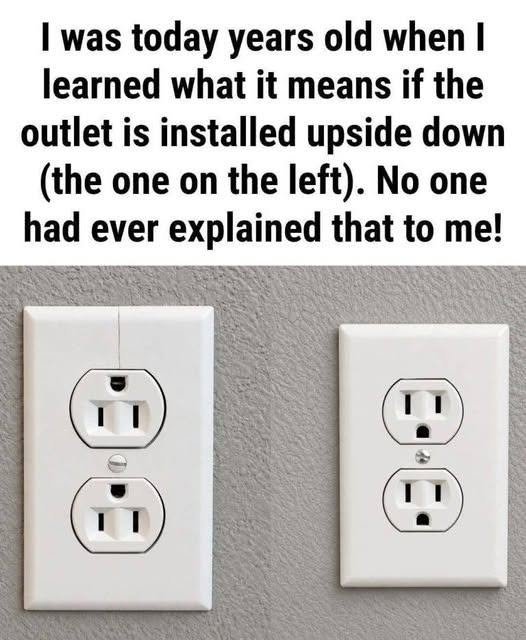
What It Really Means When an Electrical Outlet Is Installed Upside Down
Many people notice that some electrical outlets (also called receptacles) are installed with the ground slot at the top instead of the bottom and assume it was a mistake. In many cases, it is actually intentional. The “upside-down” appearance can reveal information about how the outlet was installed and why.
1. The outlet may be installed for safety reasons
A standard modern outlet has three openings:
- Small slot → Hot wire (carries electrical power)
- Large slot → Neutral wire (returns current)
- Round hole → Ground connection (safety path)
Many electricians install outlets with the ground pin facing upward because it can provide extra protection.
Why?
Imagine a plug is partly pulled out of the wall. If a metal object (such as a picture frame, tool, or loose metal item) falls behind the plug:
Ground-up orientation:
   ⏚  ← Ground pin
  | |
  | |
The metal object is more likely to touch the grounded part first, reducing the chance of contacting the energized hot and neutral blades.
Ground-down orientation:
  | |
  | |
   ⏚  ← Ground pin
A falling object could potentially bridge the two powered blades, creating a short circuit.
2. It can indicate a switched outlet
One of the most common reasons for a “flipped” outlet is that it is controlled by a wall switch.
For example:
- A living room may have a wall switch controlling a lamp plugged into the outlet.
- The electrician may install the outlet with the ground facing up to show that it is a switched receptacle.
However, this is not a universal rule. Different electricians and regions use different conventions.
3. It may show the electrician’s preference
Electrical codes generally specify how an outlet must be wired safely, but they usually do not require the ground pin to face up or down.
So an outlet installed “upside down” may simply mean:
- The electrician prefers that orientation.
- The homeowner requested it.
- It matches the installation style of the building.
- It was installed during a renovation.
4. Is an upside-down outlet dangerous?
Usually, no.
A properly wired outlet with the ground slot on top or bottom is normally safe.
The important things are:
✅ Correct wiring
✅ Secure connections
✅ Proper grounding
✅ No damaged parts
✅ Correct circuit protection
The orientation alone does not determine whether an outlet is safe.
5. How to tell if an outlet is wired incorrectly
The direction of the outlet does not tell you whether it is wired correctly. A professional or a plug-in outlet tester can check for problems.
Possible warning signs:
- Outlet feels warm
- Burning smell
- Buzzing sounds
- Sparks when plugging in devices
- Loose plug fit
- Flickering power
- Shock or tingling sensation when touching appliances
These problems require attention regardless of outlet orientation.
6. Why do hospitals often install outlets differently?
In places like hospitals, you may see unusual outlet orientations or colours.
Examples:
- Red outlets often indicate emergency power circuits.
- Different orientations may help identify special circuits.
- Equipment requirements can influence installation choices.
7. The “upside-down outlet” myth
A common internet claim says:
“If the ground is on top, the electrician made a mistake.”
That is incorrect.
An upside-down-looking outlet can be:
- A safety choice
- A switched outlet indicator
- A local installation preference
- A code-compliant design choice
It is not automatically a sign of poor workmanship.
The simple answer
If you see an outlet installed with the ground hole at the top, it usually means the electrician intentionally chose that orientation. It may improve safety in certain situations, identify a switched outlet, or simply follow a preferred installation method. The real issue is not whether it looks upside down—the real issue is whether it is wired and grounded correctly.