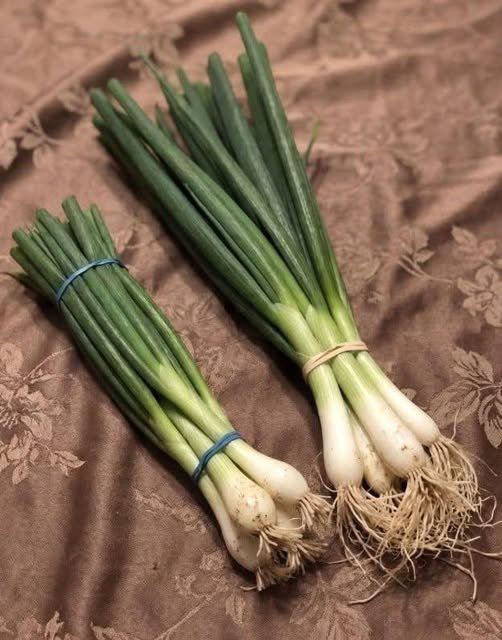
Absolutely — these names are often used interchangeably, but green onions, scallions, spring onions, and chives are not always the same thing. The biggest differences are plant variety, bulb size, flavor, texture, and how you use them in cooking.
🌱 Quick comparison
| Ingredient | Appearance | Flavor | Best use |
|---|---|---|---|
| Green onions | White base + long green stalk | Mild onion | Stir-fries, tacos, soups, eggs |
| Scallions | Usually very slender, little/no bulb | Mild, fresh onion | Garnishes, salads, Asian dishes |
| Spring onions | Noticeably round bulb + green stalk | Stronger, sweeter | Roasting, grilling, sautéing |
| Chives | Very thin, grass-like hollow stems | Delicate onion/garlic | Garnishing, eggs, potatoes, sauces |
1. Green onions 🧅
Green onion is a broad culinary name for young onions harvested before they develop a large mature bulb.
They typically look like:
white lower stalk → green upper stalk
Both parts are edible.
Flavor: Mild and slightly sweet, with more onion flavor in the white portion.
How to use:
- White part → sautéing and cooking
- Green part → garnish or finishing
- Both → soups, fried rice, noodles, eggs, tacos, salads
Example recipe: Green Onion Fried Rice
Ingredients
- 3 cups cooked cold rice
- 3–4 green onions
- 2 eggs
- 2 tbsp cooking oil
- 1 tbsp soy sauce
- ½ tsp sesame oil
- 1 garlic clove, minced
- Salt and pepper
Method
- Separate the white and green portions of the green onions.
- Slice both thinly.
- Heat oil in a wok or large skillet.
- Add the white onion portions and garlic. Cook for about 30 seconds.
- Add beaten eggs and scramble.
- Add cold rice and stir-fry for 3–4 minutes.
- Add soy sauce and sesame oil.
- Add most of the green portions.
- Toss for another minute.
- Finish with the remaining green onions.
2. Scallions 🌿
Scallion is frequently used as another name for green onion.
In many American recipes, scallion = green onion.
A typical scallion has a small, straight white base rather than a large round bulb.
Flavor: Fresh, mild, slightly peppery.
Scallions are particularly common in:
- Chinese cooking
- Korean cooking
- Japanese cooking
- Mexican food
- salads
- dips
- baked potatoes
- ramen
- fried rice
Scallion pancake
A classic example is a Chinese scallion pancake.
Ingredients
- 2 cups all-purpose flour
- ¾ cup hot water
- ½ tsp salt
- 1 cup finely sliced scallions
- 2–3 tbsp oil
Method
- Mix flour and salt.
- Gradually add hot water.
- Knead into a soft dough.
- Rest for 20–30 minutes.
- Roll dough into a thin circle.
- Brush with oil.
- Scatter generously with sliced scallions.
- Roll the dough into a cylinder.
- Coil the cylinder into a spiral.
- Flatten and roll again.
- Pan-fry over medium heat until golden and crisp on both sides.
Important: In recipes, if someone says “scallions,” you can generally substitute green onions 1:1.
3. Spring onions 🌱
This is where things get confusing.
A spring onion is generally allowed to mature longer than a typical scallion/green onion, so it develops a noticeable round or slightly elongated bulb.
It looks more like:
🧅 small bulb + long green leaves
The bulb can be white, pink, or purple depending on the variety.
Flavor: Stronger and more onion-like than scallions. The bulb can also have a pleasant sweetness.
Spring onions are excellent for:
- grilling
- roasting
- sautéing
- soups
- omelets
- frittatas
- vegetable dishes
- salsa
- salads
Simple roasted spring onions
Ingredients
- 8 spring onions
- 1½ tbsp olive oil
- ½ tsp salt
- ¼ tsp black pepper
- 1 tsp lemon juice
- Optional: Parmesan or feta
Method
- Cut off the roots.
- Wash thoroughly, especially around the bulb.
- Leave the green stalks attached.
- Toss with olive oil, salt, and pepper.
- Roast at 425°F / 220°C for about 15–20 minutes.
- Remove when the bulbs are tender and lightly browned.
- Finish with lemon juice.
The larger bulb becomes sweet and caramelized.
4. Chives 🌿
Chives are a different plant.
They aren’t simply tiny green onions.
They grow as very thin, hollow, grass-like stems and have a much more delicate onion flavor.
They’re generally used as an herb, rather than as a major vegetable.
Flavor: Mild, delicate onion with a slightly garlicky character.
Best uses
Chives are fantastic with:
- scrambled eggs
- omelets
- baked potatoes
- sour cream
- cream cheese
- soups
- butter
- fish
- chicken
- creamy sauces
Chive butter
Ingredients
- ½ cup softened unsalted butter
- 2 tbsp finely chopped chives
- 1 tsp lemon juice
- Pinch of salt
Mix everything together and refrigerate.
Use it on:
- baked potatoes
- steak
- grilled vegetables
- corn
- bread
- fish
🧅 The easiest way to remember
Think of them as four different levels:
Chives → 🌿 herb
Very thin, delicate, mostly used as a garnish.
Scallions / green onions → 🌱 young onion
Long green leaves + small/straight white base. Great for everyday cooking.
Spring onions → 🧅🌿 more mature young onion
Has a noticeable bulb and stronger flavor.
Mature onion → 🧅 full-size onion
Much stronger and more substantial.
Can you substitute them?
Green onion ↔ scallion
Yes, almost always 1:1.
If a recipe says:
3 scallions
You can use:
3 green onions
No major adjustment needed.
Green onion ↔ spring onion
Usually yes, but flavor changes.
If a recipe calls for 3 green onions and you use spring onions, use roughly the same amount, but expect a stronger onion flavor.
If the recipe is primarily using the bulb, spring onions can actually be preferable.
Green onion ↔ chives
Not a perfect substitution.
Chives are much more delicate.
For example:
1 green onion ≠ 1 chive
If you’re making soup or fried rice, chives won’t provide the same onion flavor or texture.
But for garnishing, they’re interchangeable in many dishes.
Chives ↔ scallions
For a garnish, yes.
For cooking, not necessarily.
For example, if you’re making scrambled eggs:
- chives → delicate, elegant onion flavor
- scallions → stronger, crunchier, more substantial onion flavor
Both work, but they create different results.
👩🍳 Which part should you use?
Green onions / scallions
White part:
- stir-fry
- soups
- sauces
- marinades
- fried rice
Green part:
- garnish
- salads
- noodles
- tacos
- eggs
Both:
- almost anything!
Spring onions
Bulb:
- roast
- grill
- sauté
- pickle
Green stalk:
- garnish
- soups
- stir-fries
- salads
Chives
Usually chop the entire green stem and add toward the end.
Don’t cook chives aggressively for a long time—their delicate flavor is easily lost.
🥢 A practical cooking example
Suppose you’re making potato soup.
Using chives:
Add finely chopped chives at the end.
Result: delicate onion aroma and pretty green garnish.
Using scallions:
Sauté the white portion with the onion/garlic, then add the green portion at the end.
Result: noticeably oniony and savory.
Using spring onions:
Sauté the bulb with the other vegetables.
Result: sweeter, deeper onion flavor.
Using green onions:
Use exactly like scallions.
Result: mild, fresh onion flavor.
One important regional difference
The terminology isn’t completely standardized.
In the United States, green onion and scallion are commonly treated as synonyms.
In the UK and some other countries, spring onion can refer to what Americans call green onions/scallions—even when there isn’t a large bulb.
So when following a recipe, look at the picture and description rather than relying only on the name. The same vegetable can have different names in different countries.