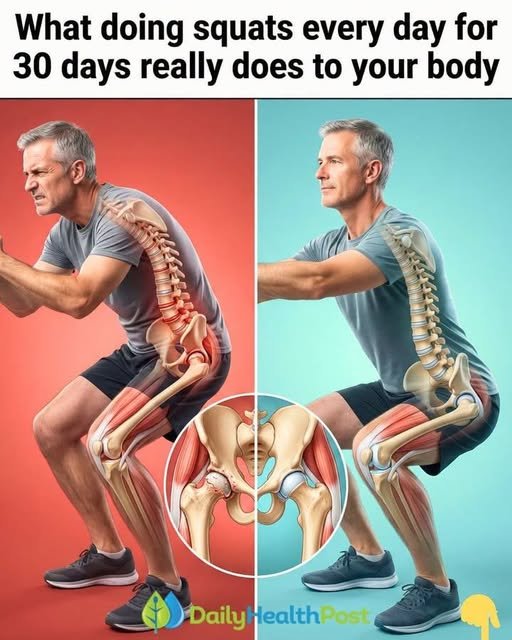
I found a few relevant sources, including current research on resistance training in older adults. The key distinction is between using squats as a daily movement/mobility habit and treating five minutes of squats as a complete fitness program.
What a 5-minute squat routine can actually do
Squats train several things at once:
- Quadriceps and glutes: important for getting out of chairs, climbing stairs and walking.
- Hip and ankle mobility: repeatedly moving through a comfortable squat range can help you maintain usable movement.
- Balance and coordination: especially when performed slowly and with good control.
- Functional strength: the squat resembles everyday movements such as sitting down and standing up.
Research is quite encouraging about resistance exercise in older adults generally. A 2026 systematic review of 92 studies involving almost 6,000 older adults found substantial improvements in strength and moderate improvements in several walking and functional measures. Multi-joint lower-body exercises such as squats were among the approaches associated with better results.
Another meta-analysis found that resistance training improved sit-to-stand performance and overall physical-performance scores in frail and pre-frail older adults.
But there’s an important catch
Five minutes of squats isn’t necessarily enough to build substantial strength.
Your muscles adapt to the challenge you give them. If you can comfortably perform dozens of bodyweight squats without getting particularly tired, eventually you need to increase the challenge — for example by:
- increasing resistance,
- slowing the lowering phase,
- increasing range of motion where appropriate,
- using more demanding variations, or
- progressively increasing the training volume.
The U.S. Physical Activity Guidelines recommend that older adults perform muscle-strengthening activity at least twice a week, involving all the major muscle groups. They also recommend incorporating balance and aerobic activity.
So I’d think of the five-minute squat habit as an excellent starting point or supplement, rather than the whole program.
A safer 5-minute version
Rather than immediately trying to hold a deep squat for five continuous minutes, I’d make it more functional:
Minute 1 — Warm-up
March in place, gently circle the hips and ankles, and do a few easy sit-to-stands.
Minutes 2–3 — Controlled squats
Do 6–10 comfortable squats.
Use a chair behind you if you’re unsure of your balance. Lower slowly, lightly touch the chair if necessary, then stand.
Minute 4 — Sit-to-stands
From a sturdy chair, stand up and sit down repeatedly at a controlled pace.
This is particularly useful because it directly trains a movement needed in everyday life.
Minute 5 — Mobility
Finish with gentle ankle and hip movements rather than forcing yourself into a deeper squat.
A published 5-minute mobility routine similarly recommends combining several movements rather than spending the entire five minutes in one position.
What I’d expect after several weeks
If someone currently doesn’t exercise much, they might notice:
- stairs feel easier,
- getting up from a sofa or chair feels easier,
- better confidence with bending down,
- improved squat depth,
- less stiffness after sitting,
- better leg endurance.
Those are realistic goals.
What I wouldn’t promise is that five minutes a day will dramatically reshape the body, eliminate knee pain, prevent falls by itself, or replace a proper strength program.
In fact, research on home-based resistance exercise suggests that it can improve lower-body strength and sit-to-stand power, but the benefits don’t automatically extend to every measure of fitness or fall prevention.
And don’t chase the deepest squat
This is particularly important for people over 50.
You don’t need to force your hips down to your heels to make squats “count.” A comfortable, controlled range is preferable to repeatedly forcing a painful position.
If you have sharp knee/hip/back pain, significant balance problems, recent surgery, or an existing musculoskeletal condition, it’s better to have a physiotherapist assess you and modify the movement rather than pushing through it. WHO guidance also recommends individualized exercise and professional input for older people with significant physical limitations.
Bottom line: the social-media squat challenge isn’t magic, but the underlying idea is good. Five minutes of consistent, controlled movement is far better than doing nothing, and it can be a very effective doorway into strength and mobility training. The biggest gains come when that habit eventually develops into progressive strength work plus walking/aerobic and balance exercises. Current U.S. guidance specifically emphasizes that combination.
If you want, I can also give you a specific 30-day, 5-minutes-a-day squat challenge for people over 50, progressing from chair squats to stronger variations without overloading the knees.