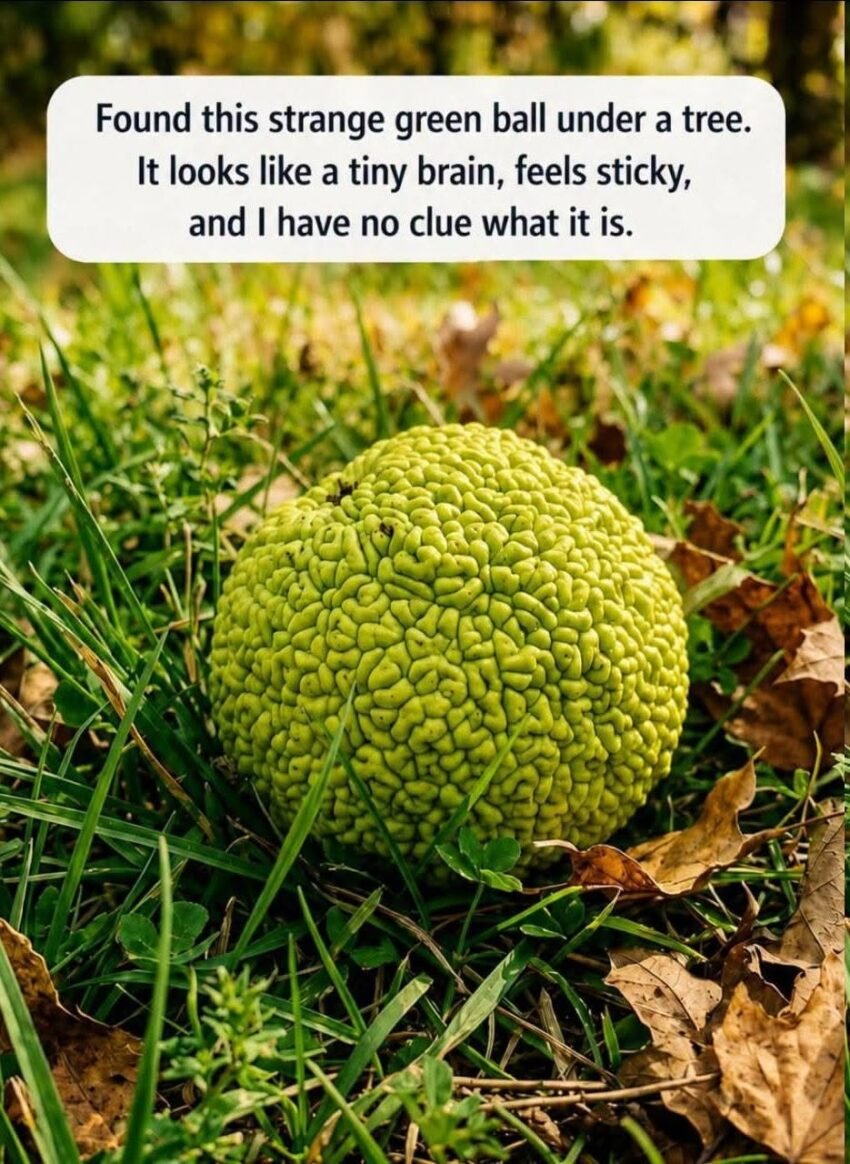
I Found a Weird Green “Brain” in the Yard… Turns Out It’s a Real Thing
If you ever walk outside in the fall and discover a strange, bright-green object lying in the grass, you might do a double take.
It can look uncannily like a brain—complete with deep folds, ridges, and an almost alien texture.
But before you assume something bizarre has landed in your yard, there’s a surprisingly ordinary explanation: you may have found an Osage orange.
Also called a hedge apple, horse apple, bois d’arc, or even a “monkey brain,” the Osage orange is the unusual fruit of the Osage-orange tree, scientifically known as Maclura pomifera. Its distinctive appearance has made it one of nature’s strangest-looking fruits.
So, What Exactly Is This Green “Brain”?
Despite its name, an Osage orange isn’t actually an orange—and it isn’t related to the citrus fruit in any close way.
The tree belongs to the mulberry and fig family. Female trees produce the peculiar round fruits, which are typically several inches across and have a bumpy, tightly packed surface that gives them their unmistakable brain-like appearance.
When the fruit falls from the tree, it can look almost surreal sitting among ordinary leaves and grass.
That is why people encountering one for the first time often wonder whether they’ve discovered some kind of fungus, animal remains, or even an exotic plant.
They’re actually looking at a fruit.
Why Does It Look Like a Brain?
The strange appearance comes from the way the fruit develops.
An Osage orange isn’t simply one smooth fruit with a peel. Instead, it is made up of many tightly packed components that create the convoluted surface. The resulting pattern of grooves and bumps resembles the folds and valleys of a human brain.
That resemblance has inspired colorful nicknames such as “green brain” and “monkey brain.”
And unlike many familiar fruits, an Osage orange feels surprisingly solid and heavy for its size.
Where Do These Trees Come From?
Osage oranges are native to parts of the central and southern United States.
The trees became particularly valuable because of their dense wood, formidable thorns, and ability to form thick hedges. Before widespread use of modern fencing, farmers planted them as living fences and property boundaries.
Their thorny branches could create an effective barrier for livestock.
That history explains another common name: hedge apple.
Some old Osage-orange plantings have survived long after the original farms and fences disappeared. Historic trees can therefore turn up in unexpected places, including parks, older neighborhoods, roadsides, and yards.
Is It Actually an Orange?
Nope.
Despite the name “Osage orange,” the fruit isn’t a citrus orange at all. The name is largely a reference to its appearance and its historical association with the Osage people and the region where the tree is native.
The scientific name, Maclura pomifera, gives a better clue to its botanical identity.
So if you find one beneath a tree, don’t expect it to taste like the orange you’d put in your breakfast bowl.
Can You Eat It?
This is where things get a little complicated.
Osage-orange fruits aren’t considered a typical edible fruit, and their texture, large seeds, and unpleasant taste make them a poor choice for eating. The milky sap can also be irritating to some people.
In other words, finding one in your yard isn’t an invitation to make a smoothie.
It’s better appreciated as one of the stranger examples of plant biology.
Do They Really Keep Bugs Away?
You’ve probably heard the old claim that putting hedge apples around a house will repel insects.
The idea has been repeated for generations, and people have tried using the fruits as a natural pest deterrent. However, the evidence that simply placing Osage oranges around a room or home provides meaningful insect control is weak.
In fact, decomposing fruit can attract insects rather than magically keeping them away. One experimenter famously discovered that an old hedge apple had become home to fruit-fly larvae.
So while the fruits have an interesting history in folk pest-control remedies, they’re not a substitute for proven methods of controlling insects.
What Should You Do If You Find One?
If you discover a green “brain” in your yard, the simplest explanation is often the right one: look up and see whether there’s an Osage-orange tree nearby.
The fruit usually gives away its source.
If several identical green spheres are scattered beneath a large tree, you’ve probably solved the mystery.
You can pick one up with care, admire its bizarre appearance, and move it somewhere out of the way. If you’re unsure what you’ve found, however, don’t eat it based solely on its appearance.
And if there isn’t an Osage-orange tree nearby, identification can be more complicated. Other plants, fungi, and natural objects can look surprisingly brain-like.
Nature’s Strangest Surprise
The next time you see something that looks like a green brain sitting in someone’s yard, don’t assume it’s something from a science-fiction movie.
It may simply be an Osage orange—a strange but completely real fruit that has been fascinating people for generations.
There’s something wonderfully odd about it: a tree that can grow into a thorny living fence, produce fruit that looks like a brain, and leave those bizarre green objects scattered across the ground when autumn arrives.
Nature doesn’t always need to look familiar to be perfectly normal.
Sometimes, the strangest thing in the yard is simply a fruit doing exactly what fruits do.