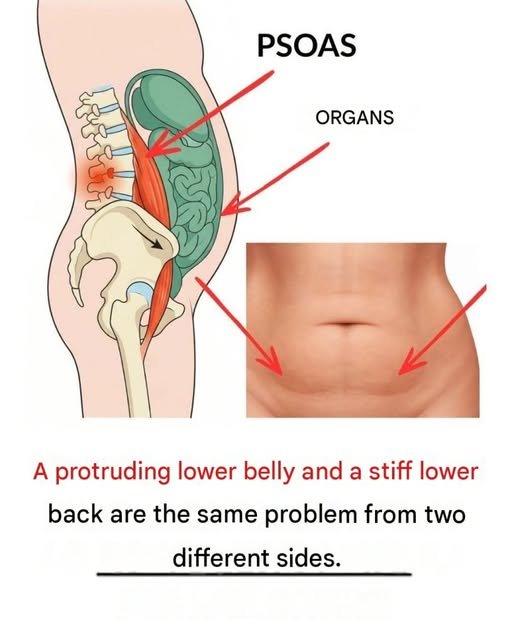
A protruding lower belly combined with a stiff or achy lower back is sometimes attributed to a “tight psoas.” There can be a connection, but the popular explanation that “a tight psoas causes your belly to stick out” is much too simplistic. The psoas is one part of a larger system involving the pelvis, spine, abdominal wall, diaphragm, hip muscles, and breathing mechanics.
What exactly is the psoas?
You have a psoas major on each side of your lumbar spine. It begins along the lower spine, travels through the pelvis, and attaches near the upper femur. Together with the iliacus, it forms the iliopsoas, one of the body’s major hip-flexor groups.
Its major jobs include:
- Flexing the hip—bringing your thigh toward your torso.
- Helping stabilize the lumbar spine.
- Assisting with movements such as walking, running, climbing stairs and rising from a chair.
- Helping maintain stability between the spine and hip during movement.
Because it attaches directly to the lumbar spine, the psoas is unusually well positioned to influence how the hip and lower back interact.
How could the psoas relate to a protruding belly?
Consider what happens when the pelvis rotates forward.
A person with an anteriorly tilted pelvis may have:
- The front of the pelvis sitting lower than the back.
- Increased curvature of the lower spine in some individuals.
- The abdomen appearing more prominent from the side.
- The buttocks appearing more prominent.
- Increased tension or stiffness around the hips and lower back.
This can create the visual impression of a “lower belly” even when the amount of abdominal fat hasn’t changed.
However, a protruding abdomen does not automatically mean anterior pelvic tilt, and anterior pelvic tilt does not automatically mean a tight psoas.
Research is particularly important here. A 2024 systematic review found that pelvic tilt tends to be somewhat greater among people with low-back pain, but the researchers emphasized substantial variation between studies and said firm causal conclusions cannot be made.
An earlier systematic review likewise concluded that there is no established causal evidence that excessive anterior pelvic tilt itself causes low-back pain.
So the better model is:
psoas + hip muscles + abdominal muscles + glutes + spinal muscles + pelvic position + individual anatomy
rather than:
tight psoas → protruding belly.
Why might the lower back feel stiff?
The psoas can become active for prolonged periods when you’re repeatedly maintaining hip flexion—for example, during prolonged sitting.
When you sit, the hip remains flexed, and the iliopsoas contributes to hip positioning and lumbar/hip stabilization.
When you then stand, walk or exercise, the relationship between the hip and lumbar spine has to change.
If several structures around the hip and pelvis are stiff or poorly coordinated, you might experience:
- Tightness in the front of the hip.
- A sensation of pulling around the lower back.
- Difficulty fully extending the hip.
- Stiffness when first standing after sitting.
- Achiness after prolonged sitting.
- A feeling that you have to arch your lower back to stand comfortably.
But these symptoms aren’t specific to the psoas. Hip-joint problems, spinal joints, discs, abdominal muscles, gluteal muscles, hamstrings and other structures can produce overlapping symptoms.
The “tight psoas” explanation is often overstated
You may encounter claims that a chronically shortened psoas:
pulls the pelvis forward, increases lumbar lordosis, pushes the abdomen outward, compresses the spine and causes back pain.
Some of these mechanical relationships are plausible, but they shouldn’t be treated as a universal diagnosis.
In fact, research on posture and low-back pain is considerably more complicated. One systematic review of 43 studies found that people with low-back pain generally had reduced lumbar range of motion, but it did not find consistent differences in standing pelvic tilt or lumbar lordosis.
That means someone can have a visibly arched back or protruding belly and have no significant pain—and someone else can have significant back pain without an obvious postural abnormality.
What else can make the lower belly protrude?
This is an important distinction.
A protruding lower abdomen can result from many things, including:
1. Abdominal fat
Subcutaneous fat around the lower abdomen can make the belly protrude regardless of pelvic position.
2. Visceral fat
Fat around the abdominal organs can produce a more generalized abdominal protrusion.
3. Relaxed abdominal muscles
The abdominal wall doesn’t need to be “weak” in a medical sense for the abdomen to project forward when standing.
4. Pelvic position
Anterior pelvic rotation can change the appearance of the abdomen and lumbar curve.
5. Rib-cage position and breathing
The position of the ribs, diaphragm and abdominal wall can substantially change how the abdomen appears.
6. Hip-flexor stiffness
The iliopsoas and other hip flexors may contribute to limited hip extension and altered movement.
7. Normal body structure
People naturally have different pelvic shapes, spinal curves, abdominal proportions and distributions of body fat.
8. Abdominal bloating or gastrointestinal causes
A belly that changes substantially throughout the day is a different situation from a stable postural protrusion.
9. Pregnancy, hernia or other medical conditions
A new, unusual or rapidly increasing abdominal protrusion shouldn’t automatically be diagnosed as a muscular/postural problem.
What about anterior pelvic tilt?
Imagine your pelvis as a bowl.
With a relatively neutral position, the bowl is neither excessively tipped forward nor backward.
With anterior pelvic tilt, the front of the bowl rotates downward and the back rotates upward.
This may make the lower back look more curved and the abdomen appear farther forward.
But some degree of anterior pelvic tilt is normal. There isn’t one universally “perfect” pelvic position.
And importantly, trying to force your pelvis into a perfectly neutral position all day isn’t necessarily the solution. The human body constantly moves through different positions.
Is stretching the psoas the answer?
Not necessarily.
This is where many online “psoas release” programs oversimplify things.
A systematic review examining stretching and strengthening interventions found that stretching did not consistently change spinal/lumbopelvic posture. Strengthening showed more promising effects overall, although the benefits were not consistently demonstrated specifically in the lumbar/lumbopelvic region.
Another systematic review specifically examining excessive anterior pelvic tilt found that the available evidence for nonsurgical interventions was very limited and of very low certainty.
So instead of thinking:
“I need to stretch my psoas.”
a better question is:
“What is limiting my hip and trunk movement, and how can I improve my overall movement capacity?”
What may be more useful than simply stretching
For someone with a protruding abdomen and stiff lower back, a comprehensive approach can include:
Hip-flexor mobility
Gentle hip-extension movements can be useful if hip extension is genuinely limited.
A common example is a half-kneeling hip-flexor stretch.
The important detail is not to compensate by excessively arching the lower back. Think about gently bringing the pelvis into a more neutral position while moving the hip forward.
Glute strengthening
The gluteus maximus contributes significantly to hip extension.
Exercises such as:
- Glute bridges
- Hip hinges
- Step-ups
- Split squats
- Squats, when appropriate
can help develop hip strength and control.
Abdominal/trunk strengthening
Rather than constantly “pulling the stomach in,” learn to produce controlled trunk tension while breathing normally.
Examples include:
- Dead bugs
- Bird dogs
- Side planks
- Modified planks
- Pallof presses
The goal isn’t to flatten your stomach at all times. It’s to improve your ability to control your trunk while your hips and spine move.
Improve hip extension
If you spend much of the day sitting, gradually increasing your ability to extend the hip during walking and exercise may be useful.
Don’t neglect movement variety
Standing perfectly upright for hours isn’t necessarily better than sitting.
The more useful goal is usually regular movement and the ability to comfortably move through different positions.
A simple self-check
You can perform a basic observation at home, although it isn’t a diagnosis.
Stand sideways in a relaxed position and look at:
- Your rib cage.
- Your pelvis.
- Your lower-back curve.
- Your abdomen.
- Your knees.
- Your feet.
Then take a few normal breaths.
Don’t deliberately suck your stomach in or push your chest up.
Now try gently rotating your pelvis backward and forward.
If your abdominal appearance changes considerably when you change pelvic position, posture is probably contributing to some degree to the visual appearance.
But that still doesn’t prove that your psoas is tight.
A physical therapist can assess hip extension, lumbar movement, pelvic control, strength, mobility and movement patterns much more reliably.
One particularly important clue
Pay attention to what happens when you walk.
If you can comfortably stand upright but experience:
- a feeling of being pulled forward,
- difficulty extending one or both hips,
- tightness at the front of the hips,
- lower-back stiffness after sitting,
- improvement after moving around,
then hip-flexor/hip-extension mechanics may be worth investigating.
If, instead, the abdomen is persistently enlarged regardless of posture and you have digestive symptoms, weight changes, pain, or a new localized bulge, the explanation may have little or nothing to do with the psoas.
What not to do
I wouldn’t recommend aggressively digging into the abdomen with a massage ball or having someone perform forceful “psoas release.”
The psoas lies deep within the body, near important nerves and abdominal/pelvic structures. You don’t need painful pressure to improve hip mobility.
Likewise, don’t assume that severe back stiffness means the psoas needs to be “released.”
Pain and stiffness can come from many different structures.
When you should get evaluated
Seek medical evaluation rather than treating this as a simple muscle imbalance if you have back pain accompanied by things such as:
- New or progressive leg weakness.
- Significant numbness.
- Numbness around the groin/saddle region.
- New difficulty controlling urination or bowel movements.
- Severe or rapidly worsening pain.
- Fever or feeling systemically unwell.
- Unexplained weight loss.
- Significant trauma.
- A new abdominal lump or bulge that is painful or doesn’t behave like ordinary abdominal tissue.
The bottom line
The psoas can be part of the picture, because it connects the lumbar spine to the hip and participates in hip movement and spinal stabilization.
But a protruding lower belly plus a stiff lower back doesn’t prove that you have a tight psoas.
A more scientifically defensible way to think about it is:
Protruding belly
↓
may be influenced by body composition, abdominal-wall behavior, breathing, pelvic position and anatomy
Anterior pelvic position
↓
may influence the appearance and mechanics of the lower back and abdomen
Psoas/iliopsoas
↓
can influence hip and lumbar mechanics
Low-back stiffness/pain
↓
can arise from many different tissues and movement patterns
The most useful treatment is therefore usually not “release the psoas,” but assess the whole hip–pelvis–spine system and progressively improve mobility, strength, coordination and tolerance to movement. The research supports taking an individualized approach rather than assuming that one postural abnormality or one muscle is responsible.
If you tell me whether your main goal is (1) flattening the lower belly, (2) reducing lower-back stiffness, or (3) correcting anterior pelvic tilt, I can give you a detailed 10–15 minute daily psoas/hip/core routine, including exactly how to perform each exercise and what mistakes to avoid.