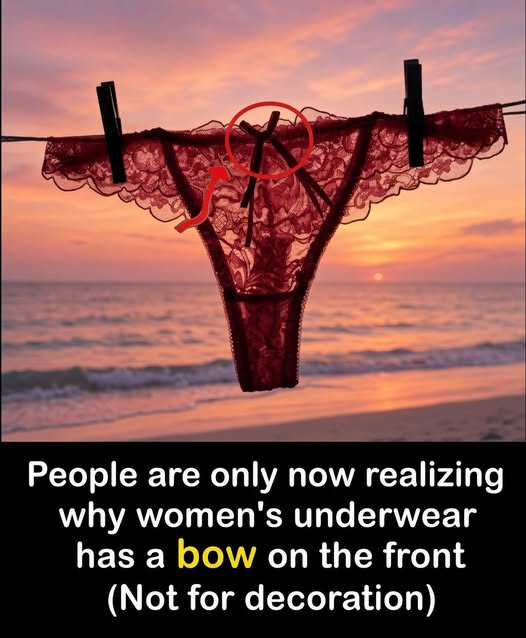
Why Do Women’s Underwear Often Have a Tiny Bow on the Front?
Have you ever noticed the tiny bow sewn onto the front of many pairs of women’s underwear and wondered why it is there?
At first glance, it seems like nothing more than a cute decorative detail. But the little bow may have a connection to an older style of underwear—although the popular explanation for its origin is more complicated than many viral articles suggest.
A practical purpose before elastic
Modern underwear usually stays in place with an elastic waistband. But elastic was not always a standard feature of clothing.
Earlier undergarments could use drawstrings or ribbons to adjust the waistband. A ribbon could be threaded through openings or eyelets near the top of the garment and then pulled tight to secure the underwear. The ends could be tied together at the front, sometimes forming a bow.
That makes the modern bow an appealing candidate for a surviving decorative reminder of an older fastening method.
However, there is an important caveat: there isn’t strong historical evidence proving that today’s tiny sewn-on bows directly evolved from those particular drawstring knots. The drawstring explanation is widely repeated, but historians and historical sources don’t establish it as a definitive origin. IFLScience, for example, notes that the theory is plausible but that evidence supporting the specific claim is limited.
Why was the tie placed at the front?
If an undergarment was secured with a ribbon, the front would have been a convenient place to tie it. It was easier to reach and adjust than a fastening positioned at the back.
Over time, as elastic waistbands became common, the practical need for such a tie disappeared. Yet familiar design features have a way of surviving even after their original function has vanished.
The little bow could therefore have continued as a visual tradition—a reminder of older underwear construction rather than a functional fastening.
It can also help identify the front
There is another simple explanation for why a bow is placed at the center front: it makes the orientation of the garment obvious.
Underwear can look surprisingly symmetrical. A small bow gives the wearer an immediate visual or tactile indication of which side is the front. This could have been particularly convenient when getting dressed in poor lighting. The idea is frequently mentioned alongside the drawstring explanation.
Today, of course, manufacturers can use printed labels, seams, cuts, tags, or other design features to indicate the front. The bow isn’t necessary for this purpose.
So why do bows still appear today?
The simplest answer is: because they look nice.
Once the bow stopped having a practical purpose, it could remain as a decorative element. Small bows fit the traditional visual language of lingerie, alongside lace, embroidery, satin, scalloped edges, and other ornamental details.
Modern underwear certainly doesn’t require a bow. Plenty of designs don’t have one at all. But the detail has become associated with femininity and traditional lingerie aesthetics, so designers continue to use it.
In other words, today’s bow is generally decorative rather than functional.
The interesting part: fashion keeps old technology alive
This isn’t unusual in clothing.
Fashion frequently preserves features long after their original practical purpose has disappeared. A design can start as a functional solution and eventually become a purely decorative tradition.
The bow on women’s underwear may be an example of exactly that phenomenon—or it may simply have become popular because designers and customers liked the appearance.
That’s why it’s better to say the bow may be a historical remnant of ribbon-tied underwear, rather than confidently claiming that every modern underwear bow directly descends from an old drawstring.
What about the idea that women needed it because they dressed in the dark?
You’ve probably seen another explanation online: women supposedly needed the bow to identify the front of their underwear while getting dressed by candlelight before electricity.
There’s a kernel of practicality behind this idea, but it shouldn’t be presented as a proven historical reason for the bow. Historical clothing practices varied enormously, and there isn’t compelling evidence showing that manufacturers originally added underwear bows specifically for this purpose. The explanation is better understood as a plausible secondary benefit than an established origin story.
The bottom line
That tiny bow probably doesn’t have a single, perfectly documented origin.
The popular historical theory is that it recalls the ribbons or drawstrings once used to secure undergarments before elastic became widespread. The front position would have made the fastening easy to reach, and a bow could also make the front of the garment easy to identify.
But the evidence for a direct historical connection is limited. What we can say with much more confidence is that modern bows are primarily decorative. They have survived because they became part of the visual tradition of women’s lingerie.
So the next time you see that tiny bow, you’re looking at a small example of how old practical clothing features can survive as modern fashion details—even after the original problem they solved has disappeared.