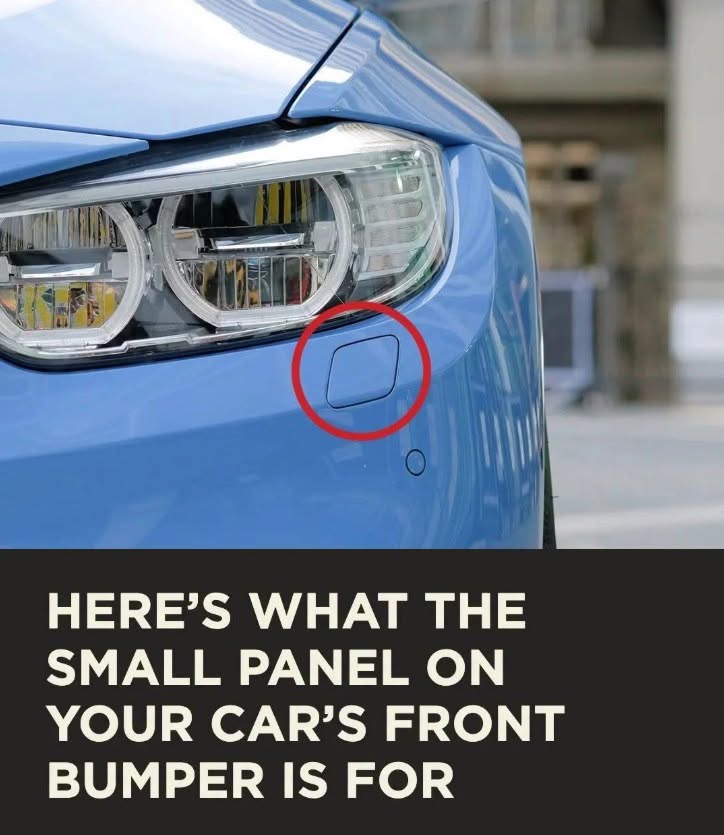
What Is That Small Panel on Your Car’s Front Bumper? The Hidden Feature Every Driver Should Know About


Have you ever noticed a small rectangular or circular panel on the front bumper of your car and wondered what it is for? It might look like a decorative piece of plastic, a removable trim panel, or a minor detail in the car’s design.
In many vehicles, that little panel covers the front towing-eye attachment point. It is a practical feature that can be important if your car breaks down, gets stuck, or needs to be recovered by a tow truck.
However, not every small panel on a bumper serves the same purpose. Depending on the vehicle, it could also cover a radar sensor, a headlamp-washer nozzle, or an access point for another component.
Here’s how to identify it, how it works, when you might need it, and what every driver should know before trying to remove it.
1. The most common purpose: a hidden towing hook


On many modern cars, the small bumper panel is a tow-hook cover, also called a towing-eye cover or recovery-point cover.
Automakers often hide the towing attachment behind a panel to keep the bumper looking smooth and attractive while protecting the attachment point from dirt, moisture, and road debris.
How does it work?
Behind the cover, many vehicles have a reinforced threaded socket designed to accept a removable metal towing eye. The towing eye is often supplied with the vehicle’s spare tire tools or stored in a compartment in the trunk.
When the vehicle needs to be towed or recovered, the process generally works as follows:
-
Locate the cover. Look for a small rectangular, square, or round panel on the front bumper.
-
Remove the cover carefully. Use the removal method specified in your owner’s manual. Some covers have a small notch; others require a particular technique.
-
Find the attachment socket. Behind the cover, you may see a threaded opening.
-
Install the towing eye. Screw the correct towing eye into the socket as instructed by the manufacturer, ensuring it is properly seated.
-
Attach the towing equipment. A trained operator connects the appropriate equipment to the designated towing point and follows the vehicle’s towing instructions.
The cover itself is not a towing device. The actual attachment point is behind it.
Important: A towing eye is not necessarily suitable for every kind of recovery. Pulling a vehicle out of deep mud, snow, or a ditch can create substantially different forces from towing it slowly on a road. Use only approved attachment points and equipment.
2. Why is the towing point hidden behind a plastic panel?

There are several reasons automakers conceal the towing point rather than leaving a metal hook permanently attached to the front of the car.
-
Cleaner appearance: A small, body-colored cover helps the bumper maintain a smooth, uninterrupted design.
-
Protection from the elements: The panel helps keep water, road salt, mud, dust, and debris away from the attachment socket.
-
Reduced protrusions: A removable cover avoids leaving a metal towing eye sticking out when it isn’t needed.
-
Convenient access: The driver or recovery operator can access the designated attachment point when necessary.
Automotive manufacturers sell these parts specifically as tow-eye access covers. For example, Ford and Chevrolet describe their bumper covers as concealing the towing-eye opening while preserving the bumper’s finished appearance.
3. Not every bumper panel is a towing-hook cover
This is where many drivers get confused. Several components can look similar from the outside, but their functions are completely different.

A. Tow-hook cover
Common identification
Usually a flush, body-colored rectangular or circular panel. Behind it is often a threaded socket for a removable towing eye.

B. Parking sensors
These are typically small, round discs fitted flush into the bumper. They detect nearby obstacles and may trigger audible alerts or distance displays when parking.

C. Headlamp-washer cover
Often positioned near the headlights. On equipped vehicles, the cover conceals a washer nozzle that extends to spray cleaning fluid onto the headlamp.

D. Radar or driver-assistance sensor area
Some vehicles place radar behind the grille or bumper fascia. This hardware supports systems such as adaptive cruise control and automatic emergency braking. Its location varies by model.
Vehicle sensor layouts differ, and radar can be mounted behind the grille or in other parts of the front bumper.

A useful rule: If the panel is a distinct, flush-fitting piece of painted plastic, it may be a tow-eye cover or washer cover. If you see several tiny circular discs distributed across the bumper, they are more likely parking sensors. Shape alone is not enough to confirm the purpose.
4. When might you actually need the hidden towing point?


You might need the designated front towing point in several situations.
A. Your car breaks down
If the engine stops working, the vehicle develops a serious mechanical problem, or it cannot safely continue driving, a recovery operator may use the designated towing point to guide it onto a flatbed truck.
B. Your car is stuck in a difficult position
A vehicle may need to be repositioned after becoming stuck on a slippery surface or being unable to move under its own power. Whether the front towing eye is appropriate depends on the recovery method and the manufacturer’s instructions.
C. Your vehicle must be moved a short distance
Some vehicles permit limited emergency towing using a specified towing eye. Others require a flatbed or have restrictions related to the transmission, drivetrain, or electric powertrain.
D. Your car needs to be secured during transport
Certain towing eyes or attachment points can also be used for vehicle loading or transport tie-downs, but a transport tie-down point and a recovery point are not automatically interchangeable.
The owner’s manual determines the permitted use. Toyota’s published owner documentation, for instance, describes emergency towing through a specified towing eye and warns against inappropriate towing methods.

5. How to open the panel without damaging your bumper

If you’re curious about what is behind the panel, don’t immediately pry it open with a screwdriver.
Follow these steps:
-
Check your owner’s manual. Look under terms such as “towing eye,” “emergency towing,” “recovery point,” or “tow-hook cover.”
-
Inspect the edges. Some covers have a small notch or release point. Others use a press-and-pull mechanism.
-
Use the specified release method. If the manual permits prying, a suitable plastic trim tool is generally less likely to scratch the paint than a metal screwdriver.
-
Stop if it resists. Some panels have hidden clips, unusual release mechanisms, or electrical connections. Don’t force them.
-
Reinstall the cover correctly. If you remove it for inspection, ensure it clips back into place without leaving gaps.
Not all covers open in the same direction, and some electric vehicles have special procedures. For example, certain vehicles incorporate electrical terminals or other emergency-access components behind panels that might initially resemble tow-eye covers.
6. Important safety mistakes to avoid
The hidden towing point can be useful, but using it incorrectly can damage your vehicle or injure someone.
-
Never attach a tow strap to an arbitrary part of the bumper. The plastic bumper fascia is not designed to withstand the loads of vehicle recovery.
-
Don’t assume the towing eye is designed for heavy pulling. A sudden, forceful pull can overload the eye, socket, or mounting structure.
-
Avoid sharp sideways pulls. Follow the manufacturer’s permitted pulling direction and recovery instructions.
-
Don’t assume every vehicle can be towed with its wheels on the road. Automatic transmissions, all-wheel-drive systems, hybrids, and electric vehicles may have specific towing restrictions.
-
Don’t crawl beneath a vehicle to locate the attachment point while it is inadequately supported.
-
Don’t use an improvised tool to force the cover open. You could damage the paint, clips, or nearby components.
If the car is stranded in traffic or an unsafe location, prioritize personal safety and contact roadside assistance rather than attempting a recovery yourself.
7. What if the little panel is missing?
A missing tow-hook cover is usually a relatively minor issue, but it is worth addressing.
Common reasons include:
-
The panel came loose after a minor impact.
-
The retaining clips broke during removal.
-
The cover wasn’t reinstalled properly after towing.
-
Road vibration or an earlier repair left it insecure.
If the panel is missing, identify the correct replacement for your specific make, model, model year, trim, and bumper configuration. Some covers are supplied unpainted, so a matching paint finish may be needed.
You can often obtain the correct part from the manufacturer’s parts department. Avoid buying a cover based on appearance alone: two vehicles can have similarly shaped panels but different dimensions or mounting clips.
8. Does every car have this hidden feature?
No. Many passenger cars have a removable front towing eye, but the design and availability of the attachment point vary.
-
Some vehicles have a threaded socket behind a removable bumper cover.
-
Some trucks and off-road vehicles have permanent recovery hooks or designated recovery points.
-
Some models have different attachment points for front and rear recovery.
-
Some vehicles require specialized towing procedures and may not permit conventional emergency towing.
A front tow-eye cover also does not necessarily mean the vehicle can be pulled out of deep mud or towed with all four wheels on the ground.
The correct instructions are vehicle-specific. Consult the owner’s manual or a qualified recovery operator before using the point.
9. Quick guide: identify the panel on your car
Select the details that most closely match your vehicle.
What shape is the panel?
Where is it located?
What does it look like?
The bottom line
That little panel on your car’s front bumper is often more than a decorative detail. It may conceal the attachment point used to connect a removable towing eye, helping a recovery operator move your vehicle when it cannot drive itself.
But the exact purpose depends on the vehicle. It could instead be a headlamp-washer cover or another component’s access panel.
The best thing every driver can do is check the owner’s manual, find the correct towing eye if their vehicle has one, and understand the approved recovery procedure before an emergency happens. A few minutes of preparation can prevent costly damage and make an unexpected breakdown easier to handle.
For a precise identification, tell me your car’s make, model, and year, or upload a photo of the small panel on your bumper. I can help you narrow down exactly what it does.