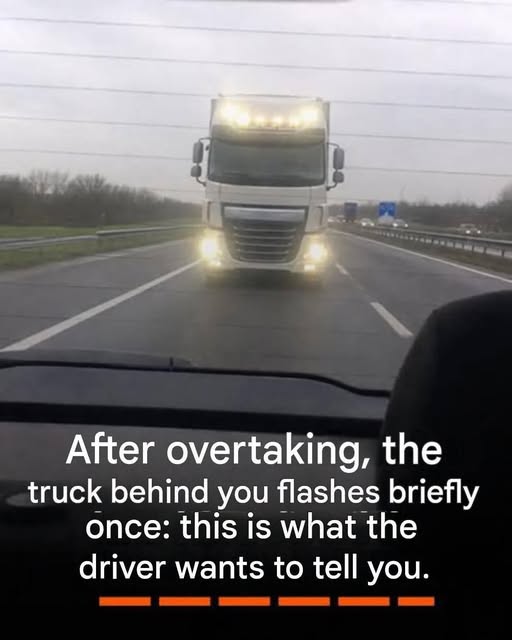
When a truck flashes its headlights after you overtake it, the meaning depends heavily on country, road culture, traffic conditions, and the exact pattern of the flash. On highways, however, there are a few common interpretations.
What the truck driver may be communicating
1. “You can move back into my lane”
This is one of the most common interpretations, particularly with large trucks.
Suppose you overtake a truck on a multi-lane highway:
- You pass the truck.
- You remain in the passing lane long enough to establish a safe gap.
- You signal and begin moving back in front of the truck.
- The truck flashes its headlights.
The flash may mean “You’re clear; come back over.”
Truck drivers have a much higher seating position and a different view of the road. They may be able to see that there is sufficient distance between your vehicle and their truck.
Important: Don’t interpret the flash as permission to merge immediately. You should still check your mirrors, blind spots, and the available gap yourself.
2. “Thank you”
In some driving cultures, a trucker may flash the headlights after you have completed an overtake as a way of saying:
“Thanks for passing safely” or “Thanks for getting out of the way.”
This is particularly possible when you have overtaken efficiently and then returned to the cruising lane, allowing the truck to continue without having to brake.
It can be part of an informal highway courtesy language between professional drivers.
3. “You are clear to merge”
This is slightly different from simply saying thanks.
A truck driver might flash when they notice that you are indicating to return to the truck’s lane. The message can effectively be:
“I see you, and you’ve got enough room.”
This can be especially useful when you’re driving a smaller car and the truck is behind you.
But remember that the truck driver’s flash is not a substitute for your own safety checks. A truck driver can misjudge the distance, and your mirrors may not show everything around your vehicle.
4. “Watch out!”
A headlight flash can also be a warning rather than a courtesy.
For example, the truck driver might have noticed:
- A stopped vehicle ahead
- Debris in the roadway
- An accident or congestion
- An animal near the road
- A vehicle approaching rapidly behind you
- A problem with your vehicle
- Something you cannot easily see from your position
If the flashing is accompanied by repeated flashes, horn use, unusual positioning, or rapid braking, treat it as a possible warning rather than a friendly acknowledgment.
Why trucks use headlights as communication
Large trucks have a practical reason for using lights as signals: their drivers sit high above ordinary passenger vehicles.
A truck driver can often see traffic patterns farther ahead than a car driver can. At the same time, the truck’s size makes it difficult for the driver to communicate with a smaller vehicle using ordinary gestures.
Headlights therefore become a convenient communication method.
Truck drivers may also use:
- Headlight flashes
- Hazard lights
- Turn signals
- Brake lights
- Horn
- CB radio, where commonly used
These signals form something of an informal highway communication system.
The famous “truck flash” after overtaking
There’s a situation many drivers experience:
You overtake a truck → move safely ahead → truck flashes its headlights.
In many cases, drivers interpret this as:
“You’re safely ahead of me.”
Some truck drivers deliberately flash headlights to let a vehicle know that it has cleared the truck sufficiently to return to the lane.
This is particularly useful because determining a safe following distance from a large truck can be difficult. A passenger-car driver may not realize exactly how much space the truck driver needs.
However, there is an important distinction:
A truck flashing you does not necessarily mean that it is safe to merge.
It could simply be a courtesy flash after you have already completed the maneuver.
What if the truck flashes before you overtake?
That’s a different situation.
If a truck repeatedly flashes its headlights while you’re preparing to pass, possible meanings include:
“Go ahead.”
The truck driver may be signaling that you have enough room to pass.
“Don’t pass.”
Less commonly, the driver may be warning you about something ahead—particularly if the flash is accompanied by other warning behavior.
“I am coming through.”
If the truck is approaching rapidly from behind and flashing, it may be communicating that it wants you to move over.
The timing and context are therefore more important than the flash itself.
One flash vs. repeated flashes
A useful—but not universal—way to interpret the signal is:
| Signal | Possible meaning |
|---|---|
| One brief flash | Courtesy / acknowledgment |
| Flash after you’ve moved ahead | “You’re clear” / thanks |
| Flash while you’re merging | “I see you” / possible permission |
| Several rapid flashes | Warning or urgent attention |
| Flash + horn | Strong warning |
| Flash + truck braking | Potential hazard |
| Flash from behind while you’re in passing lane | “Move over” or “I’m approaching” |
These are informal conventions, not universal traffic rules. The same flash can mean different things in different countries or even between individual drivers.
A very important safety point: don’t “thank” a truck with your brakes
One common highway practice is for a vehicle that has just been allowed to merge to briefly turn on its hazard lights or otherwise acknowledge the truck.
Some drivers also tap their brakes as a thank-you.
Don’t do this unnecessarily.
Brake lights can be confusing, especially to a large truck following at highway speed. If you want to acknowledge another driver, use an appropriate signal that doesn’t create ambiguity or suddenly reduce your speed.
Why truck drivers may appreciate a clean overtake
Overtaking a truck isn’t just about your vehicle’s speed. Large trucks have:
- Much greater mass
- Longer stopping distances
- Large blind spots
- Significant aerodynamic effects
- Limited acceleration
- Wider turning and lane requirements
A driver who passes efficiently and returns to the cruising lane gives the truck driver a much more predictable traffic situation.
For example:
Poor maneuver:
Car passes → stays beside truck for a long time → slows down → speeds up → cuts in closely.
Better maneuver:
Car approaches → checks surroundings → overtakes decisively → creates a safe gap → signals → returns to lane.
A flash from the truck afterward may simply be an acknowledgment of the second maneuver.
What about the truck’s blind spots?
This is particularly important.
A truck’s mirrors don’t necessarily give the driver a complete view around the vehicle. Large trucks can have substantial areas where a smaller vehicle is difficult or impossible for the driver to see.
After overtaking, you should avoid moving immediately in front of the truck.
A useful rule is to make sure you can see the truck’s front end in your rear-view mirror before moving back into its lane, while also following applicable local laws and maintaining an adequate safety margin.
And don’t assume that because the truck flashes its lights, the driver has seen every part of your vehicle.
Is the truck driver actually “talking” to you?
In a sense, yes—but it’s better to think of it as informal signaling rather than a standardized language.
Unlike a traffic light or turn signal, a headlight flash doesn’t have one universally fixed meaning.
Its meaning comes from:
Timing + location + surrounding traffic + number of flashes + what the truck does afterward.
For example:
You finish overtaking → truck gives one short flash → continues at constant speed.
Likely courtesy/acknowledgment.
But:
You are about to move into the truck’s lane → truck repeatedly flashes → truck slows down.
More likely “Don’t merge yet” or “pay attention.”
And:
You’re driving normally → truck flashes repeatedly + sounds horn.
Treat that as a warning requiring your attention.
What should you do when a truck flashes after you overtake?
The safest response is simple:
- Don’t panic.
- Check your mirrors.
- Make sure you are safely established in your lane.
- Maintain an appropriate speed.
- Look ahead for hazards.
- Don’t make a sudden maneuver just because the truck flashed.
- If you haven’t yet merged, don’t assume the flash guarantees that the gap is safe.
- If the truck is repeatedly flashing or using its horn, look for a possible hazard.
Bottom line
If a truck briefly flashes its headlights after you’ve safely overtaken it, the most likely explanations are courtesy, acknowledgment, or an indication that you’ve cleared the truck. But there is no universal “truck flash dictionary,” and a flash can also be a warning.
The best interpretation is therefore context-dependent: treat the flash as useful information, but make your driving decisions based on your own mirrors, blind-spot checks, road conditions, and traffic laws—not on the truck driver’s flash alone.