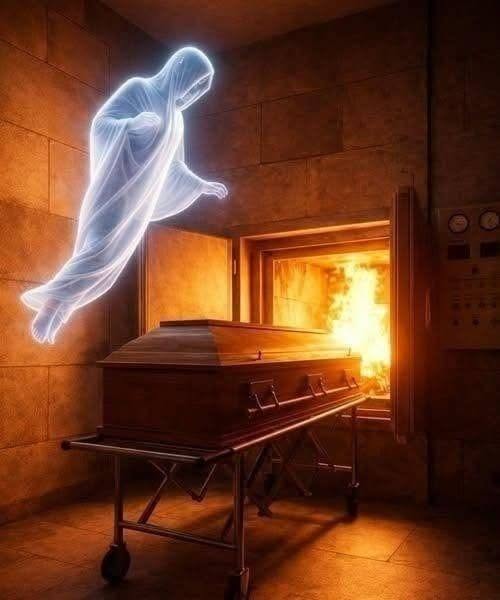
Here’s a detailed explanation.
1. What happens during cremation?

Cremation is a process that uses extremely high temperatures to reduce a deceased person’s body to bone fragments.
-
Temperatures are generally around 1,400–1,800°F (760–980°C).
-
The process usually takes around 2–3 hours.
-
Soft tissues are broken down by heat.
-
Most water and organic matter are removed.
-
Bone fragments remain.
2. What actually remains after cremation?

Interestingly, what people call ashes aren’t simply ashes from a fire.
They are mostly processed bone fragments containing calcium and other minerals.
-
Usually white, grey or pale in colour.
-
Typically around 4–6 pounds for an adult.
-
Processed into a fine, sand-like consistency.
-
Placed in an urn or another container.
3. Do cremated bodies decompose afterward?
No, not in the same way an ordinary buried body does. Cremated remains are predominantly mineral bone material, so they do not undergo ordinary bodily decomposition.
4. Some interesting facts
-
Cremation does not preserve the person’s original body structure.
-
Dental and surgical metals may remain and are generally separated.
-
The ashes are not usually completely powdery until they have been processed.
-
Cremation facilities use identification procedures to ensure remains are correctly tracked.
What would you like to know more about?
I can explain some particularly interesting questions:
-
What happens to the brain during cremation?
-
Do bones completely disappear?
-
Can teeth survive cremation?
-
What happens to the heart and internal organs?
-
Can cremated ashes last hundreds or thousands of years?
-
Can scientists identify a person from cremated ashes?
You can ask about any of these, and I’ll explain in detail.