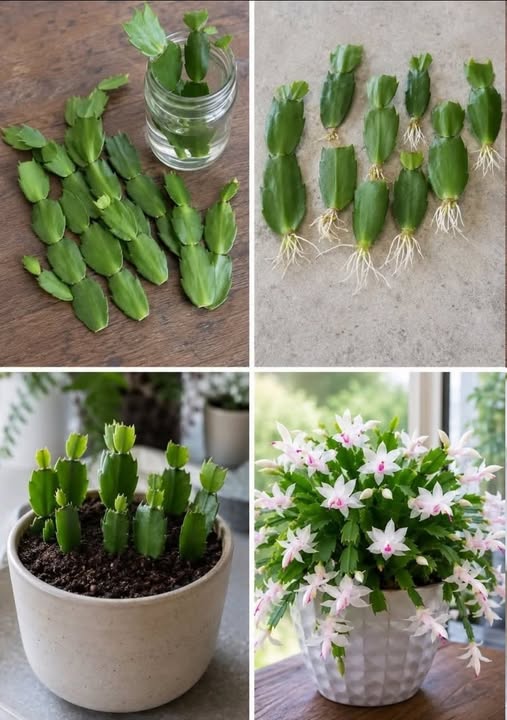
Double the Blooms: How to Make Your Christmas Cactus Thrive Year-Round
A Christmas cactus can be much more than a one-season houseplant. With the right combination of light, watering, temperature, feeding, pruning, and seasonal rest, a healthy plant can live for decades—and often become more impressive every year. Some holiday cacti have even been documented surviving for more than 100 years.
The secret to abundant flowering is understanding that a Christmas cactus is not really a desert cactus. comes from tropical and subtropical rainforests of Brazil, where it grows as an epiphyte in trees rather than in hot, dry desert conditions. That means it appreciates bright filtered light, humidity, regular moisture during active growth, and excellent drainage.
If your goal is a lush plant covered in flowers rather than a cactus that produces only a handful of blooms, the key is to care for it according to its annual growth-and-rest cycle.
1. First, understand what a Christmas cactus actually needs
Christmas cactus is a member of the cactus family, but its natural environment is very different from that of desert cacti.
Its flattened, segmented stems are adapted to growing among branches in humid forests. The plant receives filtered light rather than intense midday sunshine, and rainwater drains away quickly from its roots.
That explains several important care rules:
-
Bright indirect or filtered light is better than harsh direct sunlight.
-
The potting mix should retain some moisture but drain very freely.
-
Humidity is beneficial.
-
The plant should not be allowed to remain waterlogged.
-
A cool, somewhat drier period in autumn helps trigger flowering.
-
Sudden environmental changes can cause flower buds to drop.
Once you understand this natural cycle, caring for the plant becomes much easier.
2. Give it the right light
Light is one of the biggest factors determining whether your Christmas cactus becomes full and flower-covered or sparse and disappointing.
The ideal location is somewhere with bright, indirect light. An east-facing window is often excellent because it provides gentle morning sunshine without exposing the plant to intense afternoon heat.
A bright north or lightly shaded south/west location can also work, depending on the intensity of the sunlight in your home.
Avoid intense midday sun
Although the plant needs plenty of light, prolonged strong direct sunlight can scorch the flattened stems. Scorched segments may develop reddish, brown, or yellowish discoloration.
If your only suitable window receives strong afternoon sun, place the plant a little farther from the glass or use a sheer curtain.
More light doesn’t always mean more flowers
It is tempting to assume that maximum sunlight produces maximum flowering. With Christmas cactus, that isn’t necessarily true.
The plant needs sufficient light for healthy growth, but flower initiation is strongly influenced by day length and temperature, not simply by the amount of sunlight during the day.
3. Water correctly—not like a desert cactus
One of the most common mistakes is treating Christmas cactus like a traditional desert cactus.
During active growth, the plant prefers a potting mix that is moderately moist but never soggy. Water when the upper portion of the mix has begun to dry, then water thoroughly enough for excess moisture to drain from the bottom of the pot.
Never leave the pot sitting in a saucer of standing water.
Waterlogged conditions deprive the roots of oxygen and can eventually cause root deterioration and rot.
A simple watering test
Before watering, put your finger into the potting mix.
If the upper layer feels dry, water thoroughly.
If it still feels noticeably damp, wait a little longer.
The exact interval will vary depending on:
-
Pot size
-
Potting mix
-
Temperature
-
Humidity
-
Light level
-
Season
-
Plant size
Therefore, watering according to the calendar is less reliable than checking the actual moisture of the soil.
4. Increase humidity
Christmas cactus naturally comes from humid rainforest environments, so dry indoor air can make it less vigorous.
This becomes especially important during winter when heating systems can dramatically reduce indoor humidity.
You can increase humidity by:
-
Grouping houseplants together
-
Using a humidifier
-
Placing the plant near other plants
-
Setting the pot on a humidity tray filled with pebbles and water, while keeping the bottom of the pot above the water
The RHS also recommends misting and using a tray of damp gravel as ways of increasing humidity.
However, humidity should not replace good drainage. A humid atmosphere is beneficial; permanently wet roots are not.
5. Feed it for growth, not just flowers
A Christmas cactus needs nutrients to produce new segments and develop the branching structure that eventually carries flowers.
During the active growing season, feed with a balanced liquid houseplant fertilizer according to its label directions. Several university extension recommendations suggest approximately monthly feeding during the growing season, while the RHS recommends liquid houseplant fertilizer from April through September.
A practical approach is:
Spring through summer: regular balanced feeding.
Early autumn: reduce or stop regular feeding as the plant transitions toward bud formation.
During the flowering/rest period: don’t push vigorous vegetative growth with heavy fertilization.
The exact fertilizer formula is less important than avoiding excessive fertilizer. Too much fertilizer can encourage lush vegetative growth without necessarily producing the spectacular flowering you’re after.
6. The secret to double the blooms: grow more branches
Here is one of the most useful tricks for getting a heavily flowering Christmas cactus:
More stem tips = more potential flowers.
Christmas cactus flowers form at the ends of the stems. Therefore, a plant with many well-developed branches has considerably more places where flowers can appear.
Instead of allowing your plant to develop only a few long, trailing stems, encourage branching in spring.
How to prune
After flowering and once the plant begins active growth:
-
Select a healthy stem.
-
Remove one or a few terminal segments.
-
Make the removal at a natural joint between segments.
-
Repeat selectively around the plant to encourage branching.
-
Don’t remove a large proportion of the plant at once.
The result is a bushier plant with more growing points.
And there is an added bonus: the pieces you remove can become new plants.
7. Propagate the cuttings
Christmas cactus is remarkably easy to propagate from stem cuttings.
Take a small section consisting of a few connected stem segments.
Allow the cut end to dry briefly if desired, then insert the lower portion into a well-drained propagation medium. The cutting should be planted only deeply enough to remain upright.
The RHS recommends keeping cuttings in bright indirect light at approximately 18–24°C (65–75°F), watering very sparingly, and misting occasionally. Rooting may take approximately 3–12 weeks.
Once rooted, the young plants can be potted individually—or several cuttings can be grown together to create a fuller specimen.
This is one reason an old Christmas cactus can eventually become an enormous, multi-stemmed plant.
8. Temperature is the flowering trigger
If your Christmas cactus grows beautifully but refuses to flower, temperature may be the missing ingredient.
Christmas cactus responds to changes in temperature and day length when preparing to flower.
During spring and summer, temperatures around 65–70°F (18–21°C) are comfortable for active growth. The RHS recommends approximately 18–20°C (65–69°F) during the growing season.
Then comes the crucial autumn transition.
9. Give it a cool autumn rest
In autumn, reduce watering and provide a cooler environment.
The RHS recommends approximately 55–59°F (12–15°C) during the autumn rest period, from around mid-September until flower buds begin appearing.
University extension guidance similarly recommends cool conditions and long, uninterrupted nights to encourage bud formation.
This period essentially tells the plant:
Winter is coming—time to reproduce.
That reproductive signal encourages the plant to switch from producing foliage to producing flowers.
Don’t keep it too warm
A plant sitting in a warm room throughout autumn may continue vegetative growth and produce few or no flowers.
The RHS specifically notes that temperatures above about 18°C (65°F), combined with artificial light after dark, can interfere with bud formation.
10. Darkness matters more than many gardeners realize
Christmas cactus is considered a short-day plant.
That means the plant responds to long nights and shorter days as part of its flowering trigger. Research-based extension guidance indicates that many holiday cacti require roughly 12–16 hours of uninterrupted darkness to initiate flowering, depending on the cultivar.
This can become a problem indoors.
Imagine placing your cactus beside a window and leaving a bright lamp on nearby every evening. From your perspective, it’s only a lamp. From the plant’s perspective, the “night” may have been interrupted.
The solution
During the autumn bud-setting period:
-
Give the plant bright light during the day.
-
Keep nights dark.
-
Avoid placing it directly beside lamps that remain on late into the evening.
-
Keep the temperature relatively cool.
-
Avoid repeatedly moving it.
You don’t necessarily need to put the plant in a closet. A naturally dark room or a location away from artificial nighttime lighting is often sufficient.
11. Once buds appear, stop disturbing the plant
This is another major secret to a spectacular display.
Once flower buds have formed, stability becomes extremely important.
Holiday cacti can drop buds when exposed to sudden changes in temperature, humidity, light, or location.
Therefore, once you see tiny buds developing:
-
Don’t move the plant unnecessarily.
-
Don’t dramatically change the watering routine.
-
Keep it away from cold drafts.
-
Keep it away from heating vents.
-
Avoid sudden temperature swings.
-
Don’t overwater.
-
Maintain good bright, indirect light.
Think of the developing buds as delicate investments. Your job is now to leave the plant in a stable environment until flowering begins.
12. What to do when it starts flowering
When the first flower buds become obvious, the plant can return to its normal growing environment.
The RHS recommends moving it back to approximately 18–20°C (65–69°F) and resuming regular watering once buds appear.
Keep the plant in bright, indirect light.
You should soon see the buds enlarge and begin opening.
A healthy plant can produce flowers in shades including pink, red, white, mauve, and other colors depending on cultivar.
13. After flowering, don’t immediately push growth
Many gardeners make another mistake here.
The flowers fade, and they immediately return the plant to heavy watering and feeding.
Instead, give the cactus another short rest period.
The RHS recommends a second cooler, less-watered period after flowering, approximately from late January through late March.
During this period:
-
Reduce watering.
-
Keep the plant somewhat cooler.
-
Don’t keep the soil constantly wet.
-
Avoid unnecessary fertilizer.
Then, as spring growth begins, gradually return to more regular watering and feeding.
This creates the plant’s annual cycle:
Rest → growth → branching → autumn rest → buds → flowers → rest → repeat.
14. Repot only when necessary
Christmas cactus doesn’t need to be repotted every year.
In fact, frequent repotting can be counterproductive.
University of Connecticut guidance suggests that repotting approximately every three years is often sufficient, while other extension advice recommends waiting until the plant has clearly outgrown its container or the potting mix has deteriorated.
Good reasons to repot include:
-
Roots are becoming severely crowded.
-
Roots are emerging extensively from drainage holes.
-
The potting mix has broken down.
-
Drainage has become poor.
-
The plant is showing signs of root problems.
Choose a container only modestly larger than the current one.
A giant pot is usually unnecessary because it contains a greater volume of wet soil around relatively small roots.
15. Use a fast-draining potting mix
The ideal mix needs to accomplish two things simultaneously:
Hold enough moisture for the plant while allowing excess water and air to move through the root zone.
University and extension sources recommend airy, well-drained mixtures, and the RHS similarly emphasizes well-drained growing media.
A commercial cactus/succulent or other well-draining houseplant mix can work, provided it doesn’t become excessively dry or hydrophobic.
You can improve a standard potting mix with materials that increase drainage and aeration, such as perlite or coarse mineral material.
Most importantly, the container must have a drainage hole.
A decorative pot without drainage is one of the easiest ways to turn a healthy Christmas cactus into a root-rot problem.
16. Give it a summer vacation
If your climate allows it, Christmas cactus can benefit from spending part of the summer outdoors.
The RHS recommends placing it in a warm, sheltered, shady location during summer.
A covered porch, shaded balcony, or protected location beneath a tree can work well.
But don’t take a plant that has been indoors and immediately put it into intense outdoor sunlight.
Instead, gradually acclimate it.
And before bringing it back indoors, inspect it carefully for insects and other pests.
17. Keep an eye out for pests
Christmas cactus is generally robust, but it can occasionally experience pests such as mealybugs.
Check:
-
Between stem segments
-
Around joints
-
Near the base of stems
-
Under leaves/segments
-
Around new growth
Early detection makes treatment much easier.
Also inspect plants after they have spent time outdoors before bringing them back into the house.
18. Diagnose the most common problems
“My Christmas cactus won’t bloom.”
The most likely issue is that the plant didn’t receive the right autumn flowering conditions.
Check:
-
Was it too warm?
-
Did it receive artificial light at night?
-
Was autumn watering too generous?
-
Did the plant receive insufficient daytime light?
-
Was the temperature constantly stable instead of becoming cooler?
Christmas cactus requires the seasonal signals of shorter days and/or cooler temperatures to initiate flowering.
“The buds formed but fell off.”
This is extremely frustrating, but it is common.
Possible causes include:
-
Sudden temperature changes
-
Cold drafts
-
Excessive heat
-
Changes in light
-
Overwatering
-
Moving the plant after buds formed
-
Sudden changes in humidity
The RHS and University of Minnesota Extension both emphasize environmental stability during bud development.
Once buds appear, resist the temptation to rearrange the plant.
“The stems are shriveling.”
Shriveled stems can indicate either too little water or damaged roots from excessive watering.
That may sound contradictory, but it’s important.
A plant suffering from root deterioration may be sitting in wet soil while its stems simultaneously look dehydrated because damaged roots cannot supply water effectively.
Check the roots and potting mix before simply adding more water.
“The stems are turning red.”
Some discoloration can occur when the plant receives excessive light or experiences environmental stress.
Move it away from intense direct sunlight and make sure its watering and temperature are appropriate.
“The plant grows but doesn’t flower.”
This usually means you’re providing conditions that are excellent for foliage but poor for flowering.
Warm temperatures, long evenings under artificial lights, and abundant watering can encourage vegetative growth while interfering with the seasonal flowering signal.
19. The year-round Christmas cactus calendar
Here’s a simple annual routine you can follow.
January–March: Post-flowering rest
-
Reduce watering.
-
Keep the plant somewhat cooler.
-
Avoid heavy feeding.
-
Give bright indirect light.
-
Allow the upper portion of the mix to dry somewhat between waterings.
The RHS recommends a cooler, drier rest period after flowering.
April–June: Active growth
-
Increase watering as growth resumes.
-
Begin regular feeding.
-
Provide bright indirect light.
-
Consider pruning to encourage branching.
-
Take cuttings from healthy segments.
This is the period when you’re building the plant that will eventually carry the next crop of flowers.
July–August: Build strength
-
Continue regular watering as needed.
-
Feed during active growth.
-
Maintain bright filtered light.
-
Give it good humidity.
-
Outdoor placement can work in warm, frost-free climates if the plant is protected from strong sun.
September–October: Flower preparation
This is arguably the most important period.
-
Reduce watering.
-
Provide cooler temperatures.
-
Give bright daytime light.
-
Ensure long, uninterrupted nights.
-
Keep artificial light away from the plant after dark.
-
Avoid excessive fertilizer.
The combination of cooler conditions and shorter days helps trigger flower formation.
November–December: Bloom season
Once buds appear:
-
Return the plant to normal indoor temperatures.
-
Resume regular but careful watering.
-
Keep it in bright indirect light.
-
Don’t move it unnecessarily.
-
Protect it from drafts and heating vents.
Then enjoy the flowers.
20. The “double bloom” strategy
If your goal is a Christmas cactus absolutely loaded with flowers, focus on these five principles:
1. Build a bushy plant
Prune selected stem tips in spring to encourage branching.
More branches mean more potential flowering tips.
2. Grow strongly during spring and summer
Give it:
-
Bright indirect light
-
Appropriate moisture
-
Good drainage
-
Humidity
-
Regular feeding
3. Create a real autumn transition
Don’t keep the plant in identical conditions year-round.
Give it cooler temperatures and reduced watering as autumn approaches.
4. Give it long, uninterrupted nights
Keep artificial light away from the plant after dark during bud initiation.
5. Don’t disturb developing buds
Once the buds appear, stability is your best friend.
21. One plant can become many
One of the wonderful things about Christmas cactus is how easily it can be propagated.
Suppose you prune ten healthy stem sections from an established plant.
Instead of throwing them away, root them.
Over time, you can create several young plants—or combine multiple cuttings in one container to produce a fuller display.
Because mature Christmas cacti can become long-lived and increasingly impressive over the years, propagation also gives you an easy way to preserve a beloved family plant.
22. Why old Christmas cacti often become spectacular
Don’t assume a large, old Christmas cactus is past its prime.
Quite the opposite.
A well-maintained plant can become increasingly impressive because years of growth create more branches and more flowering points.
The RHS notes that Christmas cacti are long-lived and that plants can develop more stems over time, resulting in more flowers.
That means patience is actually one of your most powerful gardening tools.
A small plant today could eventually become a spectacular cascading centerpiece.
23. The biggest mistakes to avoid
If you remember nothing else, avoid these mistakes:
-
Don’t treat it like a desert cactus.
-
Don’t bake it in strong midday sun.
-
Don’t keep the roots constantly wet.
-
Don’t allow it to remain bone-dry for long periods during active growth.
-
Don’t keep it excessively warm during autumn.
-
Don’t leave bright artificial lights on beside it all night during bud formation.
-
Don’t move it repeatedly after flower buds appear.
-
Don’t overfertilize.
-
Don’t repot unnecessarily.
-
Don’t use a container without drainage.
These simple changes can make an enormous difference.
24. The ultimate formula for spectacular blooms
If you want to remember the entire article in one sentence, use this formula:
Bright filtered light + airy soil + careful watering + humidity + summer growth + spring pruning + cool autumn temperatures + long dark nights + stability during budding = a fuller, healthier, heavily flowering Christmas cactus.
The most important insight is that spectacular flowering doesn’t happen because of one magic fertilizer or one secret trick.
It happens because you give the plant the right conditions at the right time of year.
During spring and summer, your job is to build the plant.
During autumn, your job is to trigger flowering.
During winter, your job is to protect the buds and enjoy the flowers.
After flowering, your job is to let the plant rest before beginning the cycle again.
Follow that rhythm year after year, and your Christmas cactus can become one of those remarkable houseplants that seems to get better—and more floriferous—with age.
Quick reference
| Season | Main goal | What to do |
|---|---|---|
| Winter | Flower + rest | Bright indirect light; careful watering; cool rest after flowering |
| Spring | New growth | Increase watering; feed; prune for branching |
| Summer | Build strength | Bright filtered light; regular water and fertilizer; humidity |
| Early autumn | Set buds | Cooler temperatures; less water; long dark nights |
| Late autumn | Protect buds | Stable conditions; don’t move the plant |
| Flowering | Enjoy the display | Bright indirect light; regular but controlled watering |
With this seasonal approach, you’re not simply keeping a Christmas cactus alive—you are training it to become bigger, bushier, healthier, and dramatically more flower-filled year after year.