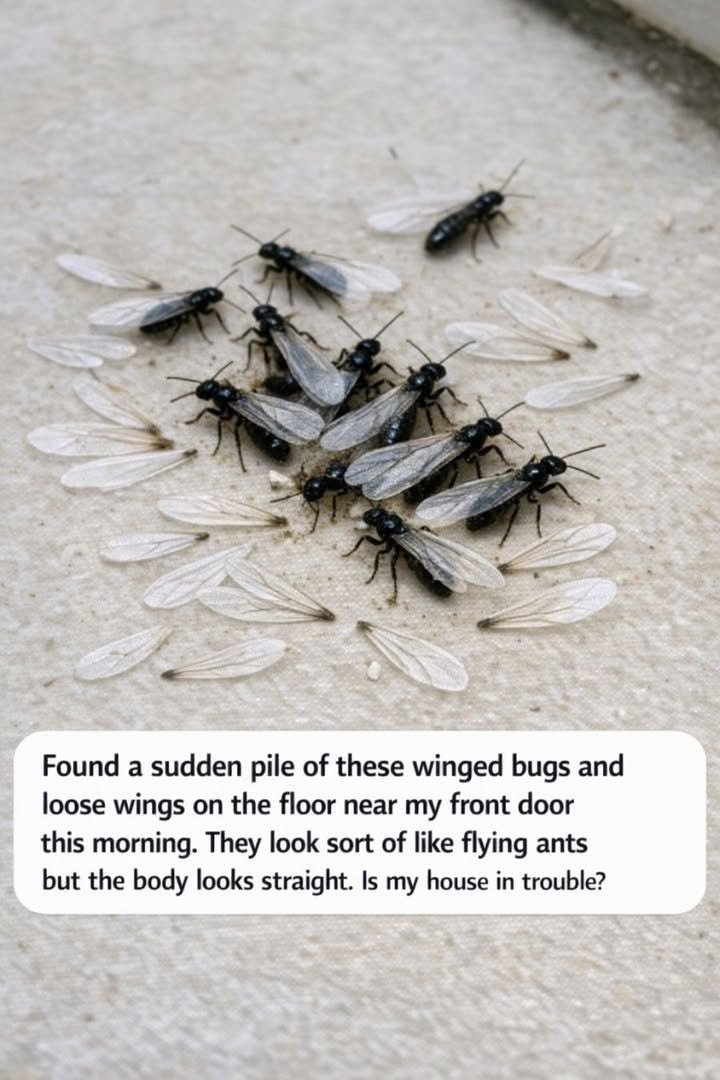
A Sudden Pile of Winged Bugs and Loose Wings Near Your Door: Could They Be Termites?
Finding a sudden pile of small winged insects—and especially a collection of loose, discarded wings—near your front door can be alarming. If the insects look like flying ants but have a relatively straight, broad body rather than a pinched waist, termites are one of the first possibilities to consider.
The good news is that this does not automatically mean your house is seriously damaged or in danger of collapsing. However, if the insects really are termite swarmers and they emerged from inside the house, the discovery deserves prompt investigation.
The biggest clue: loose wings
Termites produce winged reproductive adults called swarmers or alates. When a mature colony produces them, they leave the colony in large numbers, often gathering around windows, doors, lights, or other sources of illumination.
After the swarmers land and pair up, they shed their wings. Consequently, a pile containing numerous detached wings can be an important clue that a termite swarm occurred nearby. Penn State Extension notes that discarded wings can sometimes be the only obvious evidence that termites are present in a building.
The University of Minnesota Extension similarly explains that termite wings are easily shed and are often found near the location where the insects emerge.
So, a sudden pile of insects plus lots of loose wings is more concerning for termites than simply finding a few flying insects around a door.
How to tell termites from flying ants
Flying ants and termite swarmers can look remarkably similar, but several features are useful for separating them.
1. Look at the waist
This is one of the easiest clues.
Termite:
- Body is relatively straight or rectangular.
- There is no obvious narrow “waist” between the thorax and abdomen.
Flying ant:
- Body has a conspicuous narrow, pinched waist.
- The insect has a more wasp-like shape.
Penn State Extension describes the termite body as broad and unconstricted, while ants have a distinctly narrow waist.
Your description that the body looks straight therefore makes termites worth taking seriously.
2. Look at the antennae
Termites generally have straight, bead-like antennae.
Ants have elbowed or bent antennae.
This is another particularly useful characteristic when the insects are small.
3. Compare the four wings
Termites have four wings that are approximately the same length and shape. They are generally considerably longer than the insect’s body.
Flying ants have unequal wings: the front pair is longer than the rear pair.
This distinction can be especially useful when you find dead insects on the floor rather than watching them fly.
4. Examine the discarded wings
Termite swarmers commonly shed their wings after landing. Because large numbers may emerge together, homeowners can suddenly discover what looks like a miniature carpet of transparent wings.
A pile of detached wings concentrated around a door, window, light source, or other opening is therefore worth investigating.
Does this mean termites are living inside your house?
Possibly—but not necessarily.
This distinction is important.
A swarm of termites somewhere near the house does not automatically prove that the colony is inside the structure. Winged termites can be attracted to light, and some discarded wings may have originated from insects that entered from another location.
Penn State’s pest-management material specifically cautions that finding only a pile of discarded wings can sometimes be misleading because swarmers are attracted to light and may have come from elsewhere.
On the other hand, a large number of swarmers emerging indoors is much more significant. It can indicate that a mature termite colony is established in or immediately adjacent to the building.
The location of the pile therefore matters.
If the wings are concentrated inside the front door, particularly if you also saw the insects crawling or flying from cracks, trim, flooring, a wall, or another part of the structure, the possibility of an indoor emergence becomes more concerning.
If the insects were primarily outside on the porch and simply accumulated near the door or a light, the situation may be different.
Why termites are a concern
The winged termites themselves aren’t the insects responsible for most structural feeding.
The important members of a termite colony are the workers. They remain concealed and feed on cellulose-containing materials such as wood.
Eastern subterranean termite colonies, for example, have creamy-white workers that are normally hidden from view. The winged reproductive adults are the conspicuous stage that homeowners commonly notice during a swarm.
Termite damage can develop gradually. Workers may travel through protected passages or mud tubes and consume portions of structural wood.
Signs can include:
- Hollowed or weakened wood
- Mud or soil-like tubes along foundations or wood
- Damaged door or window trim
- Wood that sounds unusually hollow when tapped
- Crumbling or compromised wooden material
- Swarming insects inside the building
- Large numbers of discarded wings
- Repeated swarms in the same area
Penn State Extension notes that termite-damaged wood can contain runways or passages and that mud tubes may extend from soil toward structural wood.
Check the area around your front door
Because your discovery was near the front door, there are several places worth examining.
Look carefully at:
Door trim and frame:
Check the wooden casing, threshold, and areas where the frame meets the wall.
Baseboards:
Look for tiny cracks, damaged wood, mud-like material, or insects emerging from gaps.
Foundation:
If the door is at ground level, inspect the foundation immediately outside the entrance for narrow, earth-colored tubes.
Steps and porch:
Wooden steps, posts, decking, or other structures attached to the house can sometimes provide access to termites.
Moist areas:
Pay particular attention to locations where water collects or where wood has been repeatedly exposed to moisture.
Nearby soil:
Subterranean termites commonly live in soil and can travel from the ground toward wooden structures.
Basement or crawl space:
If there is a basement or crawl space below the entrance, that area deserves particular attention.
Don’t panic if you find only the wings
A pile of wings is important evidence, but it isn’t a measurement of how much damage exists.
For example, finding hundreds of wings does not mean that hundreds of termites have eaten your house. The winged adults are reproductive members of the colony, and their appearance is associated with the colony’s reproductive phase.
Penn State Extension notes that the winged forms themselves do not cause structural damage; the concern is the colony from which they originated and the worker termites associated with it.
In other words:
Lots of wings ≠ lots of structural damage.
But:
Lots of wings indoors = a reason to investigate the source.
What you should do right now
First, don’t immediately spray everything with insecticide.
Instead, preserve some evidence.
Save a few insects
Put several intact insects and some of the wings into a small sealed container or bag.
If possible, don’t crush them. Identification often depends on details such as the antennae, waist, body shape, and wings.
Penn State Extension recommends preserving intact specimens for insect identification because important body parts can easily be damaged or lost.
Take close-up photographs
Take photographs of:
- One insect from above.
- One insect from the side.
- The head and antennae.
- The wings.
- The entire pile of insects and wings.
- The area around the front door.
- Any mud tubes, damaged wood, or cracks you notice.
A clear close-up photograph can often make the difference between identifying an insect as a termite or an ant.
Don’t simply sweep everything away
You can clean the area eventually, but document it first.
If the swarm happens again, photograph the insects before cleaning them up.
Repeated emergence from the same crack or location is particularly useful information for a pest professional.
When should you call a pest professional?
If the insects are confirmed or strongly suspected to be termite swarmers, it’s reasonable to have the property inspected.
An inspection becomes especially important if:
- The swarm occurred inside the house.
- There were dozens or hundreds of insects.
- There are many discarded wings.
- You find mud tubes.
- You find damaged or hollow-sounding wood.
- Swarmers are repeatedly appearing.
- You find termites coming from a wall, floor, trim, or door frame.
- The property has a history of termite activity.
A reputable termite professional should determine whether termites are actually present, what species they are, where the colony or activity is located, and whether there is evidence of structural damage.
Don’t let someone jump directly from “I see wings” to “your entire house needs an expensive treatment.” Identification and inspection should come first.
Could they instead be flying ants?
Absolutely.
Flying ants also swarm, and they can leave behind wings after mating. Some ants can even establish nests in wall voids, damaged wood, foundations, or other areas around homes.
Carpenter ants deserve particular attention because they can excavate wood, although they do not consume wood in the same manner as termites.
Carpenter ants have a constricted waist, elbowed antennae, and unequal-sized wings.
Other winged ants can be completely harmless from a structural standpoint. For example, some species may nest beneath pavement, soil, or other areas and occasionally produce winged adults indoors.
Therefore, identifying the insect before deciding what treatment is necessary is extremely important.
A simple comparison
| Feature | Termite swarmer | Flying ant |
|---|---|---|
| Body | Broad/straight | Pinched waist |
| Antennae | Straight/bead-like | Elbowed/bent |
| Four wings | Approximately equal | Front wings longer |
| Wings | Often much longer than body | Usually closer to body length |
| Wings shed easily | Yes | Yes, after mating |
| Large indoor swarm | Concerning | May indicate an indoor nest depending on species |
| Structural concern | Yes | Depends on species; carpenter ants can damage wood |
These characteristics are consistent with identification guidance from Penn State and University of Minnesota Extension.
The most important question: where did they come from?
This is ultimately more important than the fact that you found them near the door.
Imagine two scenarios.
Scenario A: They were outside
You open the door in the morning and discover a few winged insects and wings on the exterior threshold.
There are no insects inside, no mud tubes, and no evidence of activity in the door frame.
That could represent a nearby swarm rather than a colony inside your house.
Scenario B: They appeared inside
You find a substantial pile of wings on the interior floor. You vacuum them up, and the next morning another pile appears. You then notice insects coming from a gap around the door trim.
That situation is much more suggestive of an indoor emergence and warrants a professional inspection.
The difference is significant.
What not to do
Avoid assuming that ordinary household ant spray has solved the problem.
Killing the visible swarmers doesn’t necessarily affect the colony hidden elsewhere.
Likewise, don’t start tearing apart walls, removing flooring, or drilling into structural members based solely on a pile of wings.
First establish what insect you’re dealing with and whether there is active structural infestation.
Is your house “in trouble”?
Maybe—but don’t jump to the worst conclusion.
Based on your description alone, termites are a legitimate possibility because you mentioned two classic clues:
- They look like flying ants.
- Their bodies look relatively straight rather than having an obvious ant-like waist.
The pile of loose wings makes the possibility more significant.
But those observations aren’t enough to diagnose a termite infestation conclusively. Flying ants can produce similar evidence, and even termite wings found near a door don’t necessarily prove that the colony is inside the house.
The sensible response is prompt identification and inspection rather than panic.
Bottom line
If these are termite swarmers, the swarm is essentially the colony’s reproductive event—not the stage that eats your house. The concern is that their presence can reveal a mature colony somewhere nearby or within the structure.
If you found a large number of winged insects indoors plus a pile of discarded wings, treat it as a reason to arrange a termite inspection relatively soon.
If you found them outside, especially around a light or entrance, the situation may be less serious, but identification is still worthwhile.
And if you can provide a clear close-up photo of one of the insects and the pile of wings, the waist, antennae, and wing arrangement can be examined to narrow down whether you’re dealing with termites, flying ants, or something else.