I Couldn’t Bear to Throw Away My Grandmother’s Chipped Plates—Then I Discovered These Beautiful Ways to Reuse Them
There are some things in our homes that are worth far more than their practical value.
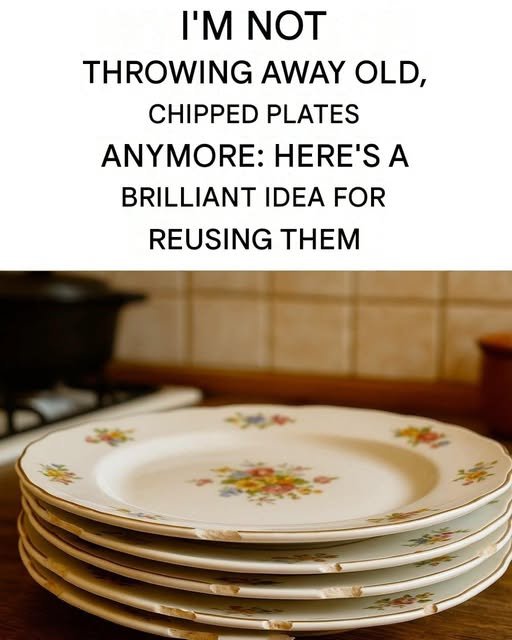
For me, that was a small collection of old plates that had belonged to my grandmother. They weren’t expensive antiques or perfect pieces of china. In fact, several of them were chipped around the edges, scratched from years of use, and showing all the little marks that come with being loved and handled over decades.
Still, I couldn’t throw them away.
Every time I opened the cupboard and saw them, I remembered my grandmother using them in her kitchen. They reminded me of family meals, holidays, cups of tea, and all those ordinary moments that become precious once the people we shared them with are gone.
But I also knew I couldn’t keep using chipped plates as dinnerware. Damaged ceramic can have sharp edges, and cracks or chips can make dishes difficult to clean properly.
So instead of putting them in the trash, I started looking at them differently.
What if they didn’t have to remain plates?
What if I could turn them into something useful while still preserving the part that made them special?
That simple idea led me to discover several wonderful ways to repurpose old plates—and some of them turned out to be surprisingly practical.
1. Turn an Old Plate Into a Jewelry Dish
One of the easiest ideas is to give a single plate a new job as a jewelry or trinket dish.
A small plate works beautifully on a bedside table, dresser, or bathroom counter. It can hold rings, earrings, bracelets, hair clips, or other small items that otherwise seem to disappear around the house.
The best part is that you don’t have to do much.
Simply clean the plate thoroughly, make sure there are no dangerously sharp edges, and place it somewhere convenient. If the chipped section is on the outer edge, you can position that side toward the back or decorate around it.
Suddenly, an imperfect old plate becomes something useful every day.
2. Make a Catch-All Tray for the Entryway
Another plate became a little “landing zone” near my front door.
You know the problem: keys, coins, sunglasses, earbuds, receipts and other tiny things somehow end up scattered across every available surface.
A decorative plate is perfect for collecting them.
Place it on a console table, shelf, or small entryway cabinet and use it as a catch-all tray. You can even give different plates different purposes—one for keys and another for loose change.
It is such a simple change, but it can make a busy area of the house feel much more organized.
3. Create a Decorative Plant Saucer
If you have a sturdy ceramic plate with only minor cosmetic damage, it can make an attractive saucer beneath a plant pot.
The plate catches excess water and protects furniture from moisture. It also gives an ordinary plant pot a more decorative appearance.
This works especially well with vintage-looking plates because the patterns can complement greenery beautifully.
There is one important consideration: make sure the plate is stable and doesn’t have a sharp or unstable chipped edge. The goal is to reuse the piece safely, not create another hazard.
4. Turn Plates Into Wall Art
This was one of my favorite discoveries.
Old plates don’t necessarily need to be functional objects at all. They can become artwork.
A collection of mismatched vintage plates can look wonderful arranged together on a kitchen, dining-room, or hallway wall. Different colors, patterns, shapes, and textures can actually make the display more interesting.
And because my plates had sentimental value, seeing them on the wall felt much better than keeping them hidden in a cupboard.
If you want to try this, plan the arrangement on the floor first. You can experiment with spacing and positioning before deciding where everything should go.
For heavier ceramic pieces, use mounting hardware specifically designed for the weight of the plate and the type of wall you have.
5. Make a Soap or Sponge Rest
A small plate can also become a useful bathroom or kitchen accessory.
For example, it can hold a bar of soap beside the sink or provide a designated place for a cleaning sponge.
However, drainage matters. A plate that allows water to sit underneath a sponge or bar of soap can quickly become messy.
If the plate has an appropriate design and can be used safely, it can be a charming alternative to a conventional soap dish.
6. Use Larger Plates as Decorative Centerpieces
Some of my grandmother’s plates were too large to be practical for small household storage, but they were perfect as decorative pieces.
A large plate can form the base of a simple centerpiece.
Place a vase, candle holder, bowl of decorative objects, or seasonal decoration in the middle. The plate acts almost like a decorative tray.
This is particularly effective when the plate has an attractive floral, botanical, or hand-painted pattern.
Instead of hiding its imperfections, you can make those imperfections part of the story.
7. Turn Several Plates Into a Tiered Stand
If you’re feeling more ambitious, multiple plates can be combined into a tiered display stand.
A tiered stand can be used for decorative objects, wrapped treats, toiletries, or other lightweight items.
This project requires more care because the plates need to be securely connected and balanced. You also need to make sure that any hardware or adhesive you use is appropriate for the materials involved.
For sentimental plates, I’d personally choose a design that doesn’t require permanently drilling through them if there’s a way to avoid it.
The goal is to preserve as much of the original piece as possible.
8. Make a Memory Display
Perhaps the most meaningful idea is to use the plates as part of a memory display.
You could combine an old plate with a photograph, handwritten recipe, small framed note, or another object connected to your grandmother.
For example, imagine displaying one of her plates beside a framed copy of a recipe she used to make.
Suddenly, the plate isn’t merely decoration.
It becomes part of a little family story.
This can be especially beautiful in a kitchen or dining room where the object feels connected to the memories it represents.
9. Use Them to Organize Small Household Items
Not every reuse project has to be decorative.
A plate can be surprisingly useful for organizing small objects.
Depending on its size, you could use one to hold:
- Hair accessories
- Sewing supplies
- Craft materials
- Keys
- Coins
- Office supplies
- Small tools
- Remote controls
- Sachets or tea bags
The trick is to match the plate to the job.
A shallow plate is ideal for items you reach for frequently, while a deeper dish is better for things that could otherwise roll away.
10. Don’t Be Afraid of the Imperfections
The biggest lesson I learned was that I didn’t need to make the plates look brand new.
For years, I thought the chips were the reason I couldn’t use them.
Eventually, I realized the opposite could be true.
The scratches and imperfections were evidence that these plates had been part of my grandmother’s life. They had been used, washed, put away, taken out again, and used some more.
They weren’t damaged objects that needed to be hidden.
They were objects with a history.
And once I stopped trying to make them perfect, it became much easier to find new purposes for them.
A Few Safety Considerations
There is one thing I would not recommend: continuing to use significantly chipped or cracked plates for serving food simply because they are sentimental.
Sharp ceramic edges can cause cuts, and damaged surfaces can be difficult to clean thoroughly.
Before repurposing an old plate, inspect it carefully. If the edge is sharp, unstable, cracked, or otherwise unsafe, don’t put it somewhere where people could accidentally cut themselves.
For projects involving food, choose pieces that are intact and appropriate for that purpose. For severely damaged pieces, decorative or non-food uses are generally the better choice.
And if you’re attaching plates to walls or constructing something from several pieces, make sure the finished object is securely supported.
The Best Part Wasn’t the DIY Project
In the end, I realized that the most important thing wasn’t what I turned the plates into.
It was that I found a way to keep them.
Instead of sitting sadly in the back of a cupboard because they were too damaged to use, they became visible parts of my home again.
One became a little dish for my everyday things. Another became part of a decorative display. Others found new uses around the house.
Every time I see them, I still think of my grandmother.
And somehow, giving those old plates a second life feels like giving a small piece of that memory a second life too.
So if you have a box of chipped dishes, old crockery, or family pieces that you can’t bring yourself to throw away, don’t rush to the trash.
Look at them again.
Maybe they don’t need to be plates anymore.
Maybe they can become something new—something useful, beautiful, and personal that lets you keep the memories without keeping an unusable object tucked away in a cupboard.
Sometimes the things we are most reluctant to throw away are simply waiting for us to imagine a different purpose for them.