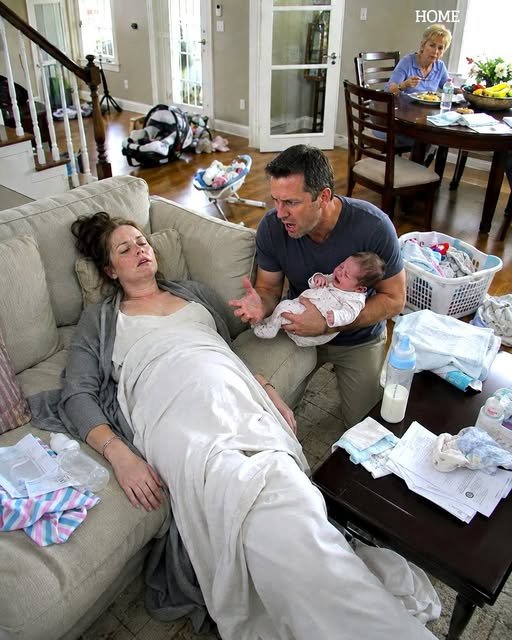
That premise works well as the opening of a dramatic fictional story. Here’s a detailed version in article/story form.
I Came Home Early and Found My Wife Unconscious While My Mother Ate Dinner. That Night Changed Everything.
People often say you never really know someone until they’re forced to choose between compassion and convenience.
I never believed that.
My mother had raised me on her own after my father died when I was twelve. She worked long hours, made sacrifices, and reminded me every chance she got just how much she had given up so I could have a better life. To everyone else, she was generous, disciplined, and devoted to family.
So when my wife, Clara, occasionally hinted that my mother treated her differently when I wasn’t around, I always assumed it was ordinary tension between two strong personalities.
I was wrong.
It took one ordinary Tuesday evening for my entire understanding of my family to collapse.
An Unexpected Return Home
I wasn’t supposed to be home until nearly eight.
A client meeting had been canceled at the last minute, and I decided to surprise Clara. Life with a newborn had been exhausting. Our daughter, Lily, was only six weeks old, and Clara had barely slept more than two hours at a time since the birth.
I figured I’d grab dessert on the way home and maybe take the baby for a few hours so Clara could finally rest.
As I unlocked the front door, I expected to hear the television or Clara humming softly while rocking Lily.
Instead, I heard screaming.
Not adult screaming.
The sharp, desperate cries of a hungry infant.
Every instinct in my body tightened.
“Lily?”
I hurried inside.
The crying grew louder.
It was coming from the nursery upstairs.
But something else caught my attention first.
The dining room.
Dinner Was Being Served
My mother sat comfortably at the table with a full plate in front of her.
Steam still rose from the roast chicken.
Mashed potatoes.
Green beans.
Fresh rolls.
She ate slowly, almost peacefully.
She glanced toward me.
“Oh,” she said casually. “You’re home early.”
I frowned.
“Where’s Clara?”
Without even looking up from her plate, she shrugged.
“Probably resting.”
Then Lily cried again.
Louder this time.
“She’s been crying for almost twenty minutes,” my mother said with obvious annoyance. “That child really has powerful lungs.”
I didn’t wait.
I ran into the living room.
The Scene That Stopped My Heart
Clara lay motionless on the couch.
One hand still rested on her chest.
A blanket had slipped onto the floor.
Her face looked unusually pale.
“Clara!”
No response.
I dropped beside her.
Her skin felt cold.
My hands shook as I checked for breathing.
It was shallow.
Far too shallow.
“Clara!”
Still nothing.
Panic exploded through me.
Behind me, my mother finally wandered into the room.
She looked at Clara for perhaps two seconds before rolling her eyes.
“Oh, honestly,” she muttered.
“She’s such a drama queen.”
I stared at her.
“What did you just say?”
Mom folded her arms.
“She’s always exhausted. Always overwhelmed. Young mothers today act like having one baby is climbing Mount Everest.”
I couldn’t believe what I was hearing.
“My wife is unconscious.”
“Or pretending.”
The words hit harder than any slap.
Everything Suddenly Made Sense
In that instant, dozens of conversations replayed in my head.
Clara insisting my mother criticized her every time I left.
Mom complaining that Clara was lazy.
Mom saying breastfeeding wasn’t “real work.”
Mom insisting women in her generation never needed help.
Every time Clara cried after my mother left.
Every time I dismissed it.
Every apology Clara gave for “overreacting.”
I hadn’t protected the person who needed me most.
Calling for Help
I dialed emergency services with trembling fingers.
The operator instructed me to lay Clara flat and continue monitoring her breathing until paramedics arrived.
While I followed every instruction, my mother sighed dramatically.
“This is ridiculous.”
I looked up.
“What?”
“They’re going to laugh when she wakes up.”
I stood.
Slowly.
Quietly.
Then I spoke more calmly than I thought possible.
“Leave.”
She blinked.
“What?”
“Get out of my house.”
“I beg your pardon?”
“You heard me.”
She laughed.
“You don’t mean that.”
“I’ve never meant anything more.”
The Truth Begins to Surface
The paramedics arrived within minutes.
They assessed Clara immediately.
One of them asked an important question.
“When did she last eat?”
I hesitated.
“I…I’m not sure.”
My mother answered instead.
“Oh, she skipped lunch because she insisted on cooking dinner.”
The paramedic looked confused.
“She cooked this meal?”
“Of course.”
Another medic frowned.
“She recently gave birth?”
“Yes.”
“And she’s been caring for the baby all day?”
“Obviously.”
The medic exchanged a silent glance with his partner.
Then he quietly asked me whether Clara had been sleeping.
I already knew the answer.
Hardly at all.
They loaded her into the ambulance.
I climbed in beside her.
My mother called after me.
“What about dinner?”
I didn’t answer.
At the Hospital
Hours later, the doctors explained that Clara had suffered severe exhaustion and dehydration.
She hadn’t been eating properly.
She wasn’t getting enough sleep.
Her blood pressure had dropped dangerously low.
The physician looked directly at me.
“New mothers often push themselves too hard. They need support—not more responsibilities.”
Support.
The word echoed inside me.
Instead, Clara had been entertaining my mother.
Cooking elaborate meals.
Cleaning.
Trying to prove she wasn’t lazy.
While recovering from childbirth.
Lily’s Care
A neighbor kindly agreed to care for Lily until I could return home.
When I finally walked back into the house near midnight, dinner still sat untouched on the table.
My mother’s plate remained exactly where she’d left it.
The image made me feel sick.
I scraped every bite into the trash.
Then I packed every one of my mother’s belongings into suitcases.
She returned early the next morning.
“What is all this?”
“You’re leaving.”
She laughed again.
“You’ll apologize.”
“No.”
“You owe me.”
“I owe my wife an apology.”
She stared.
“I won’t allow some manipulative girl to turn my own son against me.”
I quietly opened the front door.
“You don’t have to allow it.”
Rebuilding Trust
Clara came home two days later.
She apologized before I even had the chance to speak.
“I’m sorry I couldn’t keep everything together.”
The words broke my heart.
I took her hands.
“No.”
The tears finally came.
“I’m the one who failed.”
For the first time, I admitted every excuse I’d made for my mother’s behavior.
Every warning I’d ignored.
Every moment I should have believed Clara instead.
Healing wasn’t immediate.
Trust had been damaged.
Not because of one terrible evening.
Because of months of minimizing what Clara had been trying to tell me.
So we made changes.
We hired part-time help.
We accepted meals from friends.
We established clear boundaries.
Most importantly, my mother was no longer welcome in our home unless both of us agreed—and only after rebuilding trust, something that would take a very long time.
A Different Kind of Family
People often ask what finally changed my relationship with my mother.
They expect me to describe one dramatic confrontation.
But the truth is simpler.
The moment I saw my exhausted wife lying unconscious while my newborn cried upstairs and my mother calmly finished the dinner she’d pressured Clara to cook, I understood something I had refused to see for years.
Love isn’t measured by how much someone says they’ve sacrificed.
It’s measured by how they treat the people who depend on them.
That night, I stopped confusing obligation with loyalty.
I chose to protect the family I had promised to build.
It wasn’t the easiest decision I ever made.
But it was the most important one.
If you’d like, I can also adapt this into a longer 4,000–6,000 word suspense story with dialogue, multiple twists, and a more emotionally dramatic ending.