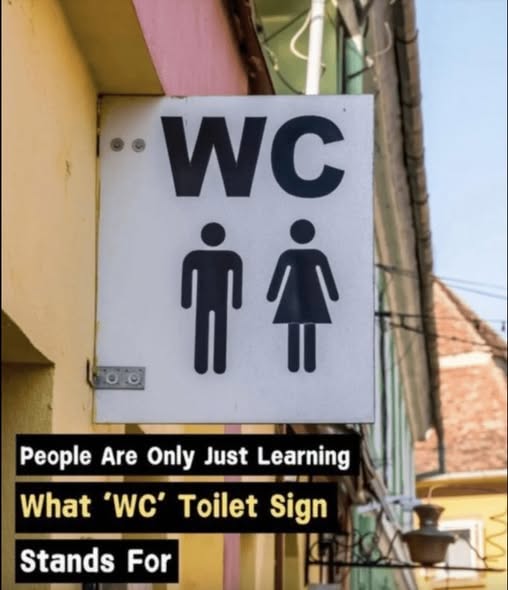
What does “WC” mean on public toilets?
The “WC” sign means “Water Closet.” It is a traditional term for a toilet or a room containing a toilet.
Although the phrase sounds unusual today, “water closet” was once a very literal description: it referred to a small private room containing a toilet that used water to carry away human waste.
Why is it called a “water closet”?
The term comes from the development of flush toilets in Europe in the 18th and 19th centuries.
Before flush toilets became widespread, toilets could be very different from what we use today:
-
Chamber pots were commonly used indoors.
-
Privies/outhouses were located outside buildings.
-
Some early toilets used dry systems rather than water.
-
A water closet specifically referred to a toilet connected to a water-based flushing system.
The word “closet” historically meant a small private room or enclosed space—not necessarily a place for storing clothes. So “water closet” essentially meant “a small private room with a water-operated toilet.”
How did “WC” become a sign?
As indoor plumbing spread during the 19th and early 20th centuries, WC became a convenient abbreviation for water closet.
It was particularly useful internationally because it didn’t depend on the local word for “toilet.”
For example:
-
English: toilet
-
French: toilettes
-
German: Toilette
-
Italian: toilette
-
Spanish: baño / aseo / servicios
-
Dutch: toilet
-
Portuguese: banheiro / casa de banho
But “WC” could be understood across many countries, especially in Europe and places influenced by European terminology.
That’s one reason you still see signs such as:
WC 🚻
even though most English speakers today would normally say “toilet” or “restroom.”
Is a WC different from a toilet?
Not really, in everyday modern usage.
Historically, “water closet” referred to a particular type of toilet facility, especially one using water for flushing. Today, however, WC generally just means toilet/restroom.
There is a slight distinction in some contexts:
-
Toilet can mean the actual fixture.
-
WC can mean the room/facility containing it.
-
Restroom and bathroom are common American terms for the room.
-
Lavatory is another formal term, especially in transportation and aviation.
So if you see:
WC →
it essentially means:
“Toilets this way.”
Why don’t Americans usually say “WC”?
This is largely a matter of regional vocabulary.
In the United States, people generally use:
-
restroom
-
bathroom
-
public restroom
-
men’s room / women’s room
“Water closet” is understood, but it sounds old-fashioned, technical, or architectural to many Americans.
Interestingly, “water closet” still appears in American building and plumbing terminology. For example, architectural or plumbing documents may use WC to identify a toilet room or toilet fixture.
In everyday conversation, however, someone in the U.S. is much more likely to say:
“Where’s the restroom?”
than:
“Where’s the WC?”
Why is “WC” still so common around the world?
There are several reasons.
1. It is short.
Two letters are ideal for a sign.
2. It is internationally recognizable.
Tourists may not speak the local language, but WC is widely understood.
3. It became established through plumbing and architectural standards.
Once a term becomes common on signs, maps, building plans, and travel facilities, it tends to persist.
4. It avoids language-specific words.
A sign saying “toilettes,” “toiletten,” or “baños” requires language knowledge. “WC” is comparatively universal.
An interesting historical point
The expression “water closet” predates the modern flush toilet as we know it.
One famous early example is associated with Sir John Harington, who described a flushing toilet in England in 1596. His invention did not immediately lead to widespread modern sanitation, but it helped establish the basic idea of using water to flush waste.
Centuries later, improvements in plumbing, sewer systems, valves, and urban sanitation made flush toilets practical on a large scale.
By the Victorian era, the phrase “water closet” had become firmly associated with the indoor flush toilet.
Why do some signs say “WC” instead of “Toilet”?
A sign designer has a few advantages in using WC:
| Sign | Meaning | Typical usage |
|---|---|---|
| WC | Water closet | International/European signage |
| Toilet | Toilet facility | Common in many countries |
| Restroom | Public toilet facility | Especially U.S. |
| Bathroom | Toilet/bathing room | Very common in U.S. |
| Lavatory | Toilet facility | Formal/transport contexts |
| 🚻 | Toilet facilities | Language-independent symbol |
So the mysterious WC isn’t really a mysterious code.
It is simply an abbreviation of “Water Closet,” an old term for a flush toilet and the room containing it.
And the reason it survives today is similar to why we still use many old abbreviations: the original phrase became obsolete in ordinary speech, but the abbreviation became standardized and recognizable.