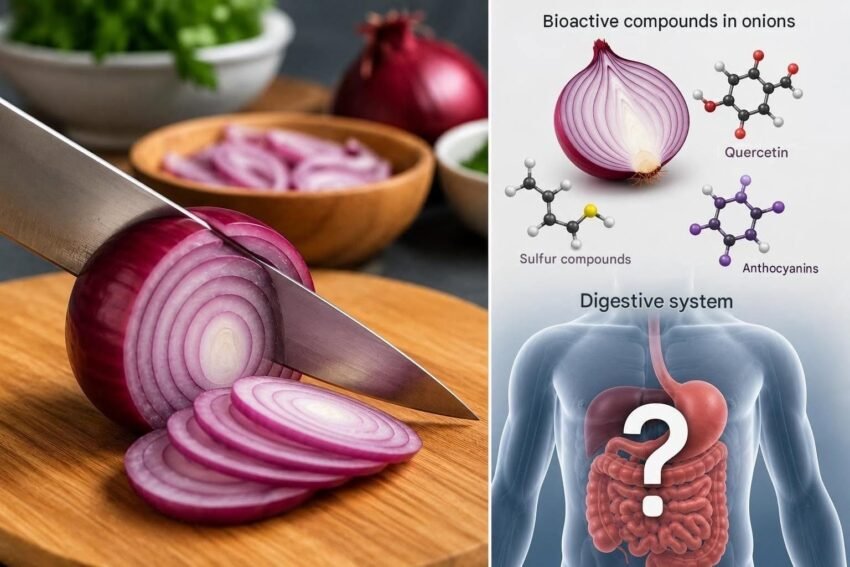
Myth or Medical Reality: Does Eating Raw Onions Really Cause a Common Health Problem?
The answer depends on which health problem you mean. If you’re referring to gas, bloating, abdominal discomfort or indigestion, then there is a real medical explanation—but the idea that raw onions universally cause these problems is a myth.
For some people, especially those with irritable bowel syndrome (IBS) or sensitivity to FODMAP carbohydrates, raw onions can trigger significant digestive symptoms. For many other people, onions are perfectly healthy and can be part of a balanced diet.
1. Why can raw onions cause gas and bloating?
The main reason is a carbohydrate called fructan.
Fructans belong to a group of carbohydrates called FODMAPs. Humans don’t have the enzymes necessary to completely break down fructans in the small intestine. As a result, they travel into the large intestine, where gut bacteria ferment them. This fermentation produces gases such as hydrogen and methane and can contribute to bloating.
In a person without digestive sensitivity, this process is generally normal. You may simply experience a little extra gas.
But in someone with IBS, the intestinal tract can be unusually sensitive to stretching caused by gas and fluid. Consequently, the same amount of fermentation that causes little or no discomfort in one person can produce bloating, abdominal pain, excessive gas, diarrhea or constipation in another.
In simple terms:
Raw onion → fructans reach the colon → bacteria ferment them → gas is produced → some people feel bloated or uncomfortable.
That doesn’t mean the onion is “toxic” or damaging the intestine.
2. Why are raw onions sometimes worse than cooked onions?
Many people report that raw onions bother their stomach more than cooked onions.
Cleveland Clinic notes that cooked onions are generally easier to digest and less likely to cause digestive problems than raw onions. Raw onions can be particularly troublesome for people who are sensitive to them.
However, there’s an important nuance: cooking doesn’t automatically make onions low-FODMAP. Monash FODMAP explains that onions are naturally rich in fructans, and the effect of cooking depends on the cooking method. In particular, fructans are water-soluble, so cooking onion in water can cause some fructans to move into the cooking liquid.
So if someone has significant IBS/FODMAP sensitivity, simply saying “cook the onion and you’ll be fine” isn’t necessarily correct.
3. Does eating raw onion cause IBS?
No.
This is an important distinction.
Raw onion does not cause IBS in the usual sense. IBS is a gastrointestinal disorder involving symptoms such as abdominal pain and altered bowel habits. Certain foods—including high-FODMAP foods such as onion—can trigger or worsen symptoms in someone who already has IBS.
Think of it like this:
Onion can be a trigger, but it isn’t necessarily the underlying disease.
A person might eat onions for years without problems and later discover that onions trigger bloating because their gastrointestinal sensitivity has changed.
4. Can raw onions cause acid reflux or heartburn?
They can trigger symptoms in some people, but again, this isn’t universal.
Onions are listed among foods that may aggravate GERD/acid reflux symptoms in susceptible individuals.
If you notice a consistent pattern such as:
raw onion → burning sensation behind the breastbone → sour taste/regurgitation
then onions may be one of your personal reflux triggers.
However, you shouldn’t conclude that raw onions cause GERD in everyone.
GERD is a medical condition involving repeated reflux of stomach contents into the esophagus. Food triggers can make symptoms worse, but they aren’t necessarily the root cause.
5. What about stomach pain?
Raw onions can contribute to stomach or abdominal discomfort in sensitive individuals.
The mechanism can involve:
- fructan fermentation
- increased intestinal gas
- intestinal distension
- increased sensitivity to intestinal stretching
- altered bowel movement
- individual food intolerance
People with IBS may experience these effects more strongly.
If you experience severe or persistent abdominal pain, however, don’t automatically blame onions. Bloating and abdominal pain can have many causes, including constipation, food intolerance and gastrointestinal disorders. Persistent symptoms deserve medical evaluation.
6. Is raw onion actually healthy?
Yes.
The fact that onions can cause symptoms in some people doesn’t mean they’re unhealthy.
Onions provide:
- dietary fiber
- prebiotic compounds
- carbohydrates
- plant compounds
- relatively few calories
A medium onion contains approximately 45 calories, 3 grams of fiber and 11 grams of carbohydrates, according to Cleveland Clinic.
Their prebiotic components can also provide food for beneficial intestinal bacteria.
The interesting part is that the same fermentation process that can cause gas can also have beneficial effects on the gut microbiome.
So:
Fermentation isn’t inherently bad.
It’s a normal part of digestion. The problem is that people with a sensitive gut may experience unpleasant symptoms from it.
7. Why do some people tolerate onions while others don’t?
There are several possibilities.
A. IBS
People with IBS often have increased sensitivity to intestinal distension. Therefore, the gas and fluid associated with FODMAP fermentation can cause more noticeable symptoms.
B. Individual food sensitivity
You don’t necessarily need to have IBS to notice that onions make you uncomfortable.
Some people simply tolerate certain quantities of onion poorly.
C. Portion size
The amount matters.
Someone might tolerate a small amount of onion but experience substantial bloating after eating a large serving of raw onion.
D. Raw versus cooked
Raw onions may cause more digestive problems for some people than cooked onions.
E. The rest of the meal
Sometimes onion gets blamed for symptoms that actually result from the entire meal.
For example, a meal containing onion plus:
- beans
- garlic
- wheat
- large amounts of fat
- spicy foods
- carbonated beverages
may produce much more gastrointestinal distress than onion alone.
8. Does raw onion cause excessive gas?
It can.
This is probably the most medically accurate version of the common claim.
Onions contain fructans, which are fermented by intestinal bacteria. Fermentation produces gas.
The amount of gas and discomfort varies substantially from person to person.
Therefore:
“Raw onions cause gas in everyone” → Myth.
“Raw onions can cause gas and bloating in susceptible people” → Medical reality.
9. What about bad breath?
This one is definitely real.
Raw onions contain sulfur-containing compounds that contribute to their strong smell and can produce noticeable onion breath. Cleveland Clinic notes that these sulfur compounds can contribute to odor from the breath and even sweat.
Cooking onions can reduce some of these sulfur compounds.
So if someone says:
“Raw onions make my breath smell.”
That’s not simply a myth.
10. Should you stop eating onions if they cause bloating?
Not necessarily.
First, consider quantity and preparation.
You might try:
- Reduce the portion of raw onion.
- Try cooked onion instead.
- Keep a food/symptom diary.
- See whether garlic or other high-FODMAP foods cause similar symptoms.
- Avoid repeatedly testing foods that cause severe symptoms.
- Discuss persistent symptoms with a doctor or registered dietitian.
If IBS is suspected, a low-FODMAP diet can sometimes be used as part of symptom management, but it is ideally done with professional guidance rather than permanently eliminating large numbers of foods on your own. Monash emphasizes that FODMAP restriction is generally individualized according to tolerance and food reintroduction.
11. Should everyone with IBS completely avoid onions?
Not necessarily.
This is another common misconception.
FODMAP sensitivity varies between people. The objective isn’t necessarily to permanently eliminate every high-FODMAP food.
The approach often involves identifying which foods and quantities trigger symptoms and then developing an individualized diet. Monash specifically notes that tolerance can differ between individuals and that food reintroduction is an important part of the process.
12. When is bloating more than “just onions”?
Occasional bloating after eating onions is usually not alarming.
But you should speak with a healthcare professional if bloating or abdominal symptoms are:
- persistent or worsening
- severe
- associated with unexplained weight loss
- accompanied by blood in the stool
- associated with persistent vomiting
- accompanied by significant changes in bowel habits
- repeatedly interfering with daily life
Cleveland Clinic notes that persistent bloating warrants medical evaluation because there can be numerous underlying causes.
Myth vs. Medical Reality
| Claim | Reality |
|---|---|
| Raw onions cause gas in everyone | ❌ Myth |
| Raw onions can cause gas | ✅ True |
| Onions can cause bloating in sensitive people | ✅ True |
| Onions cause IBS | ❌ Not established |
| Onions can trigger IBS symptoms | ✅ True |
| Raw onions can aggravate reflux in some people | ✅ Possible |
| Cooked onions are often easier to tolerate | ✅ Often true |
| Everyone with IBS must permanently avoid onions | ❌ Not necessarily |
| Onions are unhealthy because they cause gas | ❌ False |
| Onion can provide beneficial prebiotic fiber | ✅ True |
Bottom line
Raw onions don’t universally cause a health problem. The strongest medical explanation for the common complaint of gas and bloating is their high content of fructans, a type of FODMAP carbohydrate. These carbohydrates are fermented by gut bacteria, producing gas. People with IBS or particular food sensitivities may experience substantially more bloating, pain or changes in bowel movements as a result.
For most people, onions remain a nutritious food. If raw onions consistently cause symptoms, reducing the portion, trying different preparation methods, and identifying your individual tolerance can be more useful than assuming onions are inherently harmful.
So the verdict is: part myth, part medical reality. Raw onions don’t cause digestive problems for everybody, but they absolutely can trigger them in susceptible people.