The Ancient Hand Gesture With a History Far Older Than You Might Expect
If you mean the raised open-palm gesture—one hand lifted with the palm facing outward and the fingers extended—you are probably thinking of the Abhaya Mudra, one of the oldest and most recognizable symbolic hand gestures in South Asian religious art.
Today, a raised open palm can simply mean “stop,” “wait,” “hello,” or “I come in peace.” But in ancient religious imagery, essentially the same hand position carried a much deeper message: “Do not fear. You are safe.”
The fascinating part is that its history reaches back well over a thousand years, and possibly reflects an even older, ordinary human gesture of reassurance.
1. What exactly is the Abhaya Mudra?
The Sanskrit word abhaya means roughly “fearlessness” or “without fear.” Mudra means a symbolic gesture or “seal.”
The basic form is:
- The hand is raised.
- The palm faces outward.
- The fingers point upward and are generally extended.
- The gesture is directed toward another person or viewer.
Its traditional meaning is protection, reassurance, peace, benevolence, and the dispelling of fear.
In Buddhist sculpture, the gesture is particularly associated with the Buddha. A viewer encountering a Buddha with his raised palm would therefore understand the gesture not simply as a physical movement, but as a visual statement:
“Fear not.”
This is why museums sometimes describe it as the “gesture of fearlessness” or the “gesture of granting protection.”
2. Why is this gesture so powerful?
There is an interesting psychological element to it.
Imagine encountering an unknown person in ancient times. Someone approaches you and raises an empty hand with the palm visible.
You can immediately see:
- the hand contains no weapon,
- the fingers are open,
- the person isn’t concealing something in the palm,
- the gesture creates physical distance while simultaneously communicating restraint.
In other words, the gesture can visually communicate “I am not attacking you.”
We should be careful here: we cannot prove that prehistoric humans used precisely the Abhaya Mudra in the same symbolic way. But the basic open-hand gesture is intuitively understandable, which probably helped make it an effective religious and artistic symbol.
The religious tradition then transformed an ordinary human communicative gesture into a highly codified symbol.
3. Its Buddhist history
The Abhaya Mudra became especially prominent in Buddhist art.
One important piece of evidence comes from Gandharan sculpture. Art-historical scholarship identifies mudras in Buddhist images from around the 1st century CE, with their symbolic conventions becoming more established over subsequent centuries.
That means we’re dealing with a tradition that is roughly two millennia old in its surviving artistic form.
The gesture wasn’t merely decorative.
Buddhist artists used hand positions as a kind of visual language. Different gestures allowed an image to communicate an entire episode, teaching, or spiritual quality without words.
Among the best-known Buddhist mudras are:
- Abhaya Mudra — fearlessness/protection
- Dhyana Mudra — meditation
- Bhumisparsha Mudra — touching the earth
- Dharmachakra Mudra — turning the wheel of the Dharma
- Varada Mudra — generosity or granting
- Vitarka Mudra — teaching/discussion
These gestures became a visual vocabulary through which viewers could recognize what the Buddha was doing or communicating.
4. The famous story of the Buddha and the elephant
One of the most famous stories associated with the gesture concerns an enraged elephant.
According to Buddhist tradition, an elephant called Nalagiri was sent against the Buddha. Rather than responding with violence, the Buddha confronted the charging animal and raised his hand.
The gesture represented fearlessness and reassurance.
The elephant was calmed.
This story helped reinforce the association between the open palm and the ability to overcome fear without violence. The episode became particularly influential in later Buddhist artistic traditions.
It is important, however, to distinguish religious tradition from independently verifiable history. The artistic association is extremely well documented; the elephant episode belongs to Buddhist narrative tradition.
5. It wasn’t exclusively Buddhist
This is another fascinating part of its history.
Although the gesture is extraordinarily prominent in Buddhist art, related forms occur across Hindu, Jain, Sikh, and Buddhist traditions.
That makes sense when we remember that Indian religious art developed an extensive vocabulary of symbolic hand gestures.
The gesture could therefore communicate ideas such as:
protection → reassurance → divine authority → peace → absence of fear
Its precise meaning could change depending on the deity, story, period, region, and position of the hand.
6. An extraordinary surviving example
The Metropolitan Museum of Art has a Buddha from India dating to the late 6th–early 7th century. His raised hand is explicitly identified as the abhaya-mudra, the “fear not” gesture.
The Met explains that the gesture conveys reassurance and protection.
The British Museum also has an 8th-century figure from Dandan-Uiliq in Central Asia showing the Buddha with the right hand raised and palm outward in the Abhaya Mudra.
And the National Museum in New Delhi preserves a 10th-century Pala-period Buddha from Nalanda, whose right hand makes the Abhaya Mudra while the other hand makes a gesture associated with granting a boon.
So this isn’t merely a gesture described in old texts. We can actually see it preserved in sculptures made more than a thousand years ago.
7. How the gesture changed over time
Interestingly, the position wasn’t completely fixed.
In earlier Gandharan art, the raised hand can appear relatively high, around shoulder level. Later representations sometimes place the hand lower, depending on the artistic tradition.
Different regions also developed their own conventions.
For example, in Thailand and Laos, the gesture became associated with representations of the Walking Buddha. In some traditions, both hands may be raised in variations of the gesture.
The Met notes that a particular double-hand configuration became especially associated with mainland Southeast Asian traditions and was later adopted by Thai artists.
So there wasn’t one universally frozen “ancient hand signal.” It was a living visual language that evolved as Buddhism moved across Asia.
8. From religious sculpture to everyday symbolism
This is where the history becomes particularly interesting.
The basic raised-palm gesture is now used throughout the world for completely different purposes:
“Stop.”
“Wait.”
“Hello.”
“I surrender.”
“I mean no harm.”
“Stay back.”
The same physical configuration can therefore carry opposite or very different meanings depending on context.
In Buddhist art, the emphasis is generally not aggression. Instead, it communicates fearlessness and protection.
In modern traffic or everyday communication, however, the same palm can mean “halt.”
That’s a good reminder that gestures don’t have universal meanings. Culture and context determine what the body is saying.
9. An even older history may lie behind it
Here’s the important distinction.
We can establish the documented history of the Abhaya Mudra through surviving artwork and religious traditions. Buddhist artistic examples go back approximately two thousand years.
But saying “the gesture itself was invented 2,000 years ago” would be misleading.
Humans almost certainly used hand gestures long before writing and recorded history. A visible open palm is such a basic form of nonverbal communication that its origins could be much older than the religious system that eventually gave it a formal name and symbolic interpretation.
In other words:
The gesture is probably older than the name “Abhaya Mudra.”
The ancient religious traditions didn’t necessarily invent the physical movement. They formalized it, gave it a philosophical meaning, and incorporated it into a sophisticated visual language.
That distinction is crucial when discussing ancient gestures.
10. The gesture as a “visual sentence”
One of the best ways to understand ancient mudras is to think of them as visual sentences.
A Buddha statue doesn’t need to speak.
Its:
- posture,
- facial expression,
- clothing,
- objects,
- position,
- hand gestures,
- surrounding figures
all communicate information.
The raised palm essentially contributes a word or phrase:
“Fear not.”
Combine it with the Buddha’s serene expression and posture, and the entire sculpture communicates an idea about compassion, safety, spiritual authority, and freedom from fear.
This is why mudras were so important in societies where religious images were not simply decorations. They were teaching devices.
11. The connection to Indian dance
The symbolic use of hands didn’t remain confined to sculpture.
Indian classical dance traditions developed extensive systems of hand gestures through which performers can communicate objects, emotions, actions, people, and ideas.
Historical scholarship on Indian gesture traditions points to the existence of conventional hand-sign language associated with performance and representation, although the dating and development of the relevant textual traditions remain debated.
Thus, over centuries, the hand became almost like a language without words.
A dancer could communicate something through a particular arrangement of the fingers in much the same way that a sculptor could use a mudra to tell a religious story.
12. A surprising comparison: the Roman “fig hand”
There is another ancient hand gesture with a very different history.
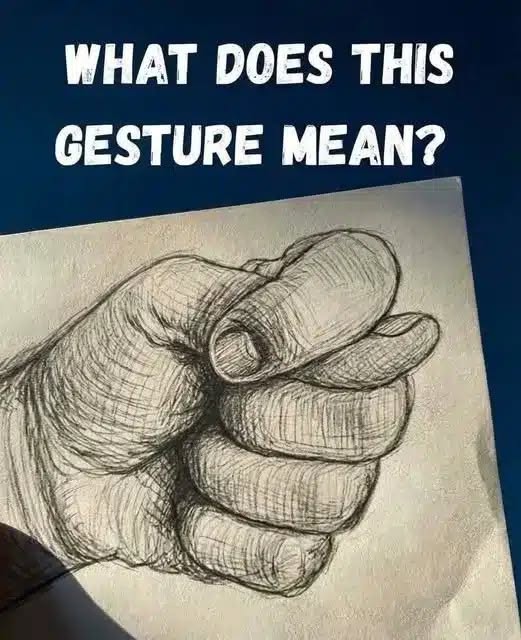
The mano fica, or “fig hand,” was used in ancient Mediterranean cultures and was associated with protection against evil or the evil eye. Roman examples have been found in the form of amulets. The Metropolitan Museum notes that the protective symbolism survived into later periods and eventually reached Spanish colonial America.
Its physical form is completely different from the Abhaya Mudra, but the underlying concept is remarkably interesting:
A hand position can become a protective symbol.
That tells us something important about ancient cultures: hands weren’t merely tools for physical activity. They could function as portable symbols of protection, authority, sexuality, blessing, warning, and identity.
13. Why ancient people used hand gestures so much
Before modern mass communication, photography, smartphones, television, and widespread literacy, images had enormous communicative power.
A sculptor couldn’t rely on a caption saying:
“This represents the Buddha granting protection.”
The gesture had to communicate the idea visually.
Consequently, religious art developed conventions that knowledgeable viewers could recognize.
A raised palm could therefore be as meaningful as a modern logo, road sign, emoji, or icon.
The difference is that these ancient visual systems could contain extremely sophisticated philosophical meanings.
14. The deeper meaning of “fearlessness”
The most interesting aspect of Abhaya Mudra isn’t really the hand position.
It’s the concept behind it.
The gesture doesn’t necessarily mean:
“Nothing dangerous exists.”
Rather, in Buddhist interpretation, it can be understood in relation to freedom from fear, compassion, reassurance, and spiritual confidence.
The Buddha isn’t depicted protecting someone with a weapon.
He is protecting through presence and fearlessness.
That makes the raised empty hand particularly powerful.
There is no sword, no shield, and no fist.
Just an open palm.
15. What makes its history so remarkable?
Put the timeline together:
Prehistoric humanity
↓
Natural human gestures of communication
↓
Ancient South Asian religious and artistic traditions
↓
Buddhist development of symbolic mudras
↓
Gandharan Buddhist art, around the early centuries CE
↓
Spread throughout Central, East, and Southeast Asia
↓
Regional variations in Buddhist sculpture
↓
Indian classical performance traditions
↓
Modern symbolic hand gestures
The exact evolutionary chain cannot be reconstructed with certainty. But the surviving artistic record demonstrates that the Abhaya Mudra became an established symbolic gesture roughly two thousand years ago and remained meaningful across enormous geographical and cultural distances.
The fascinating takeaway
When you see a Buddha statue with one hand raised and the palm facing outward, you’re not simply looking at a pose.
You’re looking at an ancient visual language.
That open palm can be read as:
“Do not fear.”
“You are safe.”
“Peace.”
“Protection.”
“Fearlessness.”
And the physical gesture may be rooted in something even older: the extraordinarily ancient human habit of using our hands to communicate “I am not attacking you.”
That’s what makes this seemingly simple gesture so fascinating: the movement may be ancient, but civilization transformed it into a sophisticated symbol that survived for nearly two thousand years.
If by “the ancient hand gesture” you meant a different gesture—such as the thumbs-up, middle finger, fig sign, V-sign, Roman salute, or anjali/namaste—tell me which one, and I can give you the same kind of detailed historical deep dive.