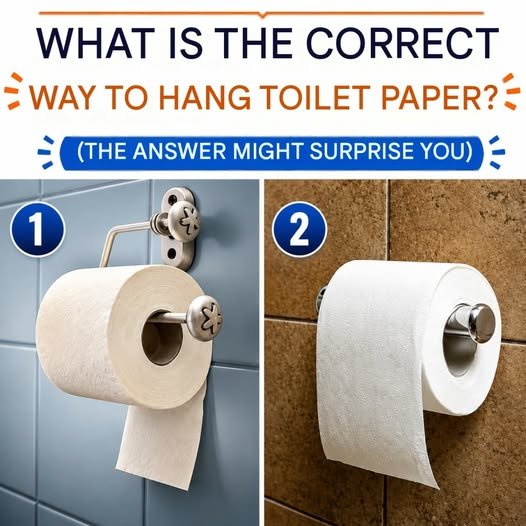
ChatGPT said:
The famous toilet-paper debate is the seemingly trivial—but surprisingly emotional—argument over whether a toilet-paper roll should hang “over” the roll or “under” it. It has become a classic example of how a tiny household preference can turn into a surprisingly serious family disagreement.
🧻 What exactly is the debate?
There are two basic orientations:
- Over: The loose end comes down from the front/top of the roll, facing into the bathroom.
- Under: The loose end comes from the back/bottom, between the roll and the wall.
Most people have a strong preference, often based on what they grew up seeing at home.
And this is where the family conflict begins: someone replaces the roll in the “wrong” direction, another person silently changes it back, and eventually somebody asks, “Who keeps doing that?”
The surprising part: there really is a historical patent
One of the most frequently cited pieces of evidence in the debate is a patent filed by Seth Wheeler, an Albany, New York inventor associated with early perforated toilet paper.
Wheeler received a U.S. patent in 1891 for an improved toilet-paper roll. The patent drawing shows the paper coming over the top of the roll.
That led to the internet-famous claim:
“The inventor of toilet paper says it goes over.”
There is, however, an important historical caveat.
The patent was primarily about how the sheets were connected and separated, not about declaring an official direction for mounting a roll. The patent describes a perforation/severance arrangement designed to make individual sheets easier to tear away.
A patent analysis also points out that another Wheeler patent depicts an under configuration. In other words, the 1891 illustration is interesting historical evidence, but it isn’t a legally binding declaration that “over” is the only correct answer.
So the historical verdict is:
The famous 1891 drawing shows “over,” but it did not actually settle the argument.
🥊 The case for “over”
People who prefer over usually have several arguments.
1. It’s easier to grab
When the loose end is hanging over the front, you can see it immediately.
You don’t have to reach behind the roll and search for the edge. This is particularly convenient when you’re in a hurry or when the bathroom is poorly lit.
2. It’s easier to tear
With the sheet coming over the top, the perforations are generally positioned where you can pull downward or outward against the roll and tear off a sheet.
3. You can see how much paper you’re taking
This is one of the practical advantages of the over position: the loose sheet is visible.
You can pull exactly the number of squares you want rather than blindly pulling paper from behind the roll.
4. It looks more orderly
This is subjective, but many people consider over to be the visually “correct” presentation.
Hotels frequently fold the end of the roll into a little triangle or point after cleaning the bathroom. That practice has become a recognizable signal that the bathroom has supposedly been serviced.
That fold is much more obvious when the roll is hanging over.
5. The “wall contamination” argument
Over advocates sometimes argue that the paper is less likely to brush against the wall because the loose surface is facing outward.
This argument gets repeated frequently, although it shouldn’t be treated as proof that over is inherently hygienic in every bathroom. The cleanliness of the holder, wall, hands, and bathroom environment matters much more.
🥷 The case for “under”
The under camp isn’t irrational either.
1. It can look tidier
With the loose end tucked behind the roll, the bathroom can have a more minimalist appearance.
There’s less paper visibly hanging down.
2. It’s harder for children or pets to attack
This is probably the most entertaining argument.
If you have a cat or a young child who discovers that toilet paper can be transformed into an enormous white ribbon, an under configuration can make it somewhat more difficult to grab and rapidly unroll the entire roll.
This is especially appealing to people who have experienced the infamous:
“Why is the entire bathroom covered in toilet paper?”
incident.
3. It may prevent accidental unrolling
The loose end is partially concealed behind the roll, making it less exposed to accidental pulls from clothing, towels, children, or pets.
4. Some people simply find it aesthetically preferable
And that’s an important point: there doesn’t have to be an objective engineering reason for someone’s preference.
People develop bathroom habits early, and once a particular configuration becomes associated with “normal,” the alternative can look bizarre.
📊 What do people actually prefer?
Surveys consistently show that over is more popular, at least in the United States.
A 2022 YouGov survey of 27,810 U.S. adults found:
- 59% preferred over
- 14% preferred under
- 21% had no preference
- 6% weren’t sure
An earlier survey of bath-and-kitchen professionals also favored over, with 1,826 voting for over versus 1,256 for under.
So if you’re trying to predict which side will win an argument in an American household, over has the statistical advantage.
But “more popular” doesn’t mean “objectively correct.”
👨👩👧👦 Why does this tiny issue cause such big arguments?
This is actually the most interesting part of the phenomenon.
The disagreement isn’t really about toilet paper.
It’s about habits, control, personal space, and household norms.
Imagine someone has lived for 30 years with the roll hanging over. To them, that’s not merely one possible arrangement. It’s the way the bathroom works.
Then their partner puts it under.
The first person’s reaction can be disproportionately strong because their brain interprets the change as violating an established routine.
The same phenomenon happens with:
- toothpaste caps
- toilet seats
- dishwasher loading
- towels
- cabinet doors
- thermostat settings
- how a bed is made
- whether the toilet-paper roll should be replaced immediately or left until the last few sheets
Toilet paper simply happens to be one of the funniest examples.
🧠 Why people become so attached to their preferred direction
Human beings are creatures of habit.
When we repeatedly perform a simple action the same way, we don’t consciously reconsider it every time. It becomes automatic.
For someone accustomed to over, seeing under can therefore produce a subtle feeling of:
“That’s not how this is supposed to work.”
The other person experiences exactly the same reaction in reverse.
There’s also an element of household ownership. A person might think:
“I replaced the roll, so I get to decide how it goes.”
Another family member may think:
“It’s my bathroom too.”
And suddenly a roll of tissue has become a territorial dispute.
🏨 Why do hotels usually put it over?
You’ve probably noticed that many hotels put toilet paper over and then fold the final sheet into a triangle.
This is partly about presentation and partly about signaling.
The folded end communicates something like:
“Someone has been here and cleaned this bathroom.”
The practice is widespread enough that toilet-paper folding has even been given names such as “toilet paper origami” or “toilegami.”
It’s not necessarily evidence that over is scientifically superior. Rather, over makes the paper more visible and easier to present neatly.
📜 The history goes back farther than the famous 1891 patent
Another interesting misconception is that Seth Wheeler invented toilet paper itself.
He didn’t.
Commercial toilet paper existed before his patents. Joseph Gayetty is commonly credited with introducing commercially marketed toilet paper in the United States in 1857, initially as flat sheets rather than the familiar perforated roll.
Wheeler’s contribution was important to the development of perforated paper rolls and dispensing systems.
His patents from the late 19th century show that the technology was evolving considerably. For example, an 1883 Wheeler patent concerned fixtures for toilet and wrapping paper rolls, while later patents addressed the construction and perforation of rolls.
So the debate isn’t merely modern internet humor. It is connected to more than a century of evolution in the way toilet paper is manufactured and dispensed.
⚖️ So which way is actually “correct”?
Here’s the honest answer:
There is no universal rule requiring one orientation.
The 1891 Wheeler patent drawing favors over, and that is why the image became famous. But the patent itself was about the construction and perforation of the roll—not establishing a household etiquette rule.
From a practical standpoint:
| Over | Under |
|---|---|
| Easier to see the loose end | Loose end is more concealed |
| Usually easier to grab | Can be harder to grab |
| Easier to display a folded hotel-style end | Less visually prominent |
| Generally more popular | Minority preference |
| May be less accessible to pets/children? No | Better argument: harder for pets/children to grab |
| Supported by the famous Wheeler patent illustration | Also historically possible—Wheeler’s other patent material complicates the “official verdict” |
🏆 The unofficial winner: Over
If you want to settle the argument by popularity, over wins. A large U.S. survey found nearly four times as many people preferred over as under (59% vs. 14%).
If you want to settle it by historical evidence, over gets a strong point from Wheeler’s 1891 patent drawing—but not an absolute victory.
And if you want to settle it as a matter of household diplomacy?
Put the roll back the way the person who uses the bathroom most often prefers it.
That may be the only solution capable of preventing a generations-long toilet-paper war. 😄