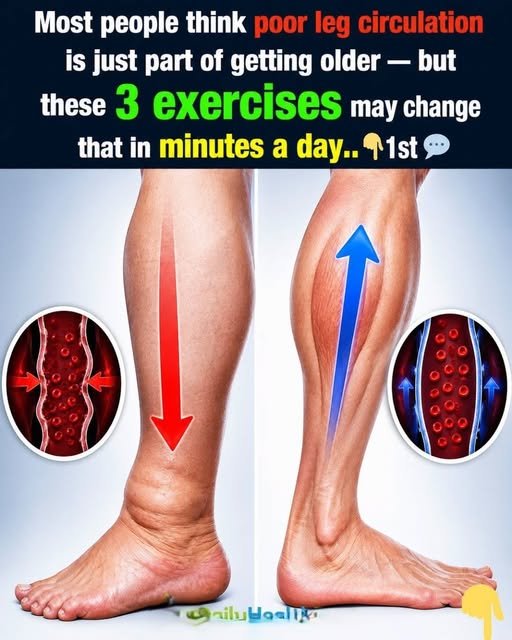
If by “leg circulation” you mean improving blood flow and reducing the effects of sitting/inactivity, three simple exercises are especially useful. If you have diagnosed peripheral artery disease (PAD), the approach is a little different, and walking is the best-supported exercise.
1. Walking — the most important one
Walking repeatedly activates the calf and thigh muscles, which helps move blood through the legs. Regular walking is also strongly supported for people with PAD and can improve walking ability and leg function.
How to do it
- Start with 10–15 minutes at a comfortable pace.
- Gradually work toward 30–45 minutes.
- Aim for about 3–5 days per week.
- If you’re sitting for long periods, getting up and walking for a few minutes regularly is also beneficial.
- Wear comfortable, supportive shoes.
If you have PAD: structured walking programs are particularly effective. Traditional PAD exercise programs often use repeated walking and rest periods, with sessions lasting roughly 30–60 minutes, three times weekly.
2. Calf raises — activate the “calf pump”
Your calf muscles help push blood upward through the veins toward your heart. This makes calf raises particularly useful for circulation when you’ve been sitting or standing for a long time. NHS guidance similarly emphasizes walking and increasing ankle movement to support venous blood flow.
How to do them
- Stand behind a sturdy chair and hold it lightly.
- Keep your feet about hip-width apart.
- Slowly raise your heels until you’re standing on your toes.
- Hold for 1–2 seconds.
- Slowly lower your heels.
- Repeat 10–20 times.
- Rest for 30–60 seconds and repeat for 2–3 sets.
Make it harder: Progress toward doing them on one leg at a time, provided your balance is good.
Easy version: Do seated heel raises while working or watching TV.
3. Ankle pumps — excellent when you’ve been sitting
Ankle pumps are very simple but useful because they repeatedly contract and relax the calf muscles and move the ankle through its range of motion.
How to do them
- Sit or lie comfortably with your legs extended or supported.
- Point your toes away from you.
- Then pull your toes toward you.
- Move slowly and deliberately.
- Do 20–30 repetitions with each foot.
- You can also make 10 circles clockwise and 10 counterclockwise with each ankle.
They’re particularly convenient during long periods of sitting—for example, at a desk or during travel.
A simple daily routine
Morning
- Ankle pumps: 30 repetitions
- Calf raises: 2 × 15
- Walking: 15–30 minutes
During the day
- Avoid sitting continuously for hours.
- Get up and walk around periodically.
- Do another set of ankle pumps if you’ve been sitting for a long time.
Evening
- Calf raises: 2 × 15
- Ankle pumps: 30 repetitions
- Optional easy walk: 10–20 minutes
Important distinction
These exercises can help movement and circulation, but they don’t “clear blocked arteries.” If you’re experiencing leg pain/cramping when walking that improves with rest, one foot becoming noticeably colder, poorly healing wounds, or major changes in skin color, you should be evaluated for PAD rather than relying solely on exercises. PAD can be diagnosed with medical assessment, including an ankle-brachial index (ABI), and structured exercise is a core part of treatment.
If you tell me your age and whether your problem is cold feet, swollen legs, varicose veins, numbness/tingling, or pain while walking, I can explain which of these three exercises is most appropriate and give you a 7-day leg-circulation routine