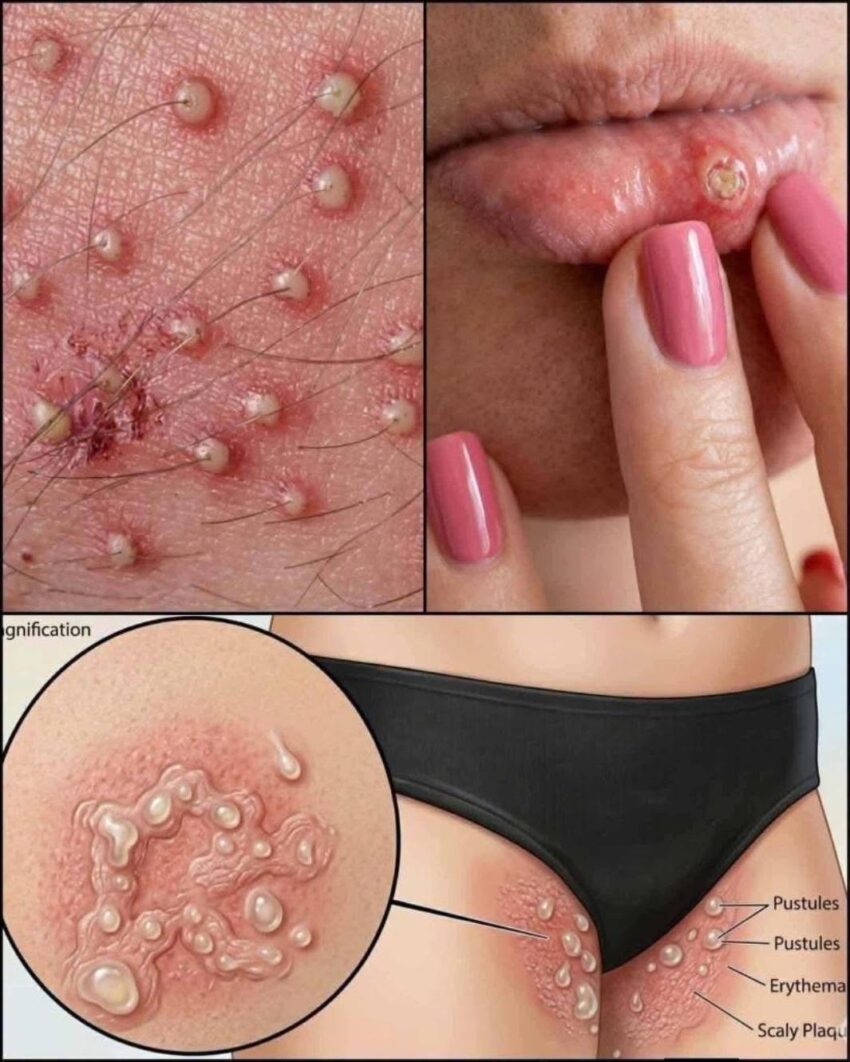
If you mean common viral skin lesions and how to distinguish them, here is a detailed clinical comparison. These conditions can overlap in appearance, so the diagnosis often depends on the type of lesion, distribution, symptoms, and history.
Common viral skin lesions
| Condition | Typical lesion | Distribution | Key distinguishing features |
|---|---|---|---|
| Herpes simplex (HSV-1/HSV-2) | Grouped vesicles → erosions/crusts | Lips/face or genital area | Painful/burning, recurrent, often in clusters |
| Herpes zoster (shingles) | Grouped vesicles on red skin | Usually one side of the body/face in a dermatome | Significant burning/nerve pain; generally does not cross the midline |
| Varicella (chickenpox) | Vesicles at different stages | Trunk, face, scalp → generalized | Crops of lesions; papules, vesicles and crusts present simultaneously |
| Molluscum contagiosum | Small pearly papules | Trunk, limbs, genital region, face | Central umbilication (dimple); usually painless |
| Viral warts (HPV) | Rough, firm papules | Hands, fingers, feet, etc. | Rough/verrucous surface; plantar warts may have black dots |
| Hand-foot-and-mouth disease | Vesicles/erosions + small papules | Hands, feet, mouth | Oral ulcers plus lesions on palms/soles; common in children |
| Orf (parapoxvirus) | Nodular lesion | Usually hands/fingers | Exposure to infected sheep/goats; evolves through characteristic stages |
1. Herpes simplex
typically begins with tingling, burning, itching, or pain, followed by small, closely grouped vesicles on an erythematous base.
Typical evolution:
- Prodrome—burning/tingling
- Small erythematous papules
- Grouped vesicles
- Vesicles rupture → shallow erosions
- Crusting → healing
Common sites
- HSV-1: lips and perioral region (“cold sores”)
- HSV-2: genital/perianal region, although either HSV type can affect either site
Clue: Painful grouped vesicles that recur in approximately the same location.
2. Herpes zoster
results from reactivation of varicella-zoster virus.
The classic lesion is a cluster of vesicles on an erythematous base in a unilateral dermatomal distribution.
Typical symptoms
- Burning, shooting, or severe pain
- Hypersensitivity of the skin
- Then grouped vesicles
- Vesicles eventually crust
Classic clue: The rash follows a nerve distribution and usually stops near the body’s midline.
Facial involvement, especially around the eye, requires urgent medical evaluation because ocular complications can threaten vision.
3. Varicella (chickenpox)
produces a generalized, itchy eruption.
Unlike many viral rashes, lesions appear in successive crops, so you can see several stages simultaneously:
Macule → papule → vesicle → pustule → crust
The classic description is “dew drops on a rose petal” because vesicles sit on an erythematous base.
Distribution
- Begins commonly on the trunk, face and scalp
- Then spreads more widely
Clue: Very itchy generalized rash with lesions at different stages.
4. Molluscum contagiosum
produces small, smooth, flesh-colored or pearly papules.
The most characteristic feature is central umbilication—a small depression in the center.
Features
- Usually 2–5 mm
- Pearly/shiny surface
- Firm
- Usually painless
- May occur in groups
- Can become red and inflamed as the immune system responds
Clue: Small pearly papule with a central dimple.
In adults, genital molluscum can be sexually transmitted, although nonsexual transmission also occurs.
5. Viral warts
are caused by human papillomavirus (HPV).
Common wart
- Rough, hard papule
- Usually on fingers, hands or around nails
- May have tiny black dots representing thrombosed capillaries
Plantar wart
- Occurs on the sole
- Can be painful with pressure
- Often grows inward because of pressure from walking
- Black dots may be visible
Flat wart
- Smaller and smoother
- Often numerous
- Common on the face or backs of hands
Clue: A rough/verrucous papule, often with interruption of normal skin lines.
6. Hand-foot-and-mouth disease
is most common in children and is usually caused by enteroviruses such as coxsackievirus.
Typical findings include:
- Fever/sore throat may precede the rash
- Painful oral vesicles/ulcers
- Small vesicles or papules on palms and soles
- Lesions can also occur on the buttocks and extremities
Clue: Mouth lesions + hand/foot lesions, particularly involving palms and soles.
A useful way to differentiate them
Think about five things:
1. Vesicle or papule?
- Vesicles → HSV, zoster, chickenpox, hand-foot-and-mouth disease
- Papules → molluscum, warts
2. Painful or itchy?
- Painful/burning: HSV, shingles
- Very itchy: chickenpox
- Usually painless: molluscum, warts
3. Is there a pattern?
- Unilateral dermatome: shingles
- Grouped lesions: HSV
- Generalized lesions in different stages: chickenpox
- Central dimple: molluscum
- Rough surface: wart
- Palms/soles + mouth: hand-foot-and-mouth disease
4. Are lesions all at the same stage?
- Chickenpox → different stages simultaneously
- HSV/zoster → lesions in a more localized cluster and generally progress together
5. Is there a preceding symptom?
- Burning/tingling → HSV
- Neuropathic pain → shingles
- Fever/malaise → chickenpox or hand-foot-and-mouth disease
Important caution
Appearance alone isn’t always enough. Impetigo, bacterial folliculitis, scabies, allergic/contact dermatitis, fungal infections, and some sexually transmitted infections can mimic viral lesions. A clinician may need to examine the lesions and, for some conditions, perform PCR or other testing.
If you want, I can also give you a detailed dermatology-style description of each lesion (macule, papule, vesicle, pustule, nodule, ulcer, crust, etc.) with clinical photographs/visual comparisons and examination clues.