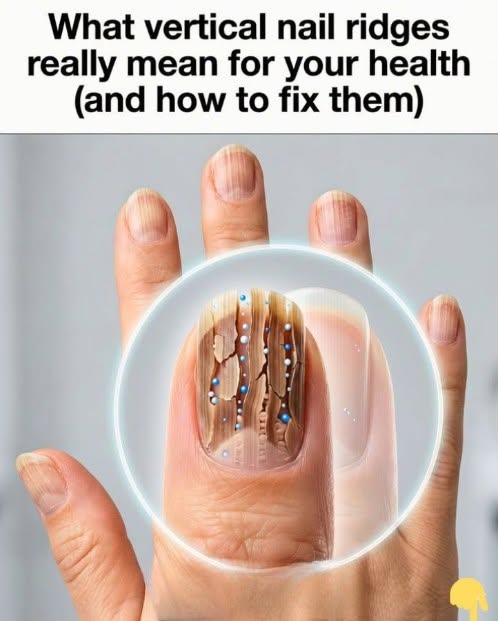
However, the cause matters—especially if the ridges are new, deep, limited to one nail, or accompanied by discoloration, pain, splitting, or changes in the skin around the nail.
1. Normal aging — one of the most common causes
As nails age, the nail plate can become thinner, drier and less uniformly produced. This can make vertical ridges more visible.
Longitudinal ridges are considered a common age-related nail finding, and nails also tend to become more brittle with age.
What you can do:
-
Moisturize your hands and nails regularly.
-
Apply a thick hand cream or petroleum-based ointment to the nails and cuticles, particularly after washing.
-
Keep nails at a moderate length.
-
Avoid aggressively buffing the ridges.
You generally don’t need to “cure” age-related ridges—they can simply be a normal structural change.
2. Dry or brittle nails
Dryness and repeated exposure to water, soaps, detergents, solvents or nail products can make ridges more noticeable. Brittle nails commonly develop lengthwise ridges and may also peel or split.
Try:
-
Wear gloves when washing dishes or using cleaning chemicals.
-
Reduce prolonged soaking of your hands.
-
Moisturize nails and cuticles several times daily.
-
Take breaks from aggressive manicures, acetone and artificial nails if your nails are becoming thin or brittle.
-
Don’t scrape or cut the cuticles.
3. Repeated trauma to the nail
The nail is produced by the nail matrix, located beneath the skin at the base of the nail. Repeated irritation or injury to this area can alter how the nail grows.
Examples include:
-
Picking at cuticles
-
Nail biting
-
Pushing cuticles back aggressively
-
Repeated tapping or pressure
-
Frequent manicures
-
Removing artificial nails
-
Hitting or injuring the nail
Chronic nail trauma can produce various nail dystrophies and ridging.
Fix: Identify and stop the repetitive trauma. Because the nail has to grow out, improvement isn’t instantaneous.
4. Nutritional deficiencies
Nutrition can contribute to abnormal nails, but vertical ridges alone do not prove that you have a vitamin or mineral deficiency.
Iron deficiency, for example, is more classically associated with spoon-shaped or concave nails (koilonychia) and brittle nails rather than simple isolated vertical ridges.
Other nutritional deficiencies can affect nail structure as well. Zinc deficiency, for example, can be associated with nail ridges.
If you also have symptoms such as:
4. Nutritional deficiencies
Nutrition can contribute to abnormal nails, but vertical ridges alone do not prove that you have a vitamin or mineral deficiency.
Other nutritional deficiencies can affect nail structure as well. Zinc deficiency, for example, can be associated with nail ridges.
If you also have symptoms such as:
-
persistent fatigue
-
unusual weakness
-
shortness of breath
-
pale skin
-
hair loss
-
frequent cracking/splitting of nails
-
spoon-shaped nails
it’s reasonable to discuss nutritional testing with your clinician rather than taking high-dose supplements on your own.
5. Thyroid or other systemic conditions
Certain systemic illnesses can affect nail growth and texture. Thyroid disorders, for example, can be associated with brittle or abnormal nails.
A nail change by itself usually isn’t enough to diagnose a thyroid problem. But if nail changes occur together with symptoms such as unexplained weight change, temperature intolerance, palpitations, fatigue or changes in hair/skin, a medical evaluation may be appropriate.
6. Skin diseases affecting the nails
Conditions such as psoriasis, eczema, lichen planus and alopecia areata can affect nail structure.
Some clues include:
-
multiple nails becoming rough
-
prominent ridges
-
tiny pits
-
discoloration
-
nail separation
-
thickening
-
changes in the surrounding skin
-
psoriasis-like skin lesions elsewhere
For example, a condition called trachyonychia (twenty-nail dystrophy) can produce pronounced longitudinal ridging and a rough, sandpaper-like nail surface.
Lichen planus of the nail is less common but important because untreated disease can sometimes cause permanent nail scarring and loss.
7. Fungal infection
Simple vertical ridges aren’t the classic appearance of nail fungus.
Fungal infections more often cause nails to become:
-
thick
-
yellowish or discolored
-
crumbly
-
distorted
-
separated from the nail bed
If your “ridges” are accompanied by significant thickening or yellow/white discoloration, it’s worth having the nail examined rather than assuming you need a nail-strengthening product.
What actually helps vertical ridges?
Daily nail-care routine
For uncomplicated ridges, try this for several weeks:
Morning
-
Apply hand cream after washing.
-
Rub some moisturizer into the nail plate and cuticles.
During the day
3. Wear rubber/nitrile gloves for prolonged contact with water or cleaning products.
4. Avoid picking, biting or scraping the nails.
Evening
5. Apply a thicker moisturizer or petroleum ointment to the nails/cuticles.
6. Keep nails reasonably short to minimize splitting.
Moisturizing and reducing the things that make nails brittle are generally more useful than trying to physically remove the ridges.
Don’t aggressively buff them
Buffing can temporarily make ridges look smoother, but excessive buffing thins the nail plate and can ultimately make the problem worse.
If you use a buffer, use very light pressure and don’t repeatedly thin the nail.
Be cautious with supplements
It’s tempting to take biotin, iron, zinc or other “hair/skin/nail” supplements, but don’t assume a deficiency is causing your ridges.
If you actually have a deficiency, correcting it can help. But unnecessary supplementation—particularly high doses of minerals or iron—can have risks. A clinician can determine whether blood testing is appropriate based on your symptoms and diet.
How long does it take to disappear?
This is important: you can’t immediately erase a ridge that’s already formed.
Fingernails grow slowly. If the problem causing the ridge is corrected, the abnormal section generally has to grow forward and eventually be trimmed away.
So expect improvement over months rather than days. Toenails generally take considerably longer.
When vertical ridges deserve medical attention
Make an appointment with a dermatologist or primary-care clinician if:
-
A ridge suddenly appears or becomes dramatically deeper.
-
Only one nail develops a persistent abnormality.
-
The nail is splitting, crumbling or lifting.
-
There’s pain, swelling, redness or drainage around the nail.
-
The nail becomes significantly thickened or discolored.
-
You develop numerous abnormal nails at once.
-
The nail becomes rough and severely ridged.
-
You have other symptoms suggesting an underlying illness.
-
You notice a new dark/brown/black vertical band, particularly if it is changing or involves the surrounding skin.
A dermatologist can examine the nail matrix, nail bed and surrounding skin and, when appropriate, test for fungal infection or investigate systemic causes. Nail abnormalities have a wide range of causes, so appearance alone isn’t always enough to identify the cause.
One important distinction
Vertical ridges ≠ horizontal grooves.
Vertical lines running from cuticle to tip are often benign. Deep horizontal grooves across the nail (Beau’s lines) can indicate that nail growth was temporarily interrupted—for example by significant illness, fever, injury, chemotherapy or major physiological stress.
Bottom line
If your nails simply have fine vertical lines, especially on several nails, and they’re otherwise normal in color, thickness and shape, the most likely explanation is ordinary nail structure, aging, dryness or minor repeated trauma—not necessarily a vitamin deficiency.
The most useful approach is moisturizing + protecting the nails + avoiding trauma + allowing the nail to grow out. If the ridges are deep, newly appearing, affecting one nail, or accompanied by other nail/skin/body symptoms, get them examined rather than treating them blindly.