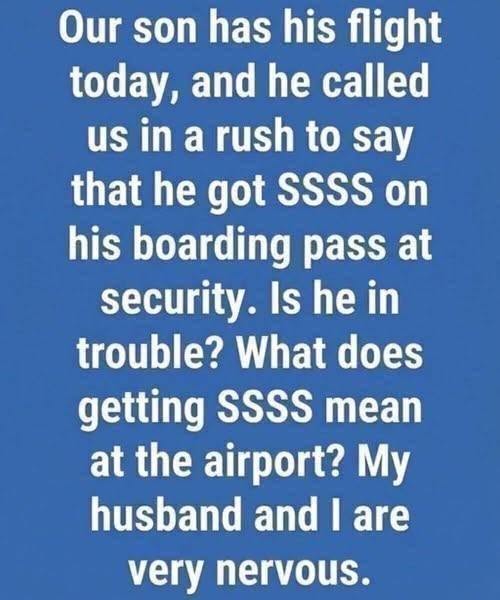
What “SSSS” on a Boarding Pass Means — And Why Travelers Sometimes See It


If you look at your airline boarding pass and notice the letters SSSS, you may wonder whether something is wrong with your ticket or whether you’ve been flagged by airport security.
The good news is that SSSS does not automatically mean you’re suspected of a crime or that you’ve done anything wrong. It indicates that you’ve been selected for additional security screening before boarding your flight.
SSSS stands for Secondary Security Screening Selection. It is associated with the U.S. Transportation Security Administration (TSA) and its aviation security screening procedures.
Here’s what the code means, why it appears, what happens at the airport, and what you can do if you receive it.
1. What exactly does SSSS mean?
The four letters stand for Secondary Security Screening Selection. When the code appears on a boarding pass, it tells security personnel that the passenger must undergo additional screening beyond the standard airport security process.
Most travelers go through routine screening, which may include walking through a metal detector or body scanner and having their carry-on bags scanned.
Travelers marked with SSSS may be subject to additional checks, such as:
-
A more thorough examination of carry-on luggage.
-
Additional screening of electronic devices.
-
A pat-down or other physical screening, as appropriate.
-
Explosive trace detection testing on hands, belongings, or luggage.
-
Additional identity and travel-document verification.
-
Further inspection of checked baggage, where applicable.
Not every traveler will experience exactly the same procedures. The screening methods depend on the circumstances and the security protocols in use.
The key point: SSSS is a screening designation, not an arrest warrant, criminal accusation, or finding that a traveler is dangerous.
2. Why do some travelers receive the SSSS code?
There is no single publicly confirmed reason that explains every SSSS selection. U.S. authorities use multiple screening processes, and the exact criteria are not fully disclosed for security reasons. A congressional report notes that the boarding pass itself does not explain why a particular passenger was selected.
Common explanations include the following.
A. Random selection
A traveler may be selected randomly as part of the airport security system’s unpredictable screening measures.
This means an ordinary traveler with no security concerns can receive SSSS without having done anything unusual. Someone who flies every week may receive it, while another passenger on the same flight may not.
B. International travel and particular itineraries
Some travelers report receiving SSSS on international journeys, particularly on certain routes or during connecting flights.
For example, a traveler returning to the United States from an overseas trip might discover the code when checking in for a connecting domestic flight.
However, traveling internationally does not automatically trigger SSSS, and there is no reliable public list of routes that will cause a passenger to be selected.
C. Passenger information and security screening systems
The TSA’s Secure Flight program uses passenger information, such as a traveler’s name and date of birth, as part of its aviation security screening process.
A selection can arise from screening processes involving passenger information or other security-related factors. But seeing SSSS alone does not tell you whether your name, itinerary, or another factor played a role.
D. Possible name similarities or mistaken identity
Some travelers experience repeated screening because their identifying information resembles that of another person who is subject to additional checks.
This is one reason the Department of Homeland Security offers a redress process for travelers who experience recurring travel difficulties or believe they have been misidentified. It is not possible to determine from SSSS alone whether a name similarity was involved.
E. Other undisclosed security considerations
Authorities may use additional security information or screening procedures that are not made public. That uncertainty is intentional: publishing every selection criterion could make it easier to evade screening.
It is important not to treat online anecdotes about specific nationalities, names, payment methods, ticket prices, or travel histories as proven explanations for an individual selection.
3. Does SSSS mean you are on a government watchlist?
No. SSSS by itself does not establish that you are on a watchlist.
There is an important distinction between being selected for extra screening and being prohibited from flying.
|
Situation |
What it means |
|---|---|
|
SSSS on your boarding pass |
Additional security screening is required. |
|
Random screening |
You may be selected even without a specific concern about you. |
|
Possible identity match |
Passenger information may need additional review. |
|
No Fly List restriction |
A separate restriction that can prevent a person from boarding a covered flight. |
These are not interchangeable categories. The U.S. Senate’s 2023 report on aviation screening explains that additional screening can result from different processes, including random selection, and that the boarding-pass code does not reveal the reason.
In practical terms, receiving SSSS ordinarily means you should prepare for a more involved security check, not assume that you have been accused of wrongdoing.
4. What happens at the airport when your boarding pass says SSSS?


The process can vary by airport and flight, but a typical experience looks like this:
-
Check-in and boarding-pass verification
You may be able to check in online, or you may need to collect your boarding pass from an airline agent. Some travelers discover the code only when a pass is printed at the airport.
-
Additional security screening
Security staff identify the screening requirement and direct you through the applicable procedures. Depending on the airport, the extra checks may occur at the main checkpoint or at another designated screening point.
-
Inspection of your belongings
Officers may open your carry-on, inspect items more closely, and examine electronics or other belongings.
-
Additional passenger screening
You may be asked to undergo further scanning, a pat-down, or explosive trace testing. The particular steps depend on the screening procedures used.
-
Completion of screening
Once you have completed the required checks and are cleared to proceed, you can continue to your gate and board, subject to the airline’s normal boarding requirements.
How long does it take?
There is no guaranteed duration. Additional screening might take only several minutes, or it could take considerably longer if the airport is busy, further checks are needed, or staff are handling several selected passengers.
For that reason, if you notice SSSS before leaving for the airport, plan to arrive earlier than you otherwise would. Don’t cut your usual airport arrival time close, particularly for an international flight.
5. Can you get SSSS even if you have TSA PreCheck or Global Entry?
Yes. Having trusted-traveler status does not guarantee that you will avoid additional screening.
-
TSA PreCheck: You can still be selected for additional screening, and you may not receive the usual expedited screening benefits for that trip.
-
Global Entry: This program primarily expedites eligible entry into the United States; it does not exempt you from airport security screening.
-
CLEAR: CLEAR helps eligible members verify their identity at participating checkpoints, but it does not override TSA screening requirements.
Even frequent flyers and travelers with elite airline status can receive SSSS. The code is not a judgment about how often you fly or how experienced you are as a traveler.
6. What should you do if SSSS appears on your boarding pass?
Here are the most useful steps to take.
Arrive early
Allow extra time for check-in, security screening, and any additional checks before boarding. For international departures, leaving a larger buffer is sensible.
Bring your required identification
Make sure your passport or other acceptable identification is valid and readily accessible. Keep your boarding pass available, too.
Prepare for a bag inspection
Pack your belongings neatly and make sure your carry-on complies with the airline and airport rules. Keep essential items easy to access.
Follow the officers’ instructions
Answer questions honestly and cooperate with the screening process. If you are unsure what to do next, politely ask the officer.
Allow time to reach your gate
Complete screening as soon as practical rather than assuming you can wait until boarding begins.
7. What if you keep receiving SSSS on multiple flights?
An occasional selection does not necessarily indicate a persistent problem. However, if you repeatedly experience SSSS or other unexplained travel difficulties, you can consider applying to the Department of Homeland Security Traveler Redress Inquiry Program (DHS TRIP).
DHS TRIP is designed to help travelers who experience issues such as repeated additional screening, boarding difficulties, or possible mistaken identity.
You can learn more or begin the process through the official government website:
DHS Traveler Redress Inquiry Program (TRIP)
Official U.S. government travel-redress service
Use this service if you believe you have been repeatedly misidentified or are experiencing recurring screening or boarding problems.
Visit the official DHS TRIP website
Source: U.S. Department of Homeland Security.
A redress application is not a guarantee that you will never be selected for additional screening again. Random and other security screening measures can still apply.
8. Does the SSSS code appear on domestic flights or only international flights?
It can appear on both domestic and international U.S. flights.
International itineraries may be more commonly associated with travelers’ stories about SSSS, but the code is not