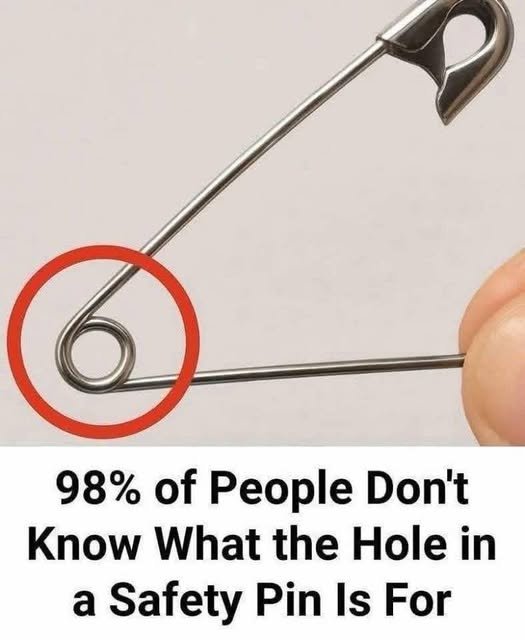
The tiny hole in a safety pin—usually found at the end of the coiled spring—is small but serves several useful purposes. While many people never notice it, it is an intentional part of the pin’s design.
1. Helps During Manufacturing (Primary Purpose)
The main purpose of the tiny hole is to assist in the manufacturing process.
During production, a thin wire or tool can be inserted into the hole.
This helps machines hold, position, and twist the wire while forming the spring coil.
It allows the safety pin to be made accurately and efficiently in large quantities.
Without this hole, it would be much harder for automated machines to grip the small spring section during manufacturing.
2. Maintains Spring Tension
The hole is part of the coiled spring structure that gives the safety pin its “snap.”
The spring stores energy when the pin is opened.
When released, it pushes the sharp point firmly back into the clasp.
This tension keeps the pin securely closed and reduces the chance of it opening accidentally.
3. Can Be Used for Thread or Cord
Although it wasn’t designed primarily for this purpose, some people use the hole to:
Attach a thin string or thread.
Tie a ribbon or tag.
Secure lightweight decorative items in crafts or sewing projects.
This is more of a convenient secondary use than the hole’s intended function.
4. Assists in Quality Testing
In some manufacturing facilities, the hole can also help during inspection:
Machines may use it to check alignment.
It provides a consistent reference point for automated quality-control equipment.
Why Is the Hole So Small?
The hole only needs to be large enough for manufacturing tools or fine wire. Making it larger would:
Weaken the spring.
Reduce the pin’s strength.
Increase the chance of bending or failure.
Interesting Fact
The modern safety pin was invented by Walter Hunt in 1849. His design used a coiled spring to keep the pin closed safely—a feature that remains largely unchanged in safety pins today.
Summary
The tiny hole in a safety pin is mainly there to:
Help manufacturers form and handle the spring during production.
Contribute to the spring mechanism that keeps the pin closed.
Provide a useful attachment point in some craft or sewing applications.
Assist with inspection and quality control in certain manufacturing processes.
Although it looks insignific