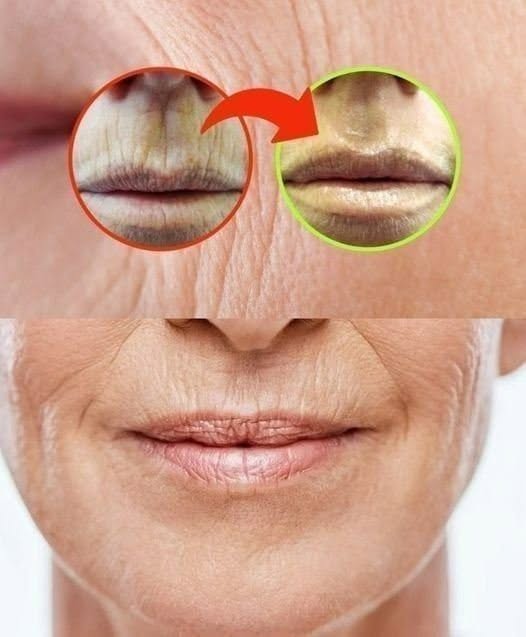
If you mean the viral claim “wrinkles around the mouth can be treated with something from the pantry, so there’s no need for creams,” there is an important distinction: some kitchen ingredients can temporarily make skin feel softer or more hydrated, but there is no well-established pantry remedy that removes perioral wrinkles.
Why wrinkles form around the mouth
Wrinkles around the lips—often called perioral wrinkles or “lip lines”—are caused by several factors:
-
Natural aging: collagen and elastin gradually decrease, making skin thinner and less resilient.
-
Sun exposure: UV radiation accelerates collagen breakdown and premature wrinkling.
-
Repeated facial movement: smiling, talking, pursing the lips, and other movements repeatedly fold the skin.
-
Smoking: smoking is associated with perioral wrinkles and accelerates skin aging.
-
Dryness: dehydrated skin can make existing fine lines look more pronounced.
-
Genetics and skin type also influence when and how strongly these lines appear.
What might be in the “pantry remedy”?
Many articles and social-media videos promote things such as:
-
honey
-
olive or coconut oil
-
yogurt
-
oatmeal
-
avocado
-
egg white
-
aloe
-
banana
-
lemon juice
These ingredients may provide temporary moisturization or a smoother appearance, particularly if the skin is dry. But that is very different from reversing the structural changes responsible for wrinkles.
For example, moisturizing can temporarily plump fine lines because hydrated skin reflects light differently and appears smoother. The American Academy of Dermatology specifically notes that moisturizers can make fine lines less noticeable.
Be particularly careful with lemon
I would not recommend putting lemon or other citrus juice around your mouth to treat wrinkles.
Citrus juice on skin can interact with sunlight and cause a reaction called phytophotodermatitis, which can produce redness, swelling, blistering, and sometimes pigmentation.
Likewise, aggressive DIY scrubs, undiluted acids, baking soda, or strongly fragranced essential oils can irritate the skin. Irritation can actually make fine lines look more noticeable, rather than improving them.
What actually has evidence behind it?
If your goal is to reduce the appearance of mouth wrinkles, the evidence-based approach is more straightforward than most viral “pantry hacks.”
1. Sunscreen is the most important preventive step
Use a broad-spectrum SPF 30 or higher every day, including around the mouth (while avoiding getting sunscreen directly inside the lips). Sun protection slows additional photoaging and helps prevent wrinkles from becoming deeper.
A hat and shade provide additional protection.
2. Keep the skin moisturized
A simple moisturizer can improve the appearance of fine lines by increasing the skin’s water content. Applying moisturizer to slightly damp skin can help retain moisture.
You don’t necessarily need an expensive anti-aging cream.
3. Retinoids have considerably stronger evidence than kitchen ingredients
Retinoids are vitamin-A-derived ingredients. Dermatologists use them to address fine lines, wrinkles, uneven pigmentation, and skin texture.
Over-the-counter retinol is generally weaker than prescription retinoids, but it can still be useful.
Because the skin around the mouth can be sensitive, start cautiously rather than applying a large amount every night. If it causes significant burning, redness, peeling, or cracking, stop and reassess.
Important: retinoids should not be used during pregnancy; if pregnant or trying to become pregnant, discuss alternatives with your clinician.
4. Don’t expect overnight results
This is another area where online claims can be misleading. A moisturizer can make skin look plumper relatively quickly, but most anti-aging products require at least several weeks, and sometimes a few months, to show their full effect.
If the lines are already deep
Home remedies are unlikely to erase established perioral wrinkles.
A dermatologist can discuss options such as:
Be particularly careful with lemon
What actually has evidence behind it?
-
prescription retinoids
-
chemical peels
-
laser resurfacing
-
other resurfacing procedures
-
injectable treatments such as fillers or botulinum toxin, depending on the specific type and location of the wrinkles
Chemical peels, for example, can be used professionally to improve fine lines around the mouth.
A simple routine
Morning
-
Gentle cleanser, if needed.
-
Moisturizer.
-
Broad-spectrum SPF 30+, including the skin around the mouth.
Evening
-
Gentle cleansing.
-
Retinol/retinoid if appropriate for you.
-
Moisturizer.
You don’t need a complicated collection of products. Dermatologists actually recommend limiting the number of products because using too many active ingredients can irritate the skin.
Bottom line: if the “pantry remedy” you’re referring to is honey, olive oil, coconut oil, banana, egg, lemon, or another specific ingredient, tell me which one. I can explain exactly what it does, whether there is scientific evidence for wrinkles around the mouth, how to use it safely, and what risks it has.