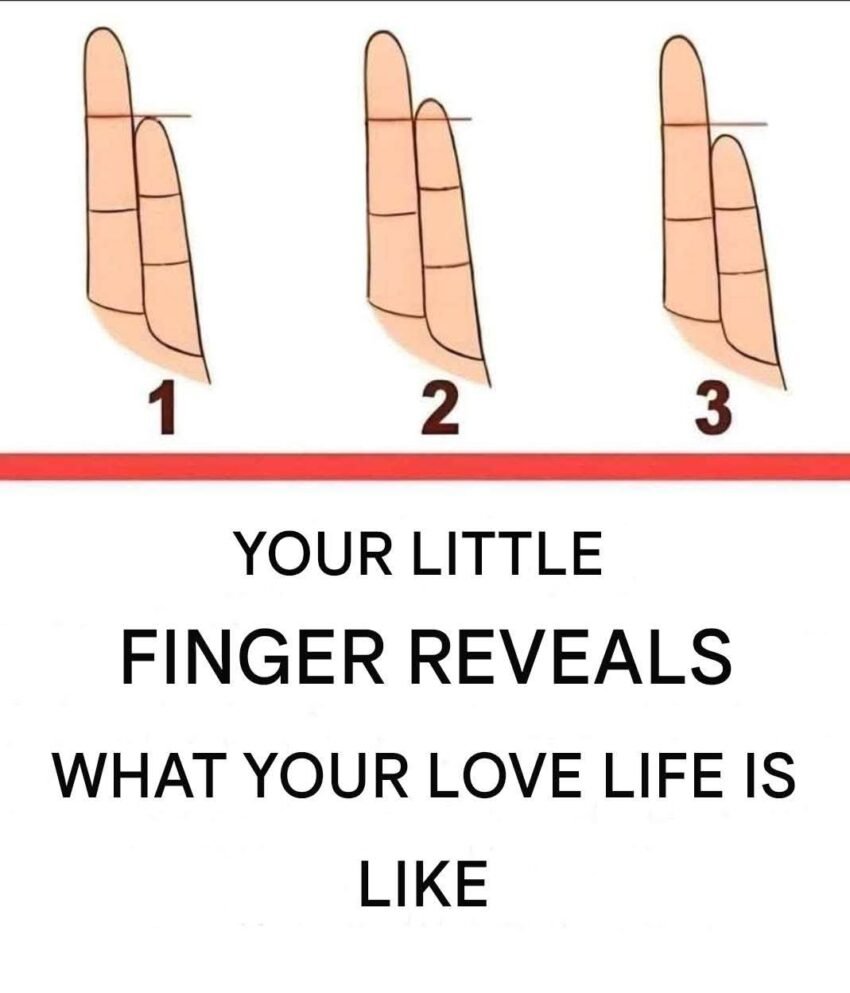
The idea that your little finger (pinky finger) can reveal details about your love life comes from palmistry (chiromancy), a traditional fortune-telling practice. It’s important to know that there is no scientific evidence that finger length, shape, or position can reliably predict personality, relationships, or romantic success.
That said, in palmistry, people often interpret the little finger as being connected to communication, social skills, and relationships. Common interpretations include:
Long Little Finger
If the tip reaches relatively high compared to the top joint of the ring finger, palmists may say:
You communicate feelings openly.
You are confident in relationships.
You value honesty and direct conversation.
You may be selective about partners.
Short Little Finger
Palmists may interpret this as:
Being more reserved emotionally.
Taking longer to trust others.
Preferring deeper relationships with fewer people.
Sometimes struggling to express feelings.
Straight Little Finger
Traditionally associated with:
Direct communication.
Reliability.
Preference for straightforward relationships.
Curved Little Finger
Some palmistry traditions suggest:
Adaptability and charm.
Creativity in social situations.
A tendency to avoid confrontation or communicate indirectly.
Wide Gap Between the Little Finger and Ring Finger
Palmists sometimes associate this with:
Independence.
Valuing personal freedom.
Wanting space within relationships.
Little Finger Close to the Ring Finger
Traditionally interpreted as:
Strong attachment to family or social norms.
Preference for security and stability in relationships.
What Actually Predicts Love-Life Outcomes?
Research suggests that relationship success is more strongly related to factors such as:
Communication skills
Emotional intelligence
Trustworthiness
Shared values
Conflict-resolution skills
Mutual respect and support
These factors have much more evidence behind them than palmistry or finger-reading.
If you’d like, you can describe your little finger (long, short, curved, straight, etc.), and I can explain the traditional palmistry interpretation in more detail.