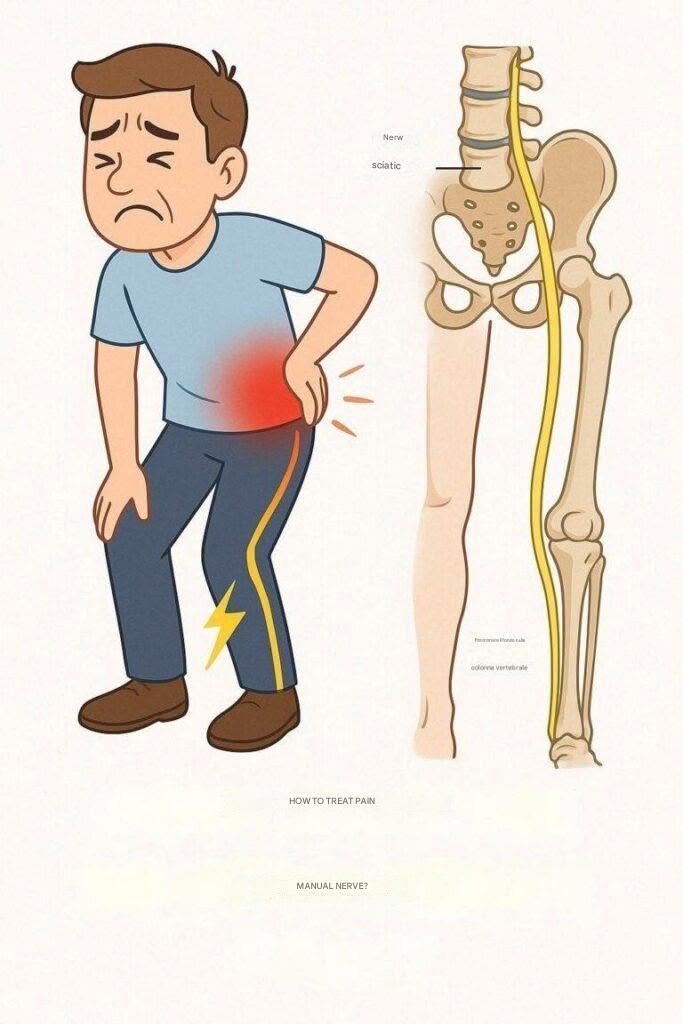
1. Sciatic Nerve Glide (Nerve Flossing)
Purpose:
This exercise gently moves the sciatic nerve through its pathway and may reduce nerve sensitivity without aggressively stretching it.
How to do it:
- Sit upright on a chair with both feet flat on the floor.
- Keep your back straight and shoulders relaxed.
- Slowly straighten one knee while pointing your toes upward toward your face.
- At the same time, gently look upward (extend your neck).
- Lower your foot back down and bring your head forward.
- Repeat the movement smoothly.
Repetitions:
- 10–15 repetitions on each leg
- 1–2 times per day
Tips:
- The movement should feel like a gentle stretch or pulling sensation.
- Do not hold the stretch at the end position.
- The goal is nerve movement, not forcing flexibility.
Common mistake:
❌ Holding the leg straight for a long time
✅ Use a slow, repeated motion
2. Piriformis Stretch (Figure-4 Stretch)
Purpose:
The piriformis muscle is located deep in the buttock. When it becomes tight, it can irritate the sciatic nerve in some people. This stretch helps relax the hip muscles.
How to do it lying down:
- Lie on your back with knees bent and feet flat.
- Place your right ankle over your left knee, forming a “4” shape.
- Hold the back of your left thigh.
- Slowly pull your left leg toward your chest.
- You should feel a stretch in your right buttock.
- Hold and breathe normally.
Duration:
- Hold for 20–30 seconds
- Repeat 2–4 times per side
Tips:
- Keep your lower back relaxed.
- Do not bounce during the stretch.
- The stretch should feel comfortable, not painful.
Common mistake:
❌ Pulling too hard and increasing nerve pain
✅ Stretch gently until you feel mild tension
3. McKenzie Press-Up (Back Extension Exercise)
Purpose:
This exercise may help some people with disc-related sciatica by improving spinal movement and reducing pain that travels down the leg.
How to do it:
- Lie on your stomach.
- Place your hands under your shoulders like a push-up position.
- Keep your hips and legs relaxed on the floor.
- Slowly push your upper body upward using your arms.
- Keep your pelvis on the ground.
- Hold for a few seconds, then lower down.
Repetitions:
- 10 repetitions
- Repeat 2–4 times daily if it feels helpful
Important response to watch:
A good sign:
✅ Pain moves from the leg toward the lower back (“centralization”)
A warning sign:
❌ Pain increases farther down the leg, especially below the knee
A Simple Daily Routine
Morning
- Sciatic nerve glides: 10 repetitions each side
- McKenzie press-ups: 10 repetitions
Evening
- Piriformis stretch: 2–4 holds each side
- Gentle walking for 10–20 minutes if comfortable
Additional Habits That Can Help Sciatica
- Avoid sitting for long periods; stand and move every 30–60 minutes.
- Use good posture while sitting.
- Keep objects close to your body when lifting.
- Strengthen your core and hip muscles gradually.
- Maintain regular walking if tolerated.
If your sciatica has lasted more than 6 weeks, is getting worse, or includes leg weakness, significant numbness, or foot drop, it is worth getting evaluated by a healthcare professional or physiotherapist.